GOP breaks with Trump on multiple issues
Republicans in both chambers are increasingly breaking ranks with President Trump across a host of sensitive issues, hoping some separation from the GOP’s unpopular standard bearer will help avert a blue wave in the midterm elections. The divisions are highly unusual for a party that’s walked virtually in lock-step with Trump for more than a…
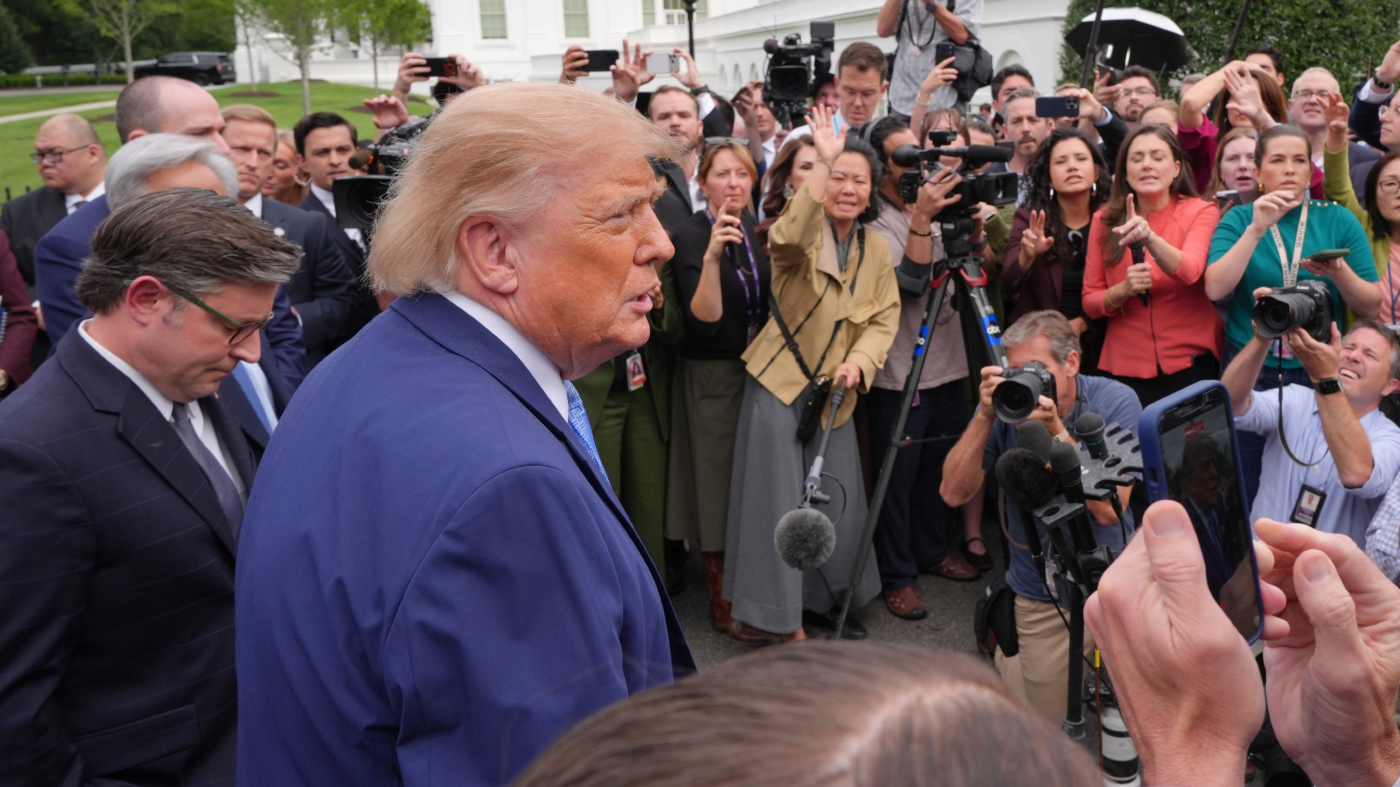
Republicans in both chambers are increasingly breaking ranks with President Trump across a host of sensitive issues, hoping some separation from the GOP’s unpopular standard bearer will help avert a blue wave in the midterm elections.
The divisions are highly unusual for a party that’s walked virtually in lock-step with Trump for more than a decade. But as the president’s numbers have tanked over the summer and rising costs have squeezed voters of all stripes, more and more Republicans are distancing themselves from Trump’s agenda, if only as a temporary strategy to retain power in the next Congress.
The pushback targets a range of policies, including Trump’s hard line on immigration enforcement; his full-throated embrace of data centers despite the public backlash; his signature tariffs, which have challenged businesses at home and alliances abroad; and his warm reception of Chinese President Xi Jinping during a recent visit to Washington.
But none of those issues seems to resonate quite as much as the cost of gasoline and diesel fuel, which have spiked in response to the global trade disruptions caused by Trump’s decision to launch a war with Iran earlier in the year. Even the top GOP leaders on Capitol Hill have been forced to acknowledge that Trump’s agenda, which was once their winning ticket, has become a liability heading into November.
“What’s happening in Iran [has] sort of trumped everything else that’s going on,” Senate Majority Leader John Thune (R-S.D.) told Fox News on Monday.
Weeks ahead of the midterms, gas prices are hovering just below $4.50 per gallon, diesel sits near $6.50 and Republicans are feeling the heat from angry voters at home. The trend is even affecting traditional GOP strongholds, including the deepest red parts of the Midwest, where farmers are being crushed by a combination of high fuel costs, high fertilizer costs and trade policies that have curtailed U.S. exports on certain crops.
The Iran war has been a major factor in driving these high prices, both physically impeding the transport and processing of oil and other goods and generating anxiety among commodities traders.
As the election gets closer and prices grow higher, even top Republicans are calling for the war to come to a close.
“It’s been a priority and an objective of every administration, for 50 years nearly, to ensure that Iran didn’t have a nuclear capability. Now that’s done. Operation Epic Fury was an epic success. … The world is safer because of it,” Speaker Mike Johnson (R-La.) said in an interview with a local TV station last week.
“But now we’ve got to bring that to a resolution,” Johnson said.
“I think that’s been a bit of a disappointment to the American people, that we aren’t at the end, especially when they see gas prices going up,” said Senate Republican Policy Chair Shelley Moore Capito (W.Va.) this week.
The problem is especially acute for Republicans in tough races, who have supported the Iran conflict for much of the year but are now changing their tune in the last legs of the campaign.
“Iowans are being squeezed and shouldn’t have to foot the bill at the pump or the checkout line for the war in Iran,” Rep. Ashley Hinson (R-Iowa), who is running for a Senate seat, wrote last week on X. She’s calling for an “immediate end” to the conflict.
However, the White House itself is standing behind the war, with Trump describing it as a small price to pay for preventing a nuclear Iran.
“It’s a very inexpensive price to pay for what we’ve done. Remember that. It’s a little more. Frankly, even if it was a lot more,” Trump said at a recent rally in North Carolina.
Fuel prices and Iran are not the only topics seeing daylight between Trump and Republicans heading into November.
The president recently welcomed Xi to Washington with a red-carpet greeting and a lavish state dinner, even as China has supplied Iran with military support against U.S. forces. Those dynamics have sparked criticism from some Republicans in the Capitol, who wanted to see Trump confront the Chinese president more forcefully.
“Is it appropriate that you welcome him? Yeah,” said Sen. Lisa Murkowski (R-Alaska). “But it’s equally appropriate that you ask him really tough questions.”
Public anger over data centers is also fueling the internal divisions. The centers are wildly unpopular among voters in both parties, leading a number of Republicans to call for new limits on their construction. But Trump has hammered those critics, warning that any restrictions would only cripple the United States in the global race AI dominance.
“The only reason that communities throughout the U.S.A. should not want Data Centers is if they want to end up being backwards and poor,” Trump posted last month on Truth Social, which he owns.
Immigration is emerging as yet another fault line within the GOP. Trump’s aggressive deportation policies have been cheered by his base, but they’ve also alienated many Hispanic voters who have shifted their support back to Democrats. To counter that shift, some vulnerable Republicans are now attacking Trump on the issue, saying he went “too far.”
“Be careful what your advisers are telling you about immigration policy,” Rep. Maria Elvira Salazar (R-Fla.) said in an explosive campaign ad directed straight at Trump.
Trump, who had endorsed Salazar, responded by reposting messages calling for her defeat.
Republican strategist Doug Heye told The Hill that Trump is a “hindrance” to Republicans because “his poll numbers are dragging Republicans down up and down the ballot” and “taking Republicans off message on the issues of affordability by creating a daily outrage du jour.”
He said that disagreeing with Trump could be part of Republicans’ election strategy and that “they need to be talking about the issues that voters are talking about.”
Meanwhile, there also appears to be division within the GOP about how to handle the diesel situation in particular.
Rural-area Republicans are increasingly calling for a ban on diesel exports to mitigate the impacts of the situation on the nation’s farmers.
“While our farmers are filling tanks at record prices and families are being impacted by affordability every day, we are still shipping diesel overseas,” Rep. Lauren Boebert (R-Colo.) said Monday in a statement. “That is backwards.”
However, recent economic analyses have found that while banning diesel exports could temporarily bring down the price of that fuel in the U.S., it could ultimately raise gas prices since the two are often produced together and refineries would have less incentive to run with limited shipping options for their diesel.
The White House has offered mixed messages on the issue, with Trump initially backing a diesel export ban but Energy Secretary Chris Wright indicating that the administration will not support one.
“We’re trying to avoid a blunt hammer of a government policy, understanding the complexity of refining,” Wright told The Wall Street Journal .
Topics in this story
Gathered from external sources. Rights to this text belong to whoever originally published it.