What to watch in Supreme Court’s new term
Watch The Gavel Live: Hill Insider members can join us live today at 3 p.m. EDT as Zach and Sophie unpack the upcoming Supreme Court term. Members can join the discussion and pose their questions. Tune in! The Supreme Court’s term begins Monday, and it’s set to be another big one. President Trump’s agenda. Guns.…
Watch The Gavel Live : Hill Insider members can join us live today at 3 p.m. EDT as Zach and Sophie unpack the upcoming Supreme Court term. Members can join the discussion and pose their questions. Tune in!
The Supreme Court’s term begins Monday, and it’s set to be another big one.
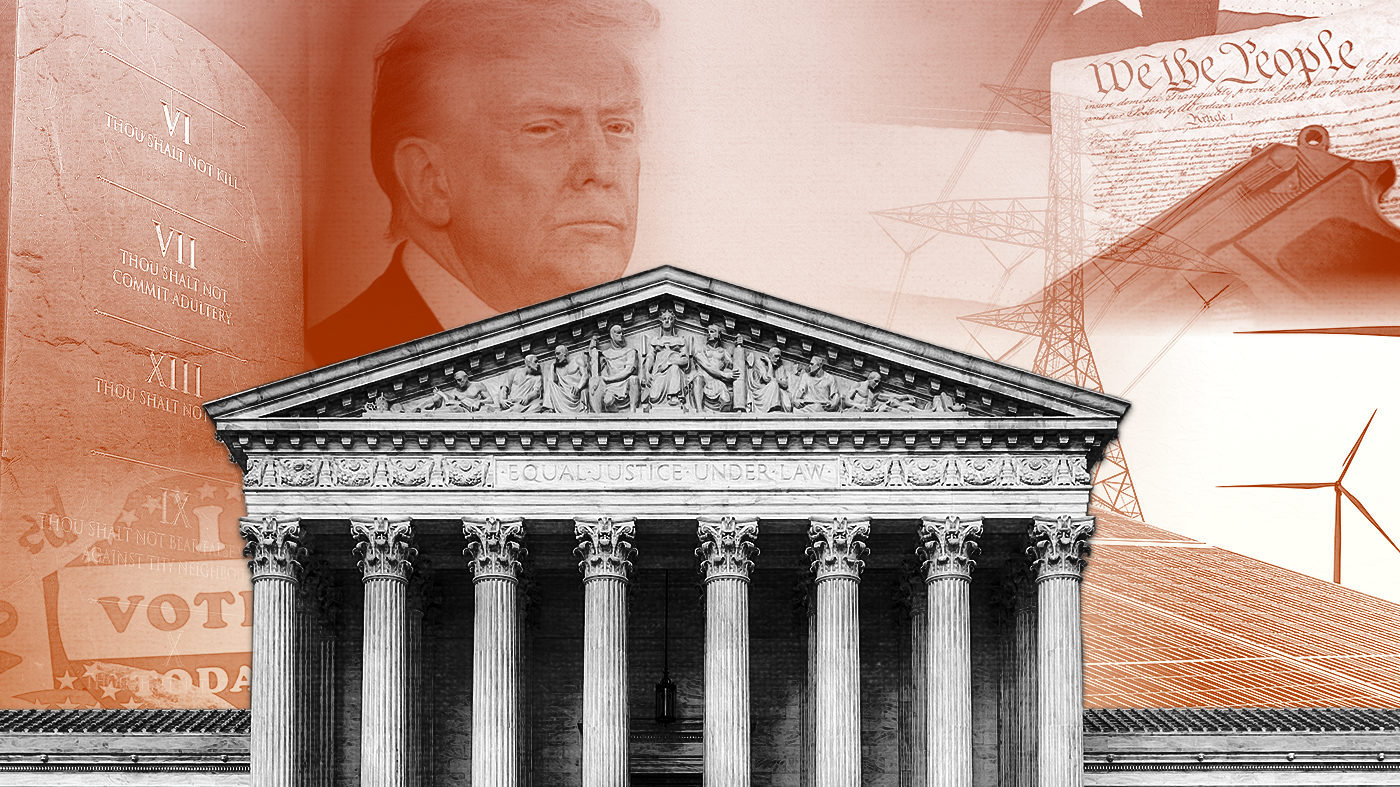
President Trump’s agenda. Guns. Climate. Religious rights. LGBTQ protections.
And, of course, curveballs to come out of the impending midterm elections.
There’s a lot to unpack. Here are five key questions we’re watching as we get into the term:
This past term, Trump’s record at the Supreme Court was mixed.
He picked up some key wins on the emergency docket, particularly in the final weeks: The justices allowed White House ballroom construction to continue and a key immigration database to be overhauled before the midterms.
But it was far from a clean sweep, and on the merits docket, Trump lost many of the cases he cared about most.
The justices found his birthright citizenship restrictions unconstitutional. They ruled his “Liberation Day” tariffs illegal. They said he didn’t give Federal Reserve Governor Lisa Cook enough due process before sacking her.
As he’s failed to convince the courts on those agenda items, Trump has more regularly won when he’s advanced the long-sought goals of the mainstream conservative legal movement. Just look at how Trump eviscerated for-cause firing protections at independent agencies, a cause conservative groups had pushed for years. The president merely teed up the Supreme Court to take the swing.
Heading into the new term, the justices on Tuesday announced they’re already adding a big Trump policy to their docket.
In December, they’ll take the bench to consider whether the president’s third-country deportation policy is legal.
More could be added in the coming weeks.
The administration has appealed cases concerning its mandatory detention of certain immigrants, suspended University of California research funding, the Department of Government Efficiency, Trump’s Day 1 asylum ban, the Pentagon’s transgender troops ban, the executive’s authority to appoint acting U.S. attorneys and more.
Is this a blockbuster moment for the energy industry?
Ask any court watcher what the most anticipated and possibly consequential case of the upcoming term is, and they’ll likely point to the one being heard first: Suncor Energy Inc. v. County Commissioners of Boulder County.
ExxonMobil and Suncor are hoping to block a lawsuit brought against them by the local government in Boulder, Colo., by arguing that federal law, such as the Clean Air Act, preempts state-level claims that aim to hold energy companies liable for the effects of climate change.
The city and county sued the two companies in April 2018, seeking billions of dollars in damages over allegations that they misled the public and sold fossil fuels at levels that they knew would contribute to greenhouse gas emissions.
The outcome would likely impact dozens of other similar pending or future lawsuits nationwide. A broad ruling in favor of the energy giants could nullify those, while a decision for Boulder could open the courthouse doors to more challenges.
And the ripple effects may not stop there.
Legal analysts say the ruling could reshape corporate liability across a range of industries, creating a litmus test for state-level authority on issues beyond climate change.
Take artificial intelligence, for example. Companies could use a decision siding with Suncor and ExxonMobil to argue that state and local regulations should be invalidated because only the federal government can put guardrails on the technology.
When the justices sit for their first oral argument, it’ll be less than a month before the midterm election. And they’ll have already weighed in on some critical issues.
So far this summer, the Supreme Court has blocked Missouri Republicans from holding the election under a more favorable set of congressional lines and struck down the Trump administration’s proposed restrictions on mail-in voting.
The justices have allowed the use of a revamped immigration database to check individuals on state voter rolls. They’ve also lifted a ruling that prevented party committees from accessing cheaper advertising rates in the lead-up to November.
There’s at least one more on the emergency docket yet to be decided: Whether Delaware can require political organizations, such as Americans for Prosperity, to publicly disclose their donors.
Other election-related disputes are already in the pipeline, with justices agreeing to review a lower court ruling that blocked key parts of an Arizona law requiring documentary proof-of-citizenship to register to vote.
The case, Republican National Committee v. Mi Familia Vota, is scheduled for oral argument in December.
Whether other questions arise that warrant the court’s intervention remains to be seen, though experts note that emergency applications are a fixture of every major election cycle.
How momentous of a term will it be for the Second Amendment?
The Second Amendment is front and center as the justices hear arguments in December on whether states can ban AR-15s and other guns they deem “assault weapons.”
It’s the latest test of the conservative majority’s expanded Second Amendment test that requires gun control measures to be consistent with the nation’s historical tradition.
The high court has since taken up cases clarifying who may carry guns (see here and here ) and where they may carry them (see here ).
This term, they’ll delve into what guns are protected.
Roughly a dozen states’ assault weapons bans hang in the balance.
This week, the justices are mulling the Trump administration’s request to take up whether the government can ban felons from possessing a gun.
It would mark a blockbuster case — it’s one of the most prosecuted federal crimes in the country.
It would also put the Trump administration at odds with some gun rights advocates, as the administration is defending the statute as constitutional.
So far, the Supreme Court has declined to get involved. It’s had plenty of opportunities but has often punted, sending cases back for another look in light of recent opinions.
Gun rights groups are bringing plenty of new cases to the justices, too. Challenges to Minnesota’s gun licensing regime, Maryland’s gun restrictions and New York’s stun gun ban all are inching closer.
Is more still coming on the religion docket?
A major religious dispute is already on the docket. Many court watchers think another one is incoming.
The American Civil Liberties Union (ACLU) has asked the justices to review a Texas law that mandates the display of the Ten Commandments in public school classrooms.
The ACLU says the law “flouted this Court’s binding precedents and gutted the religious-freedom rights of public-school children and parents.”
The justices won’t decide whether to hear the case until later this fall, but when we ask attorneys what cases they think the court will be taking up, this one is a frequent response.
As we wait, the justices have already agreed to hear a dispute that could lead them to shake up another major religious precedent.
The court will decide whether Colorado can require Catholic preschools to admit LGBTQ families to receive state universal preschool funding.
Colorado doesn’t have a great track record. The court in recent years ruled against its “conversion therapy” ban and sided with a web designer and cake baker who separately challenged a state anti-discrimination law.
Some of those cases centered on free speech. Now, the fight has turned back to religion.
Welcome to The Gavel, The Hill’s weekly newsletter unpacking the intersection of courts & politics from Zach Schonfeld and Sophie Brams. Email us tips at zschonfeld@thehill.com and sbrams@thehill.com . You can also reach out to us on X (@ZachASchonfeld and @sophiebrams) or Signal (zachschonfeld.48 and sbrams.32).
Strike three: The Supreme Court has rejected the use of a House map that would have given Missouri Republicans a pickup opportunity in the midterms for the third time. The state must use the 6-2 map design in November, the justices said.
Another blow for prediction markets: Kalshi has taken another hit after the 6 th U.S. Circuit Court of Appeals ruled that states can regulate prediction markets like gambling platforms. It is the second appellate-level loss for Kalshi in the last month.
Iowa pollster ruling appealed: Trump is appealing a federal judge’s dismissal of his lawsuit against an Iowa pollster and the Des Moines Register over a poll published days before the 2024 election that showed former Vice President Kamala Harris with a 3-point lead in the presidential race.
New York climate law struck down, again: A second federal judge has struck down New York’s “Climate Superfund” law, which sought to hold fossil fuel companies financially liable for contributing to climate change.
Judge rejects federal counterterrorism grant conditions: The Department of Homeland Security (DHS) cannot force states to change their election administration practices by threatening to withhold federal counterterrorism funding, a federal judge in D.C. has ruled.
Former special counsel Jack Smith testified before the Senate Judiciary Committee on Tuesday for over four hours as Republican lawmakers continue to probe his investigations of Trump in the Mar-a-Lago documents and Jan. 6 cases.
Judge Leslie Southwick , a George W. Bush appointee, is stepping back from the 5 th U.S. Circuit Court of Appeals after nearly two decades on the bench. Read more from Bloomberg Law .
A federal bribery case involving D.C. Council member Trayon White has ended in a mistrial after jurors deadlocked. The Ward 8 councilman was spotted tuning into a council breakfast meeting from federal court last week.
2 conservatives to watch in SCOTUS climate arguments
In conversations discussing the upcoming Supreme Court term, court watchers keep telling us the same thing: Watch two conservative justices as the court kicks off its term on Monday with major arguments implicating the energy industry.
Suncor Energy and ExxonMobil will argue that federal law preempts a wave of state-court suits alleging they contributed to climate change and must pay billions. Colorado’s top court allowed a suit filed by Boulder to proceed; the justices are reviewing whether that was in error.
But potentially unfortunate for the companies, they’ll be facing Justice Clarence Thomas and Justice Neil Gorsuch.
Yes, they are members of the conservative majority and have ruled against left-leaning climate interests in other cases. But the two haven’t been friendly faces for those trying to argue implied federal preemption, like the companies will.
In 2019 , the two agreed that the federal Atomic Energy Act didn’t preempt a Virginia uranium mining ban.
“Invoking some brooding federal interest or appealing to a judicial policy preference should never be enough to win preemption of a state law,” Gorsuch cautioned at the time.
The next year , the duo called on the court to abandon some of its preemption jurisprudence. Thomas has long described some of the court’s past decisions invalidating state laws as “judicial guesswork.”
“The founding generation treated conflicts between federal and state laws as implied repeals… Then, as now, courts disfavored repeals by implication,” Thomas wrote.
Their votes are becoming even more important now that Justice Samuel Alito , another member of the conservative majority, recused from the case on Monday.
A justice typically recuses at the onset of a case, but Alito had participated in the vote to take it up. His new announcement came suddenly and without explanation, though it did happen to land the same day as the justices met behind closed doors for their first scheduled meeting of the new term.
Alito has long held financial interests in the oil and gas sector, but he doesn’t own stocks directly in Suncor Energy or ExxonMobil. The court did not return The Gavel’s request for comment seeking clarity.
His exit came much to the delight of left-leaning groups that have long pushed the conservative justice to step aside from hot-button energy cases.
“Even without Alito’s involvement in this case, the culture of loyalty to corporate powers is ever-present in the Roberts Court,” Court Accountability CEO Alex Aronson said in a statement.
“This loyalty leaves us with polluted water, toxic air, and communities that face the constant threat of natural disasters,” Aronson continued. “Corporations have invested in a favorable outcome in Suncor, and the Roberts Court will make sure to give them their money’s worth.”
Petitions for the Supreme Court to take up cases we are keeping a close eye on…
The Supreme Court’s new term is nearly here. The justices met Monday and voted on new cases to take up. That initial meeting was a big one. The justices confronted roughly 900 petitions to accept cases that piled up over the summer. Court watchers nickname it the “long conference.” We’ve gone through the petition list. Here at The Gavel, we’re previewing cases that could pique the justices’ interest along with other interesting ones. In our third and final week of previews, we’ll focus on business-related cases.
Some cases the Supreme Court heard previously are back for another round:
Corporate Transparency Act: Business interests want the Supreme Court to declare that the Corporate Transparency Act — which requires some businesses to report their ownership to the government — exceeds Congress’ power to regulate interstate commerce and violates the Fourth Amendment’s protections against warrantless searches. The court previously intervened on its emergency docket to reinstate the law. The cases are National Small Business Association v. Bessent and Texas Top Cop Shop, Inc. v. Blanche.
Mortgage escrow interest: In 2024, the justices said an appeals court too easily struck down New York’s mandate that lenders pay interest on mortgage-escrow funds. The appeals court has again found the mandate is preempted by federal law, so the case is back. It’s called Cantero v. Bank of America, N.A. Two other appeals courts have come out the other way, and those cases have reached the justices as well: Citizens Bank, N.A. v. Conti and Flagstar Bank, N.A. v. Kivett .
Commerce Clause: The Supreme Court heard this case in 2023 . Now, it’s back, but with a different legal issue. Norfolk Southern wants the justices to rule that it can’t be hauled into Pennsylvania’s courts solely because it registered to do business there. It says Pennsylvania’s rules unconstitutionally burden other states’ commerce . The case is Norfolk Southern Railway Company v. Mallory .
Several others deal with judges certifying that a lawsuit can proceed as a class-action:
Zillow stock: Real estate marketplace Zillow appeals a ruling that certified a class over allegations the company made misrepresentations about its “iBuying” business, keeping its stock price artificially inflated and later causing it to drop. The case raises thorny questions about the proper legal standards in such disputes. The case is Zillow Group, Inc., v. Jaeger.
Unclaimed Sunoco interest: Sunoco was ordered to pay $100 million for failing to pay oil well interest owners, but a lot of the class were unidentifiable owners. So, those proceeds went to unclaimed property funds. Sunoco says the courts shouldn’t have certified the class. The case is Sunoco, Inc. v. Cline .
United vaccine policy: United Airlines wants to reverse the class certification in a Title VII employment-discrimination lawsuit over its COVID-19 vaccine policy. Federal rules require class-action lawsuits to present a “common question” that applies to class members. United says that isn’t met here. The case is United Airlines v. Kincannon .
TV retransmission fees: Nexstar Media Group, which owns The Hill, seeks to dismiss DirecTV’s suit concerning TV retransmission fees. DirecTV alleges price fixing, but Nexstar says the company shouldn’t have legal standing because it didn’t actually purchase the allegedly price-fixed programming. The case is Nexstar Media Group Inc. v. DirecTV LLC .
Superfund: Canadian mining company Teck Metals wants to end a lawsuit filed by a Native American tribe under the nation’s Superfund law concerning alleged contamination to the Upper Columbia River. The tribe seeks to recover money for the cultural loss it experienced from the incident, a claim the company says shouldn’t be permitted. The case is Teck Metals v. Confederated Tribes of the Colville Reservatio n.
Antitrust: Pharma giants AstraZeneca, Eli Lilly, Novo Nordisk and Sanofi want to throw out a revived suit over their efforts to restrict 340B drug-discount practices. It raises questions over an Supreme Court antitrust precedent dating back to 1977. The case is AstraZeneca Pharmaceuticals LP v. Mosaic Health Inc. The justices are also mulling another petition, United Biologics LLC v. Amerigroup Tennessee Inc., which raises questions about the same precedent.
Madoff foreign investors: The fallout of Bernie Madoff’s fraud isn’t done yet. Liquidators seeking to recover funds for investors in foreign funds that lost billions in Madoff’s Ponzi scheme want to reverse a decision involving their claims and bankruptcy law. The case is Fairfield Sentry Ltd. v Citibank NA London .
Bankruptcy & arbitration: Two people who had an account with Marcus by Goldman Sachs claim the bank violated the automatic pause on pending litigation that commenced when it filed for bankruptcy protection. They want damages, but Goldman claims it has an agreement requiring the dispute be arbitrated. The lower courts refused to honor it, and the bank appealed. The case is Goldman Sachs Bank v. Brown .
The U.S. Court of International Trade will hear arguments over whether Trump’s latest round of sweeping tariffs is lawful.
A federal judge in Texas will hold a hearing to decide whether Wilber Rafael Garces Perez , a Venezuelan migrant shot by an Immigration and Customs Enforcement (ICE) officer in Austin earlier this month, should be deported.
A federal judge in Seattle will hold a hearing in a lawsuit filed by Roger Rogoff challenging Trump’s decision to abruptly fire him as U.S. attorney for the Western District of Washington.
A federal judge in Fresno, Calif., will hear arguments as the Trump administration seeks to dismiss a lawsuit brought by a nonbinary Yosemite National Park ranger who was fired after unfurling a transgender pride flag on the El Capitan summit on their day off.
Former Rep. David Rivera (R-Fla.) will be sentenced in Miami after being convicted in May of secretly lobbying on behalf of the Venezuelan government
The Supreme Court will open its new term with oral arguments in Suncor Energy Inc. v. County Commissioners of Boulder County, a blockbuster climate case , and Johnson v. United States Congress, a veteran benefits dispute .
Cole Thomas Allen , the man charged with attempting to assassinate Trump at the White House Correspondents Association dinner this spring, will appear in a federal courtroom in D.C. for a status conference.
The Supreme Court will hold oral arguments in Anderson v. Intel Corp. Investment Policy Committee, a case implicating retirement plan lawsuits .
The D.C. Circuit Court of Appeals will hold oral arguments in a lawsuit filed by the National Association of the Deaf and two of its members over the White House’s decision to stop providing sign language interpreters at press briefings and public events.
A federal judge in Maryland will hold a hearing to resolve all remaining issues in the case of Kilmar Abrego Garcia, a Salvadoran national and Maryland resident who has been fighting his unlawful deportation.
Topics in this story
Gathered from external sources. Rights to this text belong to whoever originally published it.