Thune seeks lifeline for 3 embattled Senate GOP incumbents
Senate Majority Leader John Thune (R-S.D.) is seeking to throw a political lifeline to embattled Republican incumbent Sens. Jon Husted (Ohio), Pete Ricketts (Neb.) and Dan Sullivan (Alaska) by scheduling votes Wednesday on two bills that would address the growth of AI-driven data centers and stock trading by members of Congress. All three GOP senators…
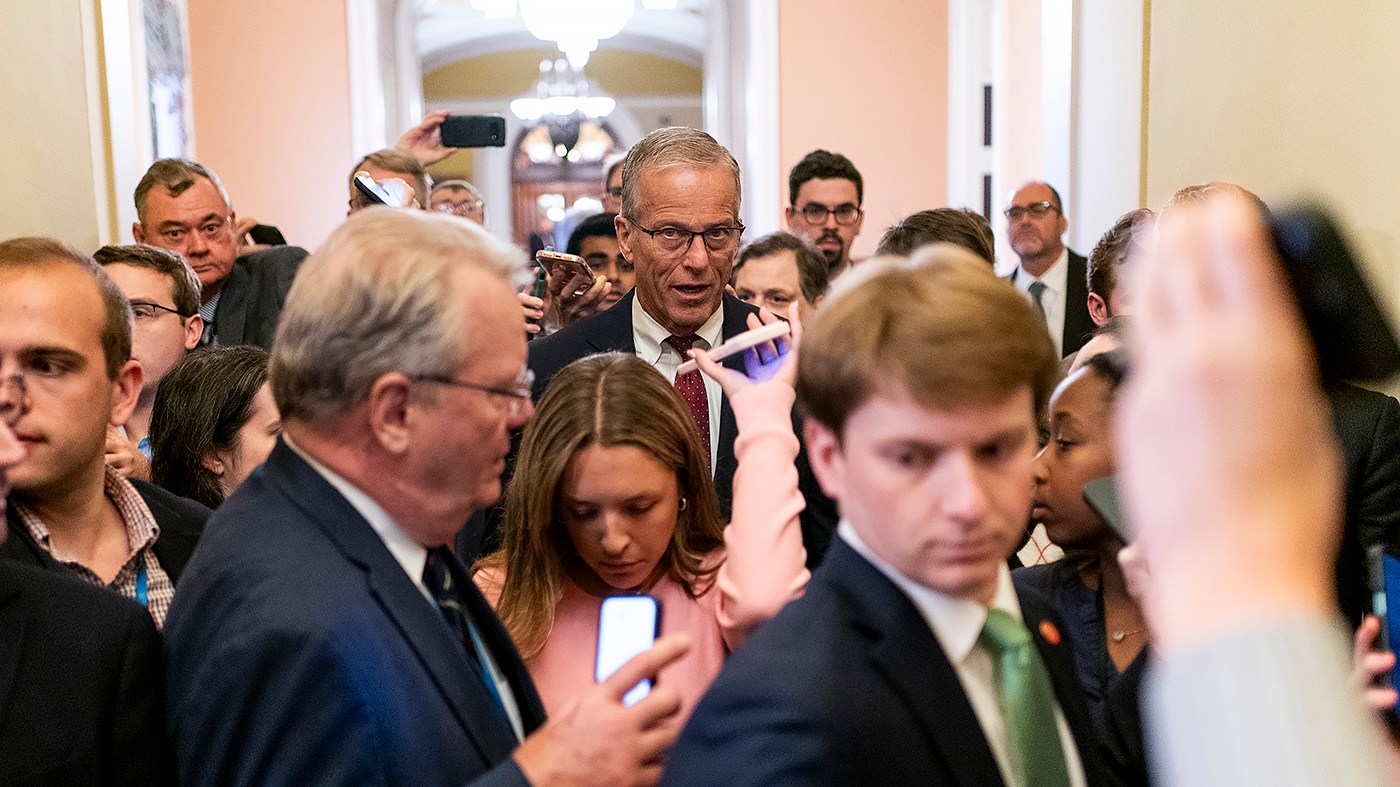
Senate Majority Leader John Thune (R-S.D.) is seeking to throw a political lifeline to embattled Republican incumbent Sens. Jon Husted (Ohio), Pete Ricketts (Neb.) and Dan Sullivan (Alaska) by scheduling votes Wednesday on two bills that would address the growth of AI-driven data centers and stock trading by members of Congress.
All three GOP senators are locked in tough battles, and whether they win or lose in November could determine if Thune remains Senate majority leader in 2027.
Democrats, however, are gearing up to defeat the bills. They argue the reforms are “watered down.”
Sen. Jacky Rosen (Nev.), a centrist Democrat, told The Hill on Tuesday that she’s planning to vote against the data center bill coming to the floor Wednesday, waving it aside as a hastily arranged rescue plan for Husted and other embattled GOP incumbents.
“This bill … has no teeth,” she said. “This is just a pivot.”
She said it “sure seems like” a political bailout for Husted.
“He’s been real friendly to data centers,” she said.
Recent polls show former Sen. Sherrod Brown (D) leading Husted by an average of nearly 4 points in the Ohio Senate race.
In Ohio — where 75 percent of voters oppose the construction of data centers in their communities, according to one recent poll — Democratic Senate candidate Brown has tagged Husted as “the face of data centers in Ohio.”
One ad approved by Brown slams Husted for “aggressively recruiting data centers to the state” and “cutting sweetheart tax deals and fast-tracking approvals while ordinary residents watch their electricity bills explode.”
“This is a last-ditch effort for a candidate who is way underwater in his state,” Rosen said, voicing a view shared by other Democratic senators.
Recent polls, meanwhile, show Ricketts in a tight race with Independent candidate Dan Osborn in the Nebraska Senate contest and Sullivan neck and neck with former Rep. Mary Peltola (D) in the Alaska Senate race.
Political prognosticators are increasingly predicting that Democrats could recapture the Senate, even though few handicappers thought that scenario was likely at the start of the election cycle.
Thune has brought two House-passed bills to the floor that will give Husted, Ricketts and Sullivan a chance to argue that they’re responding to voters’ concerns over energy- and water-hungry data centers and lawmakers getting rich on stock trades by voting for legislation to address those issues.
Thune is looking to flip the script in the Ohio, Nebraska and Alaska Senate races, where the GOP incumbents have had to play defense in the face of Democratic attacks.
“It makes it pretty hard for Democrats to make that argument” that Husted is the “face of data centers in Ohio” or that Ricketts and Sullivan are profiting from stock trades if they block the Ratepayer Protection Act and the Stop Insider Trading Act, Thune told reporters.
“These are both broadly bipartisan bills that have passed the House with huge majorities, all of which get at the issues that Democrats seem to find able to use in their campaigns,” he said.
“If you’re really serious about doing something on data centers, then voting for Husted’s bill would be a great solution. And if you’re concerned about members using the knowledge and information they have here in some sort of a financial way, then passing the stock act would be a great way to address it,” he argued.
“Both of those [bills] would literally go to the president’s desk,” he said. “If they get through the Senate, they’re both cleared out of the House. We could send them to the president’s desk.”
The Ratepayer Protection Act, sponsored by Husted, would ask states to consider standards for requiring data centers to pay for the costs of upgrading infrastructure to meet their higher energy consumption needs.
It passed the House overwhelmingly on Sept. 16 by a vote of 417-3, with only three Democrats voting against it.
The other House-passed bill Thune is bringing to the floor is the Stop Insider Trading Act, sponsored by Ricketts.
It would generally prohibit members of Congress, their spouses and dependent children from purchasing new stocks and would require public notice before they sell their existing stocks. It includes a provision requiring voters to show photo identification when casting a ballot — a core element of the Safeguard American Voter Eligibility (SAVE America) Act, one of President Trump’s top priorities — in an effort to address the possibility of voter fraud.
It passed the House in July by a vote of 232-198. Only 13 Democrats voted for the bill.
The Democratic and Independent candidates running against Ricketts and Sullivan have attacked the senators over data centers and the trend of members of Congress getting rich from stock trades.
Osborn, the Independent challenger in Nebraska, has accused Ricketts of profiting from data center construction and criticized him for recruiting — while governor — Facebook to build a data center in Papillion, Neb.
Earlier this month he posted a picture of Ricketts at the groundbreaking for the Facebook data center on social media and commented, “Pete loves data centers,” using the heart emoji for “loves.”
Osborn has also attacked Ricketts for earning an estimated $10 million in the stock market in April 2025, when the market gyrated wildly after Trump announced his sweeping “Liberation Day” tariffs.
Ricketts touted the upcoming Senate vote on his stock trading bill on social media.
“This week, the Senate is planning to vote on my Stop Insider Trading Act. This bill would ban congressional insider trading. We need to pass this commonsense legislation and restore integrity to Congress,” he posted on Facebook.
Peltola, the Senate Democratic nominee in Alaska, has slammed Sullivan for getting “three-times richer” by trading stocks during his Senate career.
She has called for a ban on congressional stock trading.
A new ad from WinSenate, a super PAC aligned with the Senate Democratic leadership, features a narrator who identifies herself as a line cook and bartender criticizing Sullivan for having “nearly quadrupled his net worth” and “cutting healthcare for Alaskans” while in Congress.
Senate Democratic Leader Chuck Schumer (D-N.Y.) is keen to deprive Husted, Ricketts and Sullivan of claiming legislative wins that they could use to shield themselves from attacks on the campaign trail.
“We don’t vote for frauds!” Schumer declared Tuesday, panning the bill that Thune is bringing to the floor that Republicans say would help shield taxpayers from paying higher utilities costs because of data centers.
Schumer slammed the bill as a fake guardrail, even though House Democratic Leader Hakeem Jeffries (N.Y.) and almost every other House Democrat voted for it earlier this month.
He argued the data center bill “does not require any productions at all” and dismissed it as a “toothless messaging bill.”
The Democratic leader has also pooh-poohed the proposal to limit members of Congress from trading stocks as weak sauce.
“The stock trading bill. They’re doing the same thing on stock trading. All of the sudden the GOP is pretending they care about banning stock trading in Congress,” he said, arguing that last year the House Homeland Security Committee advanced a stronger bipartisan bill.
“Now they watered down the ban and created loophole after loophole in this sham legislation. Let’s be clear, this bill does not ban stock trading. In fact, under this bill, members of Congress could keep stocks they own, sell them and continue trading in privately held companies. What kind of bill is that?” he said.
“The bill doesn’t cover the president,” Schumer noted. “Yet Trump traded more stocks than all of Congress combined.”
Other Democrats indicated that their caucus will vote largely in unison Wednesday to block the bills sponsored by Husted and Ricketts.
“I’m hearing that they’re diluting it,” Sen. Cory Booker (D-N.J.). said of the Stop Insider Trading Act. “That’s weak sauce, that’s milquetoast, that’s not what we need to do. We need to stop both sides of the aisle from trading stocks. We need to stop the corruption in Washington.”
“No senator should own individual stocks and this bill I don’t think gets the job done,” he added.
Topics in this story
Gathered from external sources. Rights to this text belong to whoever originally published it.