In 2026, Boston’s sea-turtle robot avoided obstacles 91% of the time while tracking real fish, pointing to quieter ways to monitor coral reefs
A cutting-edge sea-turtle inspired robot named Crush by MIT demonstrates 91% success in navigating coral reefs, providing a quieter, less invasive method to monitor fragile marine ecosystems.
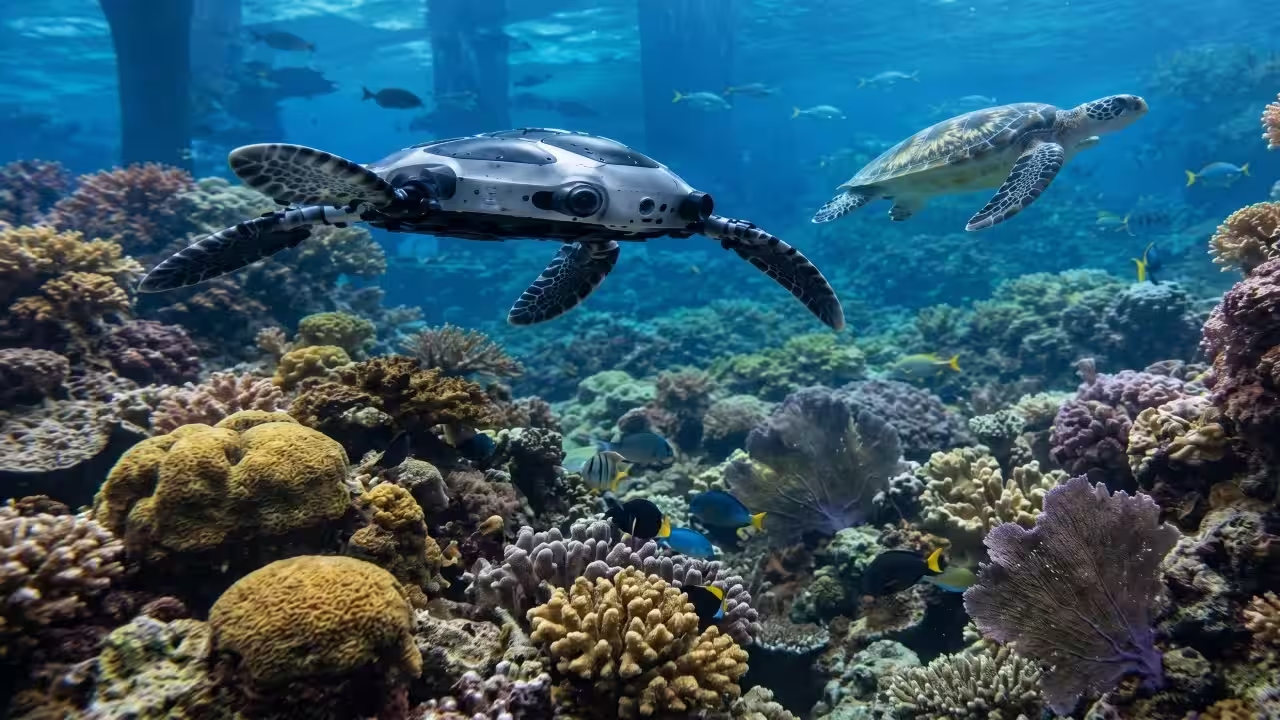
It has always been necessary to accept some degree of disturbance when studying a coral reef up close. Even skilfully manoeuvred underwater vehicles can be awkward in tight coral formations, bumping against structures that took decades to create and only a few seconds to harm, as divers throw up sand and boats dock nearby. A recent experiment from Boston hints that a biologically inspired solution may now be within reach. Researchers have long sought a technique to observe reef life up close without adding to the very pressures presently endangering these ecosystems.Engineers have developed an autonomous underwater robot patterned on the shape and movement of a juvenile hawksbill sea turtle, including flippers that resemble the animal’s gentle but strong swimming action. The robot, called Crush, was tested in an acoral reef exhibit at an aquarium in Boston, where it had to navigate around real coral, glass walls, divers and other swiftly moving critters, successfully avoiding contact in the large majority of trials. In untethered trials, the robot avoided obstacles 91 percent of the time, a result that the developers at the Massachusetts Institute of Technology say is a meaningful step towards robots that can operate safely in cluttered marine environments rather than in simplified laboratory tanks.Why undersea bioinspired design mattersStandard underwater robots use stiff propellers and thrusters, which function well in open water but have issues in the thick, unpredictable topography of a coral reef. A stiff vehicle that misjudges its distance from a coral formation might break fragile branches in seconds, but the same mistake by a soft-flippered robot travelling at turtle-like rates is much less likely to inflict permanent damage. The research team has tried to bridge this gap, designing a machine that blends the softness of organic movement with the kind of autonomous decision making generally reserved for far clunkier vehicles.A crucial factor in demonstrating the notion was the environment used for testing itself. Instead of depending on computer simulations or empty pools, the researchers did longer experiments in a real coral reef display with real marine animals, including a 550-pound green sea turtle, some barracudas and stingrays. The robot utilised its onboard cameras and visual processing to track these creatures, altering its heading in real time as the targets darted, paused or changed direction unexpectedly in twenty separate tracking efforts. Critically, the animals themselves showed no clear changes in behaviour in the presence of the robot, something the researchers refer to as early proof that the design is indeed minimally disruptive.A greater problem it might help tackleWhich leads into why this type of research important beyond one aquarium tank. Coral reefs worldwide have been under increasing pressure from warming oceans, pollution and physical damage, and keeping them under close enough observation to spot problems early has usually meant either frequent diver visits or underwater vehicles that are not necessarily suitable for close-range operations. Organisations like the National Oceanic and Atmospheric Administration run programmes that rely heavily on consistent, long term data collection to track reef decline, and a robot able to move through fragile terrain without causing harm could one day support that kind of monitoring at a scale human divers simply can’t sustain.The setting of the aquarium itself was picked carefully, that’s why. Such institutions as the New England Aquarium maintain living coral exhibits, in part, to facilitate that exact kind of applied research, providing engineers with a realistic reef environment that avoids the logistical and ecological risks inherent in early-stage testing in open ocean waters. Only when a robot like Crush is proven reliable in a controlled but genuinely complicated situation does it make sense to think about deployment near a real, wild reef.What more has to happen before genuine reefs Despite the positive results, the robot remained a research prototype rather than a deployment-ready instrument. The 91 percent success rate in avoiding obstructions is impressive for a machine so early in development, but it also means collisions still occurred close to one time in ten, a margin that would need tightened greatly before any responsible team turned the robot loose near a living, wild reef system. The team has also developed a low computation tracking mode which allows the robot to run for extended periods without the need for continuous high powered computing, an important concern for any device intended to operate far from shore with limited power reserves.Even with such restrictions, the initiative hints to a genuinely valuable direction for reef science. Instead of encroaching on the animals' environment with inflexible gear, a computer that swims like the creatures it examines provides a more subtle, gentler way to monitor ecosystems already under great strain. If further versions can bridge that remaining gap in reliability, robots like Crush might become a common sight wherever scientists need eyes on a reef but don’t want to contribute to the damage they are attempting to avert.
Topics in this story
Gathered from external sources. Rights to this text belong to whoever originally published it.