Saturday Rockpile: Mason Adams is giving the Rockies something to look at
Colorado Rockies news and links for Saturday, September 12, 2026
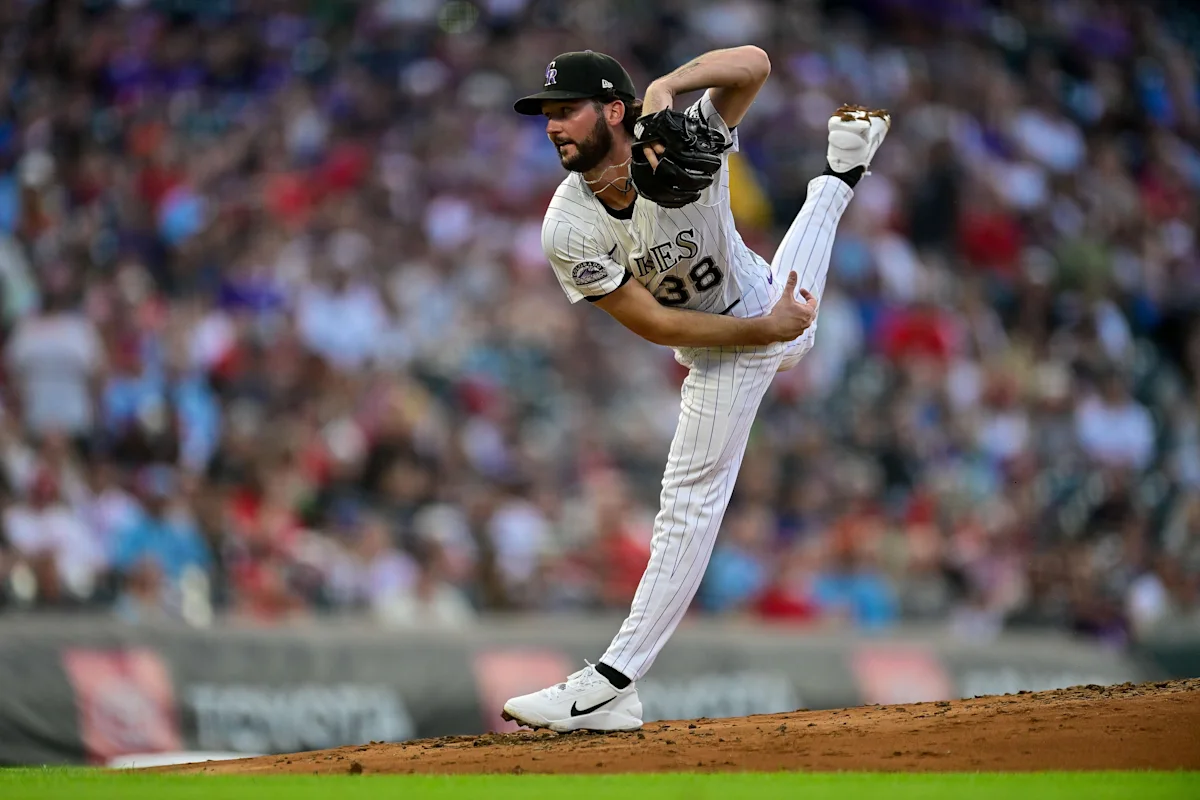
Mason Adams did not come to the Rockies with the pedigree of a top pitching prospect.
Acquired from the White Sox along with Carlos Vielma in exchange for Brenton Doyle , Adams arrived as an older arm with an injury history rather than a marquee prospect. At 26, he is pitching in the big leagues for the first time while still working his way back toward a full workload after Tommy John surgery.
It is impossible to know what he will ultimately become, but through four starts, the results are intriguing. Adams has struck out 22 batters in 18.2 innings, while allowing five home runs and plenty of hard contact.
Still, there is enough here to get excited about for a Rockies team desperate for pitching. And with four starts now under his belt, there is enough to start looking under the hood.
Adams has already shown six pitches in the majors: a four-seam fastball , sinker , cutter , curveball , sweeper and changeup .
None of them looks particularly elite on its own. What stands out is the variety — different speeds, different movement profiles, and enough options to change how he attacks hitters as the game progresses.
Even the three fastballs move differently enough that a hitter cannot treat them as the same pitch, and the velocity separation across the arsenal gives Adams another way to change the look. His four-seamer sits roughly 11 mph above his curveball, with the cutter falling in between.
Taken together, the arsenal fits the broader direction the Rockies have been moving on the mound, even if nothing in Adams' profile screams future ace .
The Rockies do not need Adams to become an ace. They need competent major-league pitchers — and a lot of them. So far, the way Adams has used his six-pitch mix suggests there may be enough for Adams to become a useful major-league starter.
What stands out more than the number of pitches in Adams' arsenal is how he changes the mix once hitters have seen him.
Bryan Torres provided one of the clearest examples against St. Louis , seeing five four-seam fastballs during a six-pitch walk the first time they met.
The second meeting lasted one pitch: another four-seamer, which Torres lined for a single.
The third plate appearance looked completely different.
Two curves. Two changeups. No fastballs.
A similar adjustment had shown up five days earlier in Atlanta , where Adams struck out Drake Baldwin twice using two different pitch progressions.
The usage by time through the order makes the pattern easier to see:
Adams has consistently changed his pitch mix once hitters see him again, though the specific adjustment has varied by start.
Atlanta and St. Louis make it easy to think Adams is following a simple script: show the four-seamer early, then shift toward the sinker once hitters come back around.
Detroit complicated that assumption. Instead of leaning harder on the sinker the second time through, Adams nearly doubled his curveball usage. The adjustment itself appears to be the point, not necessarily which pitch he turns to.
The swing-and-miss gives that approach some teeth, too, particularly with two pitches.
Through his first three starts, Adams' four-seam fastball generated a 27.8% whiff rate, compared with a league baseline around 21–22% for four-seamers. His curveball was even more impressive at 58.3%, compared with a major-league baseline around 29–31%.
Against Detroit, both generated a 33% whiff rate as Adams struck out five over five innings.
That is where the warning signs start to show.
Through his first three starts, only 36.1% of Adams' balls in play were on the ground, compared with a league rate around 44%. Nearly 64% were hit in the air.
The contact was not soft, either. Adams entered Friday with a 61.1% hard-hit rate, well above the league average of roughly 39%, while right-handed hitters had slugged .808 against him.
Those numbers come from barely 14 major-league innings and should not be treated as established trends, but they are difficult to ignore:
Batted-ball results through Adams' first three MLB starts. (Baseball Savant)
That is the early concern: when hitters make contact, too much of it has been hard and too much of it has been in the air.
Friday did not eliminate that problem. Riley Greene singled at 111.5 mph, Colt Keith hit a ball at 99.6 mph and John Peck hit one at 97.1 mph before Max Clark homered at 95.2 mph in the fifth.
After Clark's home run, Adams walked the next two hitters before getting Javier Báez to roll over a sweeper for an inning-ending double play, his second of the game. Seven of his 10 non-strikeout outs came on the ground.
The contact is still a warning sign, but Detroit offered a glimpse of what is possible when Adams can keep more of it on the ground.
The hard contact is real. The amount of air contact is real. The four-seamer cannot carry the arsenal by itself.
But Adams has already shown some swing-and-miss, and he has not attacked hitters the same way every time through the order. The ability to change the mix as hitters adjust is part of what makes these first four starts interesting.
Four starts are nowhere near enough to know where that leads. But for a rotation that needs competent major-league innings almost as badly as it needs upside, Adams is showing enough to suggest he could help raise the floor in 2027.
The Albuquerque Isotopes (69-73) battled back from an early three-run deficit and briefly took the lead in the seventh, but the pitching could not quite hold it in a 6-5 loss to the Reno Aces (63-78).
Roc Riggio got Albuquerque on the board with his fifth Triple-A home run in the third, and the Isotopes continued chipping away after falling behind 4-1. Edouard Julien and Chad Stevens drove in runs in the fourth before Nic Kent tied the game with an RBI single in the sixth. Sterlin Thompson then gave Albuquerque its first lead with a solo homer in the seventh, his 12th of the season.
Thompson finished 2-for-5 with the homer, two runs and an RBI and is now hitting .325 with a .989 OPS. Riggio went 3-for-4 with his homer and an RBI, pushing his OPS to .840. Julien added two hits and an RBI, while Kent also had two hits. Albuquerque finished with 12 hits and three walks, but went just 3-for-10 with runners in scoring position and left nine on base.
The pitching was leaky throughout. Patrick Weigel allowed two runs over two innings, pushing his season ERA to 7.38, while Mason Green gave up two more over four innings. Parker Mushinski surrendered the tying run in the seventh, moving his ERA to 3.38, before Jeff Criswell allowed the go-ahead solo homer to Aramis Garcia in the eighth and took the loss.
The Hartford Yard Goats (65-70) were held scoreless for seven innings before making a late push, but the comeback fell just short in a 4-3 loss to the Somerset Patriots (73-63).
Somerset built a 4-0 lead against Konner Eaton , scoring once in the first, once in the third and twice in the fourth. Eaton allowed four runs on six hits and three walks over five innings, striking out five and surrendering two home runs before Nathan Blasick and Hunter Mann combined for three perfect innings out of the bullpen.
Hartford finally broke through in the eighth when Jack O'Dowd singled and Jimmy Obertop followed with his fifth home run of the season to cut the deficit to 4-2. The Yard Goats threatened again in the ninth, loading the bases with nobody out before O'Dowd brought home Braylen Wimmer with a sacrifice fly. Dyan Jorge stole second for his 55th steal of the season, but Obertop and Skyler Messinger struck out to end the game.
O'Dowd finished 2-for-3 with an RBI, while Obertop drove in two with the homer. Hartford had eight hits but struck out 11 times, went 0-for-6 with runners in scoring position and left six on base.
Defector's Lauren Theisen checks in on the Rockies, finds them improved from last year and still very much the Rockies. It's a short, funny read built around Tuesday's loss in New York and one especially ugly defensive sequence.
Sarah Langs looks at the ridiculous success hitters have had in their MLB debuts this season, including a record 15 players who have homered in their first game. There's some Rockies history in the mix too, with Trevor Story among the rare players to homer twice in a debut.
MLB.com's Mark Feinsand looks at a Tigers team that has struggled this season but still has a young core led by Kevin McGonigle, Riley Greene, Max Clark and Dillon Dingler . With the Rockies in Detroit this weekend, it's an interesting look at a rebuilding club that already has several young players producing at the major-league level.
Download the SB Nation app on iOS or Android .
Please keep in mind our Purple Row Community Guidelines when you're commenting. Thanks!
Topics in this story
Gathered from external sources. Rights to this text belong to whoever originally published it.