Career turning point: “It’s something that you have to prove year after year. It’s a nice accomplishment”: How Sidney Crosby’s historic sophomore season turned him into an NHL superstar
NHL News: Before Sidney Crosby became the face of the Pittsburgh Penguins, he was a teenager carrying huge expectations. The No. 1 pick in the 2005 NHL Draft ha.
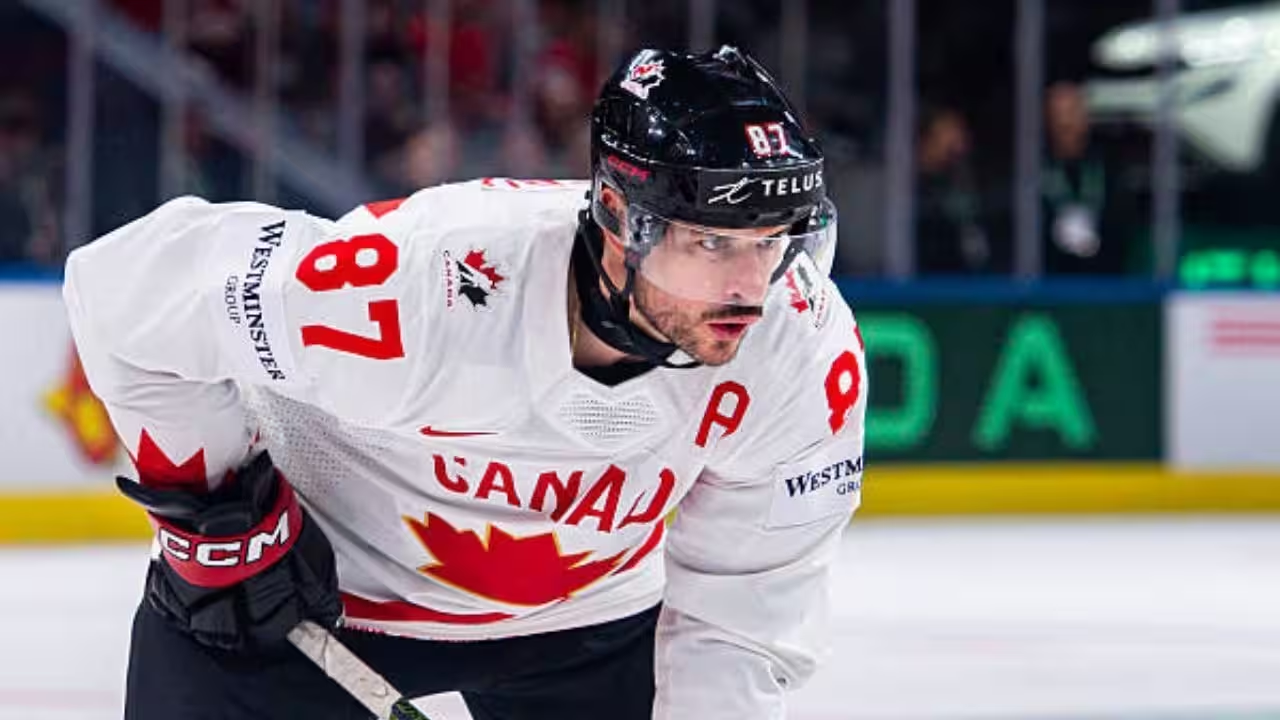
Before Sidney Crosby became the face of the Pittsburgh Penguins, he was a teenager carrying huge expectations. The No. 1 pick in the 2005 NHL Draft had already produced 102 points as a rookie, but his second season changed how the league viewed him.Crosby finished 2006-07 with 120 points, won the Art Ross Trophy and helped Pittsburgh return to the playoffs for the first time since 2001. At 19, he had moved from a highly rated young player to one of the NHL's biggest stars.How did Sidney Crosby’s second NHL season become his career turning point?Crosby's rookie season had shown why Pittsburgh selected him first overall. He scored 39 goals and added 63 assists for 102 points in 81 games, but the Penguins finished with only 58 points and missed the playoffs. His second season brought a different challenge because he needed to show that his individual talent could help change the team's fortunes.Crosby responded with a spectacular campaign. He scored 36 goals and recorded 84 assists for 120 points in 79 games, finishing six points ahead of Joe Thornton to become the NHL's leading scorer. Pittsburgh also improved dramatically, finishing with 105 points and returning to the playoffs after a six-year absence.The Art Ross Trophy became the clearest sign of Crosby's rise. At 19, he became the youngest player to win the NHL scoring title. His season also earned him the Hart Trophy as the league's most valuable player and the Lester B. Pearson Award, now known as the Ted Lindsay Award.After the regular season, Crosby spoke about winning the scoring title during a media conference on April 9, 2007. He treated the achievement as something worth appreciating but made it clear that individual awards were not his main goal. “It’s a nice accomplishment and I didn’t come into this season expecting it”Crosby then explained that winning with Pittsburgh mattered more to him than collecting personal honours. “I think everyone realizes my ultimate goal is to win championships, and those things are always bonuses.”His comments were significant because the attention around Crosby was already growing rapidly. He had become the NHL's youngest scoring champion, but he did not speak as though one successful season had completed his development.During that same April 9 media conference, Crosby also discussed the importance of maintaining his level instead of allowing one great season to define him. “It’s something that you have to prove year after year. It’s not just one or two years. It’s year after year.”The 120-point campaign gave Crosby the recognition that had been expected since his draft day, but his first playoff appearance provided another important test. Pittsburgh faced the Ottawa Senators in the opening round, and Crosby scored in his postseason debut. The Penguins eventually lost the series, but the experience introduced him to the pressure of playoff hockey. How did Crosby’s breakout season lead to him becoming the Penguins’ captain?Only weeks after Pittsburgh's playoff exit, Crosby's role changed again. On May 31, 2007, the Penguins named him captain at 19 years and 297 days old, making him the youngest NHL captain in history at the time.The decision came after a season in which Crosby had established himself as Pittsburgh's best player and helped take the team from 58 points to 105. He was no longer simply the franchise's prized young prospect. The organisation now viewed him as the player who could lead its future.Interestingly, Crosby had initially hesitated when the Penguins approached him about becoming captain earlier in the season. General manager Ray Shero raised the possibility in January, but Crosby felt he needed more time to grow into the responsibility.During the May 31, 2007 news conference at Mellon Arena, Crosby explained why he had initially felt he was not ready. “I thought I needed some time to grow a little bit more.”The decision changed after Crosby experienced his first playoff run. Although Pittsburgh lost to Ottawa, the postseason gave him valuable experience and increased his confidence about taking on a leadership role.At the same May 31 news conference, Crosby explained how the playoff experience had influenced his thinking. “Going through the playoffs and having that experience has probably given me more confidence.”He also understood that becoming captain would bring greater expectations. Rather than avoiding that pressure, Crosby said he was prepared to accept it. “I understand there’s going to be a lot more responsibility on my shoulders with this, but I think I’m ready for it.”That was a major moment in Crosby's development. He had entered the NHL as a teenager who was expected to become a superstar, but now Pittsburgh was formally trusting him to lead the franchise.His age naturally became part of the discussion. Crosby was still only 19 and was taking responsibility for teammates with far more NHL experience. However, he did not believe his age should prevent him from taking on the role.Speaking during the captaincy announcement, Crosby said: “I was always told that age is just a number. I try not to let it get in the way of anything.”The appointment showed how much had changed in less than two years. Crosby had gone from being a highly touted No. 1 pick to the NHL's leading scorer and then the youngest captain in league history at the time.His second season had therefore become much more than a statistical breakthrough. It had changed his standing inside the Penguins and established the leadership role he would carry for the rest of his career. How did the 2006-07 breakthrough shape the superstar Sidney Crosby became?Crosby's 2006-07 season did not end with a Stanley Cup. Pittsburgh lost to Ottawa in the first round, but the experience became part of the foundation for what came next.The Penguins took another major step in 2007-08, reaching the Stanley Cup Final against the Detroit Red Wings. Crosby missed 29 games because of an ankle injury but still recorded 72 points in 53 regular-season games. Pittsburgh ultimately lost the Final in six games, giving Crosby an early lesson in how difficult it was to win at the highest level.The following season brought the result he wanted. Pittsburgh returned to the Stanley Cup Final and defeated Detroit in seven games. Crosby lifted the Stanley Cup as the Penguins' captain at 21, becoming the youngest captain at the time to lead his team to the championship.That achievement was bigger than anything Crosby had accomplished during his sophomore season, but the path towards it had already started in 2006-07.His 120 points proved that he could dominate the NHL. The Art Ross Trophy established him as the league's leading scorer, while the Hart Trophy confirmed his value. Pittsburgh's 47-point improvement showed that his impact was helping transform the team as well.Crosby's own words after the scoring-title season also showed that he understood the importance of consistency. During the April 9, 2007 media conference, he was asked about the comparisons with Wayne Gretzky and the possibility of challenging the records set by the NHL legend.Rather than embracing the comparison, Crosby focused on what he still needed to prove.“You have to be consistent. That’s something I’ve always tried to be.”That attitude became an important part of his career. Crosby did not view becoming a superstar as a single achievement. He understood that he would have to maintain his standard while dealing with growing expectations.The captaincy reinforced that responsibility. When Pittsburgh handed him the “C” in May 2007, the organisation was recognising not only his production but also the growth he had shown during his first playoff experience.Several major achievements followed. Crosby won his first Stanley Cup in 2009, captured Olympic gold with Canada in 2010 and later added another Olympic gold in 2014. He also led Pittsburgh to Stanley Cup titles in 2016 and 2017, becoming the Conn Smythe Trophy winner during both championship runs.However, the foundation of that career was laid before those accomplishments.His rookie season introduced him to the NHL and showed that he could produce immediately. His second season was different because Crosby proved that he could dominate the league while helping transform his team.At 19, he became the NHL's youngest scoring champion, won the Hart Trophy and helped Pittsburgh return to the playoffs. Less than two months after the season ended, he became the youngest captain in NHL history at the time.The Stanley Cups and Olympic gold medals came later, but the transformation began with that remarkable sophomore season.Get the latest Sports News and Live updates. Download the TOI app.
Topics in this story
Gathered from external sources. Rights to this text belong to whoever originally published it.