In the 1860s, Bartholdi imagined a torch-bearing woman at the Suez Canal; the project stalled, but the concept helped inspire America’s Statue of Liberty
Discover how Auguste Bartholdi's original vision of a torch-bearing woman at the Suez Canal in the 1860s laid the groundwork for the iconic Statue of Liberty in America.
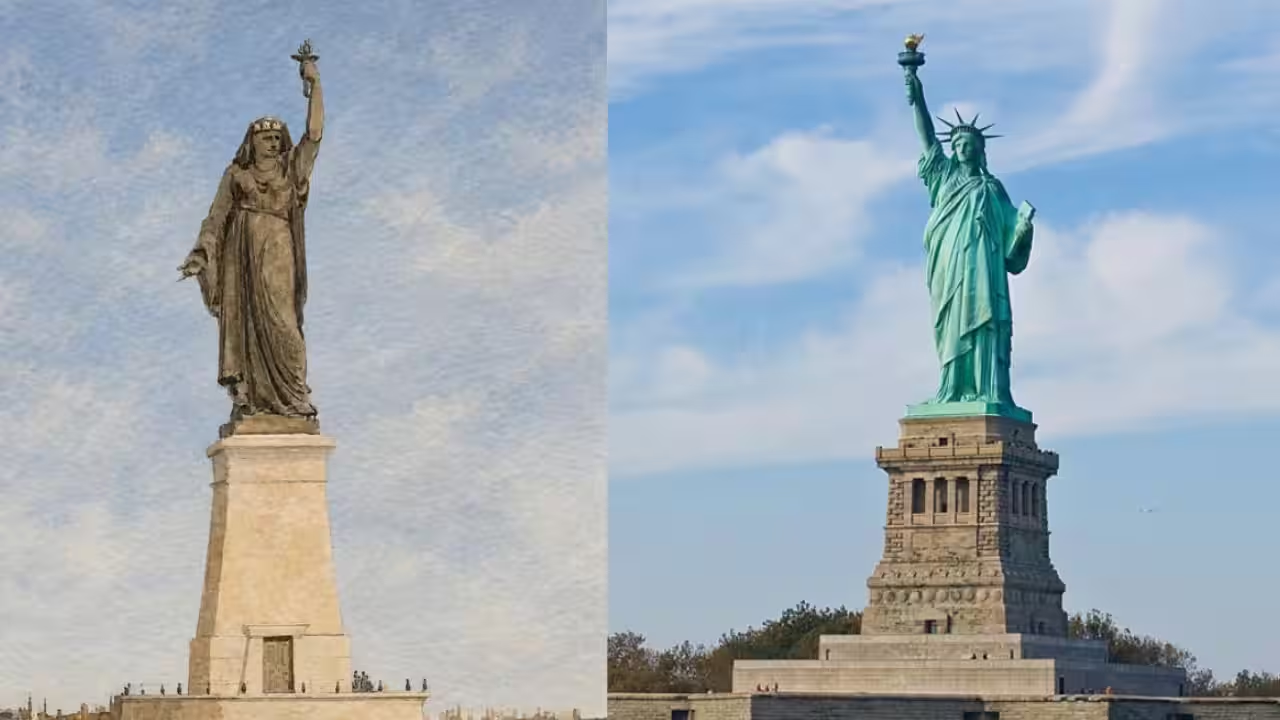
Most people know the Statue of Liberty from postcards, films, and holiday snaps. Few people know that her story may have begun in Egypt long before New York. Anthropologist Rebecca M. Joseph looked into the monument's early history in a National Park Service report. She found that the design almost certainly grew from an earlier idea. That idea was of a huge torch-bearing woman, which sculptor Auguste Bartholdi imagined as a lighthouse for Egypt’s Suez Canal in the 1860s.A young sculptor who loved big thingsFrédéric-Auguste Bartholdi was born in 1834 in Colmar, France. At the age of 20, he completed his first commission, which was a large bronze statue of a general. He also went to Egypt with a group of French cultural ambassadors. Their job was to photograph some ancient works. According to the National Park Service biography of Bartholdi, they found ruined cities in the desert, but the colossal statues were still standing there. This was what inspired the young artist. Joseph's report also recorded that he drew Egyptian women in 1856, and those sketches would matter later.The lighthouse that never roseBy the late 1860s, the French were building the Suez Canal under the oversight and funding of Egypt's ruler, Khedive Isma’il Pasha. Bartholdi had a meeting with him. He had brought a small figure of a giant lighthouse. It showed an Egyptian peasant woman, or fellah, carrying a torch high to guide ships. Bartholdi called it ‘Egypt (or Progress) Carrying the Light to Asia.’ The khedive turned the design down, and the project stalled. The lighthouse was never built, but the idea did not die there.A new chance in a new countryThe next opportunity came to Bartholdi through Édouard de Laboulaye, a scholar and an abolitionist. Laboulaye suggested the idea of a gift of friendship from France to America. But then war got in the way. During the Franco-Prussian War, Bartholdi led a local regiment to defend his hometown. France lost, and Germany occupied Colmar. He then sailed to America. Soon after arriving in New York Harbour in June 1871, Bartholdi settled on his preferred spot on Bedloe’s Island in New York Harbour. Joseph's report suggested that the statue idea went back to 1870 or 1871. It called the 1865 dinner party story a legend.How much of Egypt is in Lady Liberty?The statue's design, Joseph noted, almost certainly came from Bartholdi’s Egyptian idea. From that earlier plan, he had used his drawings of Egyptian women as models. A note from the park service added that scholars had named the same link. These are both tall women holding a torch high, and both were meant for busy waterways. Certain details did change. The report says Bartholdi replaced a broken shackle and chain in the statue's left hand with tablets marked 4 July 1776. This was what Laboulaye had asked for. The change signalled a message of liberty for all people.A strong link, not a copyThe report used careful words like “almost certainly.” The park service also states that the document’s release didn't mean it endorsed every conclusion in it. The report also tested a popular rumour that Liberty was supposed to be a black woman. However, no evidence was found that Laboulaye or Bartholdi meant that. So the Egyptian connection is a strong one, but it is a connection of designs. It doesn't mean that the statue was copied. The Suez plan may have been a dry run for Bartholdi to imagine a giant woman holding a torch, even though nobody paid for it. The completed statue was assembled in Paris, then disassembled and shipped to America. It was dedicated in 1886 in New York. Today, the Suez design is seen as part of how the Statue of Liberty took shape.You use AI every day. Now get your AI Quotient. Take the AIQ test.
Topics in this story
Gathered from external sources. Rights to this text belong to whoever originally published it.