Germany, South Korea enhance strategic, security ties against backdrop of China-Russia-North Korea collusive threat
SEOUL: Ahead of the 19th Asia-Pacific Conference of German Business here in the South Korean capital, German Chancellor Friedrich Merz held a summit with
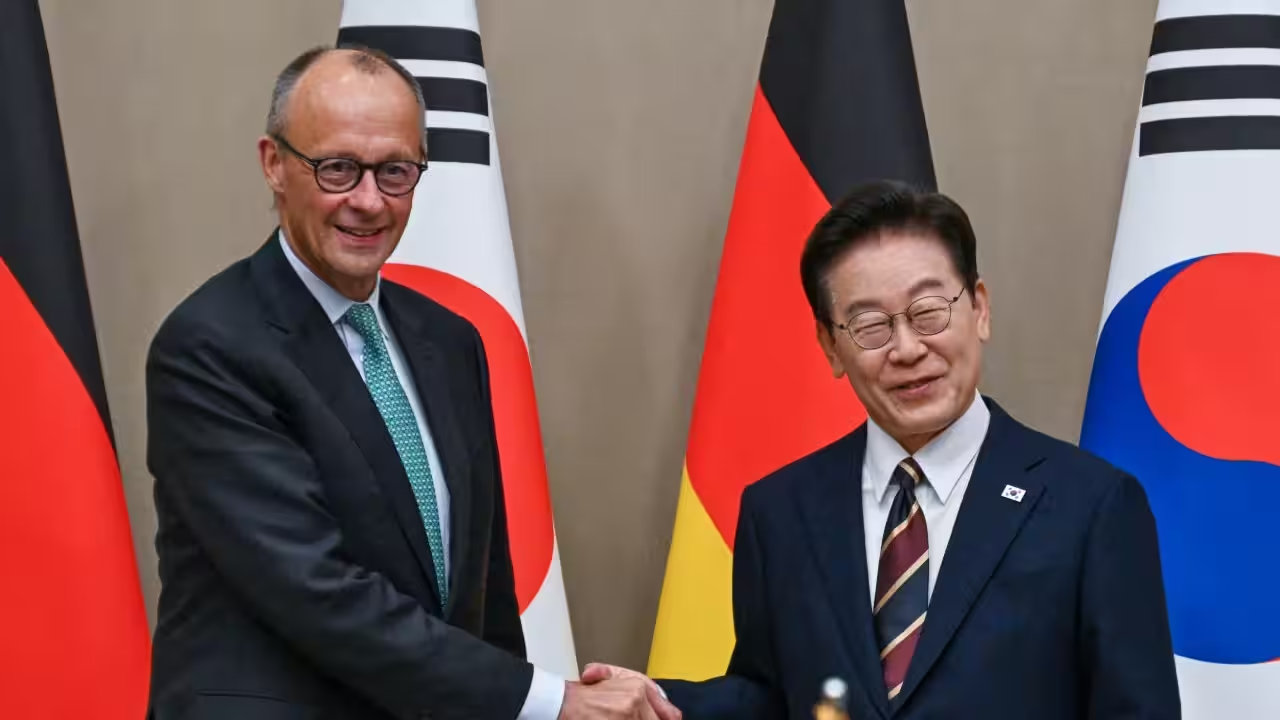
SEOUL: Ahead of the 19th Asia-Pacific Conference of German Business here in the South Korean capital, German Chancellor Friedrich Merz held a summit with South Korea’s President Lee Jae-myung, setting out a roadmap for an enhanced security partnership and raising their overall bilateral relationship to an Enhanced Strategic Partnership.Both sides agreed to deepen their ties in security and defence through regular military exchanges, training cooperation, and to conclude a bilateral agreement on the protection of classified military information. President Lee also expressed the interest of Korean defence companies in forming long-term partnerships with Germany, including through joint ventures and joint development projects.The summit and the Asia-Pacific Conference comes against the backdrop of Russia’s full-scale war against Ukraine that has seen more than 10,000 North Korean soldiers participate in that war on Russia’s behalf. This has raised serious concerns in Seoul that North Korean soldiers have gained high-tech battlefield experience that could now be deployed by Pyongyang on the Korean Peninsula.Meanwhile, China’s domination of global supply chains has allowed Beijing to provide industrial support to Russia and help it evade sanctions, thereby keeping Moscow’s war machinery going. Chancellor Merz, who has been on a week-long tour of East Asia with stopovers in Singapore and Japan, has been critical of this China-Russia collusion. In Singapore, Merz demanded that Beijing use its influence over Moscow to ensure a just peace in Ukraine, and called for strengthening economic relations between Europe and the Indo-Pacific region to reduce one-sided dependence on China.The wars in Ukraine and Iran, and China’s fingerprints on both conflict theatres, have sharply brought home the point that Europe’s economic and security interests are intertwined with that of Asia’s. And it is this reality that is compelling German businesses, as represented in the Asia-Pacific Conference, to look for resilient supply chains, non-hegemonic partnerships in critical technologies like AI, semiconductors and batteries, and cultivate suitable leverage against China’s weaponisation of its industrial domination.You use AI every day. Now get your AI Quotient. Take the AIQ test.
Topics in this story
Gathered from external sources. Rights to this text belong to whoever originally published it.