From Gillian Anderson to Simone Biles, stars are asking fans for space. Has 'parasocial' become the internet's catchall insult for fan behavior?
Celebrities are increasingly calling out fans who cross the line. But experts say 'parasocial' doesn't necessarily mean what the internet thinks it does.
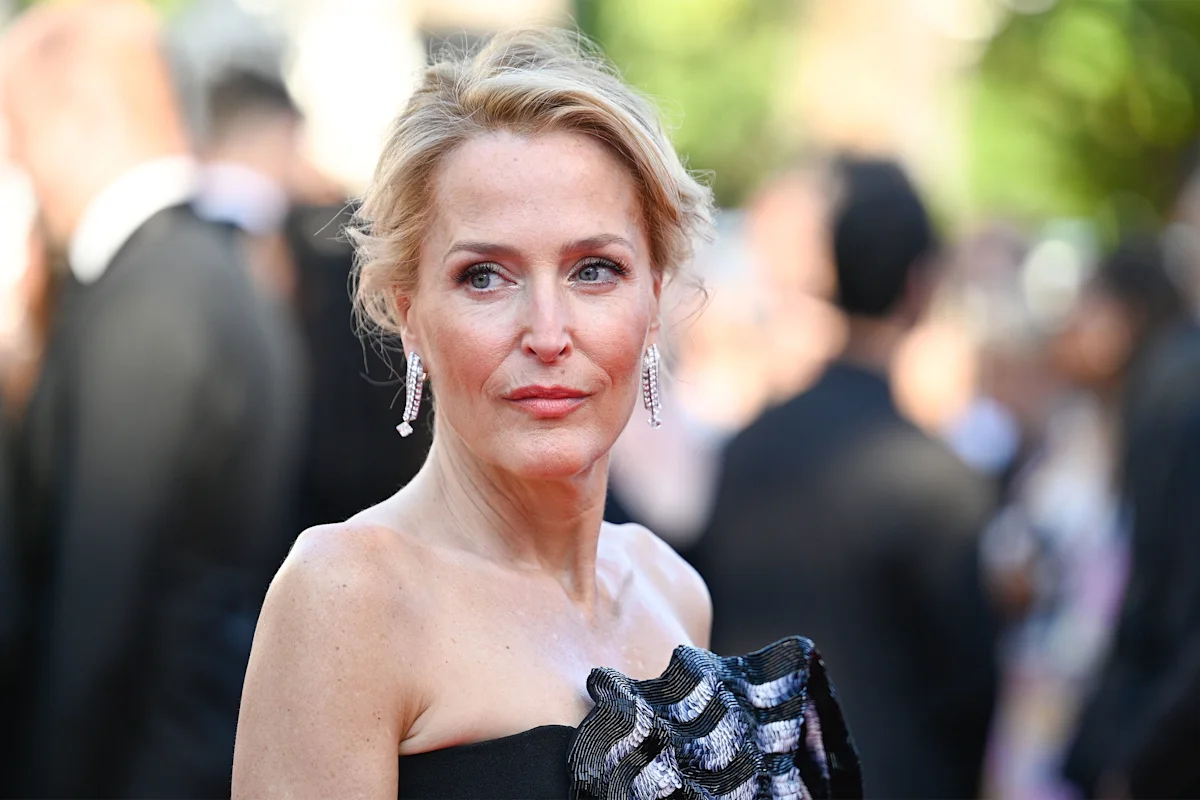
Last week, actor Gillian Anderson was filmed at a West End theater stage door asking some of her longtime fans to sit elsewhere during her performances of Who's Afraid of Virginia Woolf? , telling them they couldn't attend "20 times and sit in the front row" because their presence was "so distracting."
The exchange quickly went viral, with some viewers describing the fans' behavior as "parasocial" and accusing them of crossing a boundary. "Some of you are so parasocial with this gillian play you're actually turning into real life STALKERS like no it is not normal to go to a play and wait for the celebrity outside for 36297 nights in a row!!!! It gets to a point you guys have no boundaries," one person wrote on X .
Anderson, however, soon complicated that characterization. She defended the fans and explained that she had known them for more than 20 years.
"The video doing the rounds is me talking with women i go back over 20 years with - so please don't say anything negative to or about them," she wrote in a note shared to X .
"We're thrilled to be doing this show but for people in the front row, please be aware that in such an intimate venue we can all see you and sometimes, it can be a tad distracting! That's all."
Anderson's exchange is one of several recent celebrity-fan encounters that have reignited questions about where the boundaries of fandom should lie. The Pitt actor Isa Briones asked fans to stop shouting references to her television character while she was performing on Broadway. Simone Biles asked fans to show her "love from afar" after people repeatedly photographed her while she was traveling. Heated Rivalry actor Hudson Williams confronted autograph seekers who had followed him to his temporary residence in Paris in August, telling them, "You guys aren't fans. You're being really creepy."
While the fans' behavior in these encounters was markedly different, the same word has repeatedly surfaced in discussions about fans overstepping boundaries: "parasocial."
Once a relatively obscure academic term for the one-sided relationships audiences form with media figures, "parasocial" has become part of the internet's everyday vocabulary — and, increasingly, an accusation.
The concept of "parasocial interaction" dates back to 1956, when American sociologists Donald Horton and R. Richard Wohl coined the term to describe the apparent face-to-face relationship audiences could experience with media personalities, especially those who spoke directly to the camera, according to Merriam-Webster .
The word has since moved out of academia and into widespread use, a shift Merriam-Webster recognized when it added "parasocial" to its dictionary in 2026.
"In its origins, the term simply means that a relationship is mediated: you aren't engaging with someone directly but are relating to them and feeling like you know them (in whatever sense) in a one-sided way through the media," Mel Stanfill, a professor who studies fandom and digital culture, told Yahoo.
But as the term has entered everyday language, Stanfill said, it has taken on a more judgmental meaning.
"Now it's used to describe intense fandom, but specifically intense fandom that people disapprove of and want to frame as inappropriate."
That shift mirrors what has happened to other terms that originated in academic contexts before they became words repurposed on the internet, Stanfill said.
"This is in the same way pop psychology language generally is distorted from what it meant in its original context," they said. "This is a term that has escaped academic language and become something people throw around, like 'triggered' or 'gaslighting' and the other clinical words that have entered everyday speech in recent years."
Social media hasn't just made celebrities more accessible to fans; it has also changed what celebrities are expected to share about themselves.
"There is now an expectation of self-promotion and self-branding through social media, a kind of manufactured intimacy that is simply part of being a star," Stanfill said.
That intimacy is different from the publicity that has long surrounded famous people, Stanfill said, because it is both "always-on" and something celebrities are increasingly expected to manage themselves, whether personally or through their teams.
"When celebrities don't participate in it, they're often seen as shady or as hiding something," they said. "That supercharges the sense of intimacy fans have always had in these parasocial relationships."
At the same time, social media may have made it harder to distinguish between knowing someone and simply knowing about them.
"I think what modern social media has done (in part) is to blur the boundaries we are able to perceive between ourselves and strangers (not just celebrities)," Gayle S. Stever, an academic and coauthor of Parasocial Experiences , told Yahoo.
That doesn't necessarily mean fans have become worse at respecting those boundaries. "The largest percentage of fans I have observed and talked to and interviewed respect boundaries and are annoyed with the fans who don't," Stever said.
The people who do overstep, however, are also more likely to attract attention.
"Of course, the fans who repeatedly come on the radar of a Gillian Anderson are most often the ones who don't respect boundaries," Stever said. "But that can be true in any social situation. We just notice this one more because these people are famous and thus more reported on."
She compared it to encountering a coworker or acquaintance who doesn't respect personal boundaries. "This is an unfortunate but common part of social life in general."
For Stanfill, the tension is partly the product of stars being encouraged to cultivate intimacy with their audiences.
"I don't want to blame celebrities for the responses they get by any stretch of the imagination, but it is something of a perfect storm," they said. "The realities of promotional culture and the realities of fan culture at this moment are colliding to produce an often-harmful set of interactions."
Who decides when fandom has gone too far?
While feeling a strong connection to a celebrity isn't unhealthy, the harder question is where ordinary fandom ends and problematic behavior begins.
Stanfill believes "the problem is the behavior, not the feeling behind it."
"As with gambling or other compulsive behaviors, fandom becomes a problem when it causes problems for somebody's work, school, sleep, finances, etc., when it causes problems in their life and is no longer just recreation. It's also a problem when it harms other people, whether other fans or the celebrity," the academic explained.
However, there are no "hard and fast rules" for determining where that line falls. While some examples are clearly unacceptable, there is a gray area in what is acceptable from one celebrity to another.
"It is deeply contextual, and that's what makes this so difficult," Stanfill said. "It's why boundary-drawing and separating one kind of fandom from the other are so hard."
There is another complication in Anderson's case: If her relationship with these particular fans is reciprocal, Stever said, it may not be parasocial at all.
Parasocial relationships are, by definition, "non-reciprocated," Stever said. Once a fan and celebrity actually develop a reciprocal relationship, she said, it no longer fits that definition.
The debate surrounding Anderson also prompted some of her other fans to scrutinize their own behavior.
One fan, who said they had visited Anderson's stage door three times in a week despite attending the show only once, resurfaced an earlier message in which they acknowledged that they were "not entitled to a stage door experience" and described deliberately trying not to draw attention to herself.
"While this doesnt exonerate me from being a part of the crowd, i want it to be clear i've always been respectful and tried to keep myself small," they wrote on X after the Anderson video circulated.
Now, the word parasocial does more than describe the relationship between a fan and a celebrity. The loaded term has given fans a new vocabulary through which to judge themselves — and each other.
Topics in this story
Gathered from external sources. Rights to this text belong to whoever originally published it.