Paul McCartney joins over 500 public figures calling for an end to trophy hunting of lions, elephants and endangered rhinos
Paul McCartney is among hundreds of public figures backing a new international campaign calling on the United Nations to abolish trophy hunting.
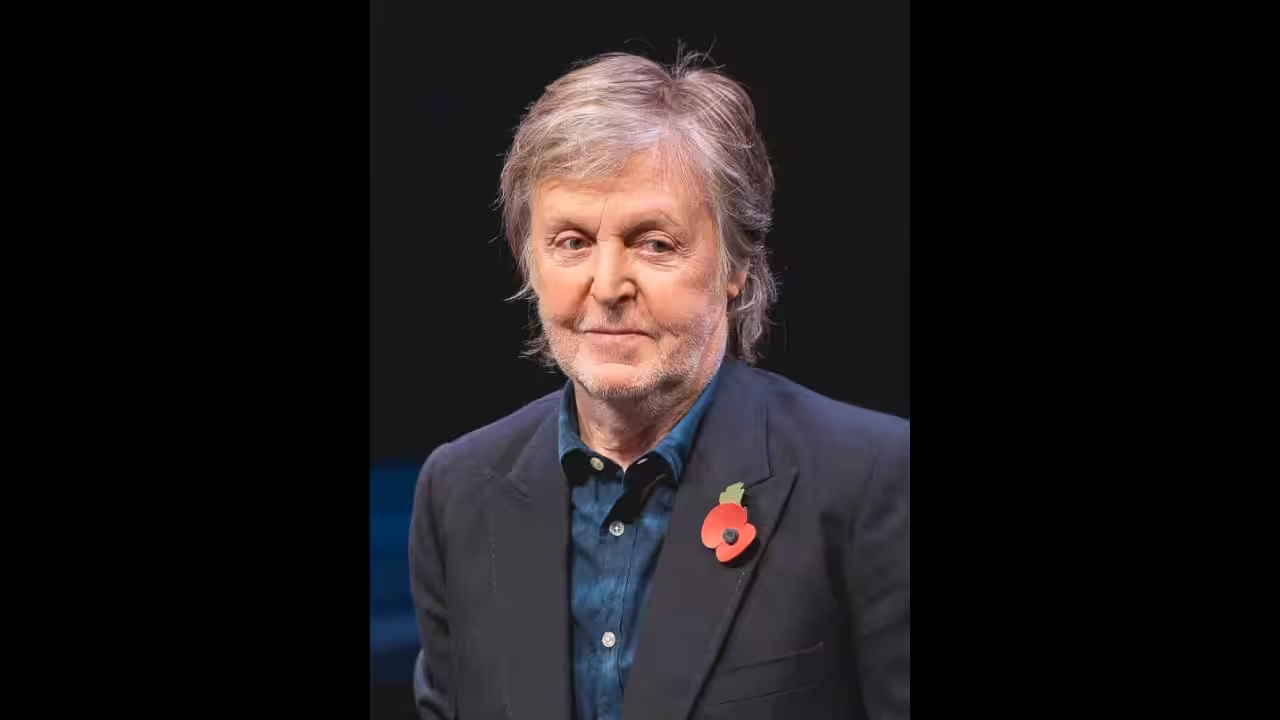
Paul McCartney is among hundreds of public figures backing a new international campaign calling on the United Nations to abolish trophy hunting. Launched on July 1, 2026, the initiative brings together celebrities, conservationists, former heads of state, Indigenous leaders and religious figures around a declaration calling for an end to trophy hunting. The launch was timed to coincide with the 11th anniversary of the killing of Cecil the lion in Zimbabwe, whose death in 2015 became a major international flashpoint in the debate over trophy hunting. The Wildlife & Conservation Foundation, through its Campaign to Ban Trophy Hunting, is coordinating the initiative. Its organisers say more than 500 founding signatories have backed the Declaration on the Abolition of Trophy Hunting, which was developed with the late primatologist and conservationist Jane Goodall.Paul McCartney is among a long list of celebrity backersMcCartney is joined by a large group of actors, musicians and other public figures. The campaign's launch announcement names Michael Caine, Emma Thompson, Hugh Laurie, Judi Dench, Joanna Lumley, Hilary Swank, Bryan Adams, Annie Lennox, Liam Gallagher and Gary Lineker among its supporters. Jenson Button, Ricky Gervais, Pierce Brosnan, Alec Baldwin, Mark Ruffalo, Kim Basinger, Daryl Hannah, Brian Cox, Michael Palin, Alan Cumming, Kate Moss and Bianca Jagger are also listed. Other prominent names include the Dalai Lama, Priscilla Presley, Edie Falco, Bill Maher, Isabella Rossellini, James Cromwell, Alicia Silverstone, Alyssa Milano, Heather Mills, Belinda Carlisle and Ranulph Fiennes. The campaign also lists former Mexican President Ernesto Zedillo and former Botswana President Ian Khama among its supporters. The coalition extends beyond celebrities. Its supporters include conservationists, African community representatives, Indigenous leaders and religious figures. The campaign's declaration calls for governments to prohibit trophy hunting as well as the international import and export of hunting trophies, with the longer-term aim of securing a global agreement to abolish the practice.Organisers say tens of thousands of animals are killed for trophiesThe campaign's accompanying report argues that trophy hunting continues to affect a wide range of wild animals. It identifies bears, monkeys and elephants as the most frequently hunted animals in its analysis, while also highlighting giraffes, lions, hippopotamuses and leopards. The report says critically endangered black rhinoceroses are among the species that continue to be targeted. The Jane Goodall Institute has endorsed the campaign and has repeated some of its headline figures. It says there are approximately 20,000 lions remaining in the wild and that 10,000 lions have been shot since Cecil was killed in 2015. Those figures are campaign-backed estimates rather than figures that should be presented as an independently established global census.The campaign's report also focuses heavily on the role of international trade. It says hunters from 12 countries account for 90% of trophy trade activity, with the United States at the top of the table. A separate campaign-linked report published in July 2026 gives another way of illustrating the US role. It says the United States recorded 18,249 imports from protected species, representing 57% of the global trade covered by that analysis. Because this figure concerns US imports of protected-species trophies, while the 90% figure refers to the combined share attributed to hunters from 12 countries, the two statistics describe different measures rather than necessarily contradicting one another.The campaign has put Cecil the lion at the centre of its messageCecil's killing remains central to the campaign's identity. In July 2015, American dentist Walter Palmer killed the lion in Zimbabwe after paying to hunt him. The incident generated international outrage and brought renewed attention to the international trophy trade. The new campaign was deliberately launched around the anniversary of Cecil's death. Its organisers argue that the decade since the killing has demonstrated the need for governments to move beyond individual hunting restrictions and towards an international prohibition on trophy hunting. The campaign also highlights the United States because of its role as a major importer of hunting trophies. Its July 2026 report says US imports alone accounted for 57% of the protected-species trophy trade examined in its analysis, while identifying the country as the world's largest importer.Jane Goodall helped shape the declaration before her deathGoodall was involved in the campaign before her death, but she was not present for its 2026 launch. The Jane Goodall Institute says the initiative grew from an event held in 2025 to mark the 10th anniversary of Cecil's killing. At that event, Goodall spoke against trophy hunting and described the practice as unconscionable. Goodall died on October 1, 2025, aged 91. According to the campaign and the Jane Goodall Institute, Eduardo Gonçalves, founder of the Wildlife & Conservation Foundation and Campaign to Ban Trophy Hunting, worked with Goodall on the Declaration on the Abolition of Trophy Hunting before her death. The Jane Goodall Institute has subsequently endorsed the declaration and said it is committed to continuing Goodall's work in her name. The July 2026 launch therefore represents a continuation of an initiative she helped shape, rather than a campaign she personally launched.The coalition is calling for a global banThe declaration goes beyond calls for individual countries to restrict hunting. The campaign is asking governments and the United Nations to work towards a comprehensive international agreement abolishing trophy hunting and restricting the international trade in hunting trophies. The campaign's supporters span entertainment, conservation, politics and Indigenous communities, giving the initiative a considerably broader public profile than a conventional wildlife advocacy campaign. Whether its call for a global prohibition gains support from governments and international institutions remains to be seen, but the July 2026 launch has placed trophy hunting back at the centre of an international campaign built around Cecil the lion and Goodall's conservation legacy.You use AI every day. Now get your AI Quotient. Take the AIQ test.
Topics in this story
Gathered from external sources. Rights to this text belong to whoever originally published it.