Drilling for water on his Texas farm, Fritz Fuchs hit oil at 300 feet; a deeper test followed, and leases paid $84,000 in cash plus a 1/6 royalty on 482 acres
Discover how Fritz Fuchs' search for water on his Texas farm led to an unexpected oil boom that transformed a small town and created economic opportunities for struggling farmers in 1915.
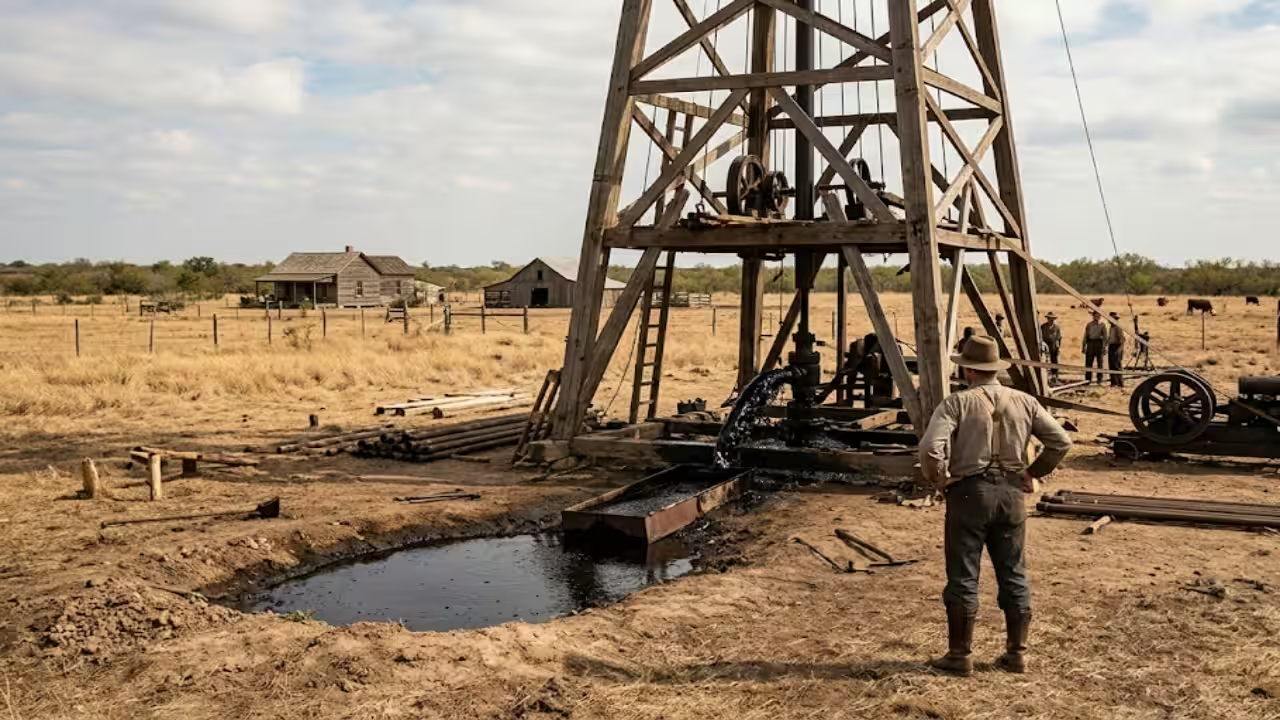
Williamson County farmers were considering water rather than oil in 1914. The area had been dried by a drought; the local economy relied heavily on cotton and livestock, with about 150 people living in the little town of Thrall, which was located on the railway some six miles east of Taylor. An excellent well becomes a farm's most important asset when the rain stops. Based on this, farmer Fritz Fuchs chose to drill for water in the southwest corner of his 100-acre farm. In a 1921 article in the AAPG Bulletin, he stated he found little or no water but abundant oil in the well at a depth of 300 feet. That little surprise changed the fortunes of the town and, for a few frenetic years, much of the county around it.From water well to discovery wellA water well that produces oil might look like a disappointment today but an opportunity tomorrow. By early February 1915, preparations had been made to drill deeper, and on 22 February, the discovery well was in. Williamson County's history describes the discovery well as possibly the first drilled in the Serpentine formation. It was on the Fuchs property about a mile south of town. Read Williamson County's history of Thrall. Nobody had set out to find oil on that farm. The drill was meant to solve a farming problem, and the same hole that disappointed its owner on the water question ended up answering a much bigger one.Cash rented by farmersOnce oil was discovered, farmers struggling through the 1914 drought could lease land for cash. A contemporary account reported that Fritz Fuchs received $84,400 for a lease covering 482 acres, along with a one-sixth royalty on oil and gas produced. Read the archived contemporary account of the lease. This was a favourable arrangement because a one-sixth royalty gave the landowner a larger share than the one-eighth royalty common in many oil leases. The original discovery well, however, is described in another account as being on a 100-acre farm. The available records do not fully explain the relationship between that farm and the later lease covering 482 acres, so the two figures should not be treated as the same parcel.The 1915 discovery attracted oil operators and other visitors to the field. Williamson County's history names Alf Landon, who later became the Republican presidential nominee in 1936, among those who visited, alongside Harry J. Sinclair, who founded the Sinclair Petroleum Corporation, and J. L. Lattimer, who later became president of Magnolia Petroleum. The historical account does not give a precise date for each visit, so Landon's later political role should not be mistaken for a position he held during the 1915 discovery.University geologists later studied the field. Halbert P. Bybee worked for the University of Texas Bureau of Economic Geology during the summers of 1915 and 1916. In 1916, J. A. Udden and H. P. Bybee published The Thrall Oil Field, a Bureau bulletin documenting the geology of the field and the oil-bearing formations associated with the discovery.A boom that went bustThe boom dramatically changed Thrall. The town had about 150 residents in 1914 and grew to as many as 3,000 during the oil rush before its population fell to 272 by 1920. About 200 wells were drilled in the area, and the first hundred were described as gushers. Williamson County's history records that the field proved shallow and that most wells had failed by 1940, although a few were still producing modest amounts in 1973.Lease bonuses provided landowners with cash up front, while later income depended on how long the wells continued producing. A separate surge of activity took place near Thrall in 1930, when a well on the J. C. Abbott property brought renewed drilling interest. Williamson County's history says crowds in Taylor doubled and more than 1,500 leases were signed in less than three days during that later surge. Those lease signings should not be attributed to the initial 1915 discovery.In 1914, Fritz Fuchs set out to find water on his farm and instead encountered oil, helping trigger one of Texas's early oil booms. The discovery brought lease income to farmers struggling with drought and attracted oil operators and geologists to Williamson County. The boom eventually faded, but the discovery remains a defining part of Thrall's history.You use AI every day. Now get your AI Quotient. Take the AIQ test.
Topics in this story
Gathered from external sources. Rights to this text belong to whoever originally published it.