Senate adjourns until November with Republicans fearful of losing majority
The Senate adjourned for the midterm election on Wednesday night despite having a big pile of unfinished business on its plate, as vulnerable Republicans were ready to get back to their home states to campaign amid growing fears that they may lose their majority in the upper chamber. Senators adjourned after voting to confirm Keith…
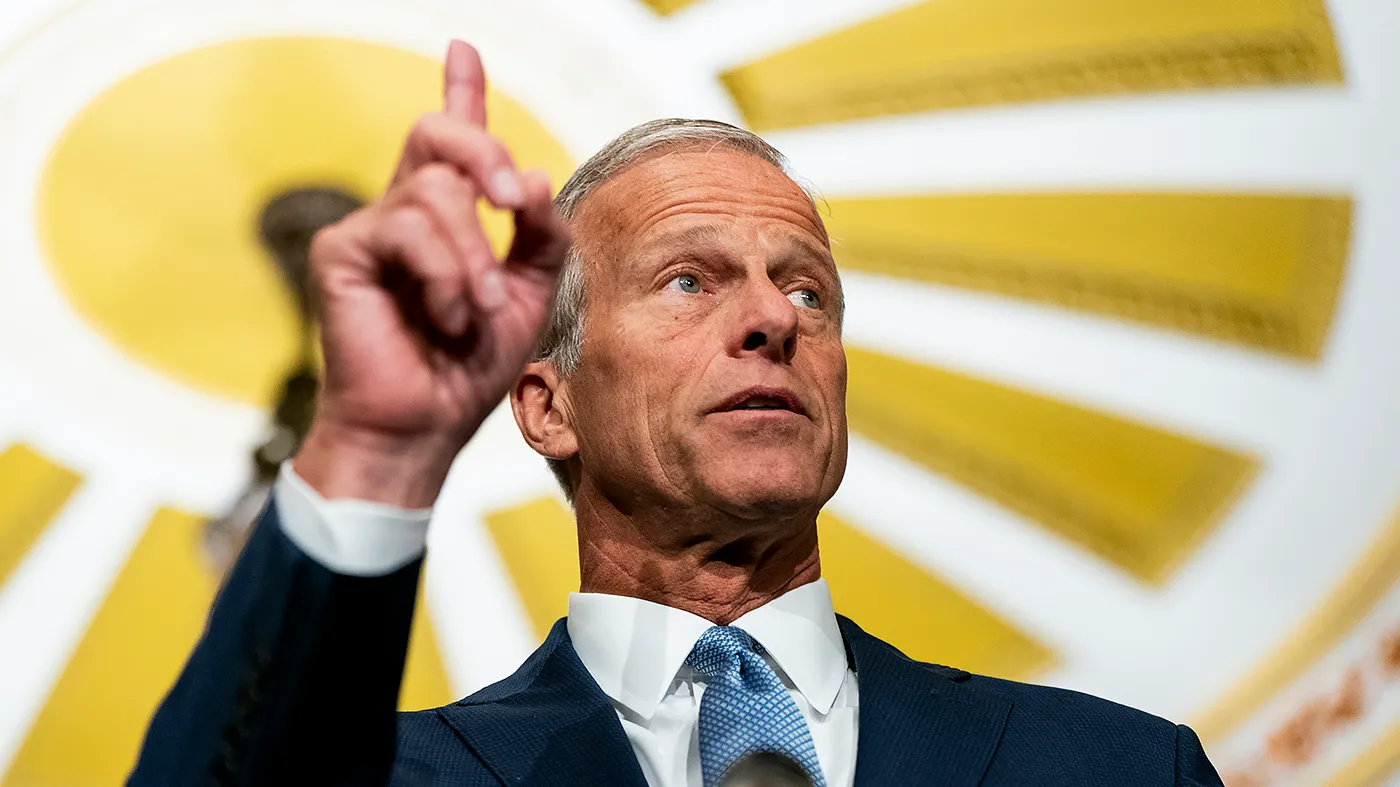
The Senate adjourned for the midterm election on Wednesday night despite having a big pile of unfinished business on its plate, as vulnerable Republicans were ready to get back to their home states to campaign amid growing fears that they may lose their majority in the upper chamber.
Senators adjourned after voting to confirm Keith Sonderling, President Trump’s nominee to serve as secretary of the Labor Department.
They left Washington without acting on three Congressional Review Act resolutions to waive California regulations that some Republicans wanted to pass before the extended recess.
Senators aren’t scheduled to return to the Capitol until the week of Nov. 9, leaving many top priorities in limbo until after the Nov. 3 election.
Those priorities include permitting reform, the annual defense authorization bill, the extension of expired surveillance authorities under the Foreign Intelligence Surveillance Act (FISA) and other high-profile items.
“It breaks my heart. It’s bad planning. We should have started after we passed One Big Beautiful Bill [in July of last year], planning what we wanted to do and how we were going to get it done,” Sen. John Kennedy (R-La.) said of the Senate adjourning.
Kennedy also warned the failure to finish up the Congressional Review Act resolutions on California-related regulatory waivers would add to the logjam in November and December.
But vulnerable Republican senators, such as Sens. Dan Sullivan (Alaska), Roger Marshall (Kan.) and Pete Ricketts (Neb.), are eager to get back on the campaign trail.
So is Republican Sen. Susan Collins (Maine), another top Democratic target, who was hoping to get a vote on her bipartisan bill to cap the monthly out-of-pocket cost of insulin at $35 before the election.
Collins acknowledged she had a busy month of campaigning in Maine ahead of her as she left the Capitol late Wednesday.
Senate Majority Leader John Thune (R-S.D.) has made it clear that he thinks his GOP colleagues can help themselves by getting back to their home states as soon as possible to make the argument to voters that they deserve six more years in Washington.
On the Democratic side, Sen. Jon Ossoff (D) has a competitive race in Georgia, though strategists in both parties think he’s pulling away from the Republican challenger, Rep. Mike Collins.
“I think everybody’s nervous about their races,” Kennedy said. “It’s a weird year. I don’t know how these things are going to turn out.”
“I’ve done polling in my own state, and it’s a pretty red state, but people all across the political spectrum are very unsettled,” he added.
An Emerson College Polling survey released last week showed Democrats with an 11-point lead on the generic congressional ballot. The survey of 1,000 likely voters conducted from Sept. 21-22 showed Democrats with 53 percent support and Republicans with 42 percent support.
Kennedy noted it was a struggle to convince GOP leaders just to bring senators back to Washington this week to vote on two bills sponsored by Sen. Jon Husted (R-Ohio) and Ricketts — the Ratepayer Protection Act and the Stop Insider Trading Act, respectively.
“We had to raise fresh hell just to get a vote on Sen. Husted’s bill,” Kennedy said.
Husted’s bill would ask states to consider new standards to shield taxpayers from paying the costs of upgrading energy and water infrastructure to accommodate data centers while Ricketts’s bill would have banned members of Congress from buying new publicly traded stocks.
Democrats blocked both measures by party-line votes on Wednesday.
When the Senate reconvenes in November, Republicans plan to tee up a vote on a permitting reform deal announced by Senate Energy and Natural Resources Committee Chair Mike Lee (R-Utah) and Sen. Sheldon Whitehouse (D-R.I.).
Senators could have stayed in town to finish drafting the deal and possibly voted on it in October.
That may have allowed them to tout a major accomplishment to constituents, but they decided the next few weeks would be better spent talking to voters at home.
Sen. Thom Tillis (R-N.C.) said senators in tough races wanted to get out of town as soon as possible with Election Day fast approaching.
“I think we’ll have a net loss. I think it’s unlikely we’d have the same numbers. The margins will be thinner,” he said.
He predicted that Senate Republican losses will be “manageable” if “we let candidates execute down the stretch.”
Tillis warned that keeping vulnerable incumbent senators in Washington comes at a high political cost.
“Every time you’re here, it’s a fundraiser you can’t host or it’s a town hall you can’t speak at. We need to get them back in the state. Invariably, the people who want to stick here, they all have one thing in common: They’re not up [for reelection] this cycle,” he said.
Republicans say that getting through the pile of unfinished work awaiting them in November and December will be a daunting task. After planned votes on the permitting reform bill, there’s little consensus on what comes next.
Senate Agriculture Committee Chair John Boozman (R-Ark.) is pushing for the Senate to finish the long-stalled farm bill before Christmas.
“The majority leader is one of our most active members on the committee, and he’s committed to getting it done,” Boozman said of the farm bill. “The farm bill’s a priority.”
Meanwhile, Senate Armed Services Committee Chair Roger Wicker (R-Miss.) wants to make both the annual National Defense Authorization Act and an emergency supplemental defense spending package top priorities.
The leaders of the Senate Intelligence Committee want to take up legislation extending the expanded surveillance authorities under Section 702 of FISA that lapsed in June.
Also in the mix are the 12 annual appropriations bills.
Government funding is due to expire on Dec. 11. That sets up a high-stakes negotiation to avoid another government shutdown after Thanksgiving.
Senate Budget Committee Chair Ron Johnson (R-Wis.) is pushing for a marathon series of votes on a budget resolution in the lame-duck to unlock the process for moving a third budget reconciliation package.
“That’s where I’ll be working at,” he said.
Johnson said he’s worked closely with House Budget Committee Chair Jodey Arrington (R-Texas) to lay the groundwork for moving a budget reconciliation package after the election.
Debating and voting on the preliminary budget resolution and then tackling a follow-up reconciliation package could easily consume a couple weeks of the Senate’s schedule.
Some Republicans may also insist on voting on the three Congressional Review Act resolutions — which were tentatively on the agenda for this week — in November or December.
The impending traffic jam of priorities has Republicans skeptical about getting much done at all in the lame-duck session.
“It’s going to be our golden era,” Sen. John Cornyn (R-Texas) quipped when asked if Republicans were punting too many items into November and December.
The Senate is scheduled to be in regular session only eight days in November and 14 days in December — counting Fridays, which aren’t typically workdays in the upper chamber.
The Senate voted 53-47 along party lines Wednesday afternoon to advance Sonderling’s nomination to head the Labor Department. About 10 hours later, weary senators returned to the Capitol for a final confirmation vote on the nominee after Democrats agreed to shorten the debate time on the floor.
Sonderling was confirmed shortly before midnight by a vote of 47 to 41.
Republican and Democratic senators spent part of Wednesday evening battling over requests for unanimous consent to advance bipartisan bills.
Johnson objected to a request by Sens. Patty Murray (D-Wash.) and Jeff Merkley (D-Ore.) to pass a bill to eliminate pocket rescissions after the Trump administration advanced a request last week to cancel nearly $1 billion in funding already appropriated by Congress.
Sen. Rand Paul (R-Utah) objected to a request by Sens. Richard Blumenthal (D-Conn.) and Marsha Blackburn (R-Tenn.) to pass by unanimous consent the Kids Online Safety Act, which is designed to protect minors who use social media platforms.
Topics in this story
Gathered from external sources. Rights to this text belong to whoever originally published it.