GOP’s historic inroads with key voting blocs evaporate ahead of midterms
President Trump’s gains amongst Hispanic/Latino voters, Black voters and young men dominated headlines after his successful reelection in 2024 – offering a bright red warning sign for Democrats about some of the voting blocs they needed to gain ground with heading into 2026 and 2028. Trump’s historic inroads with these historically blue-leaning constituencies helped propel…
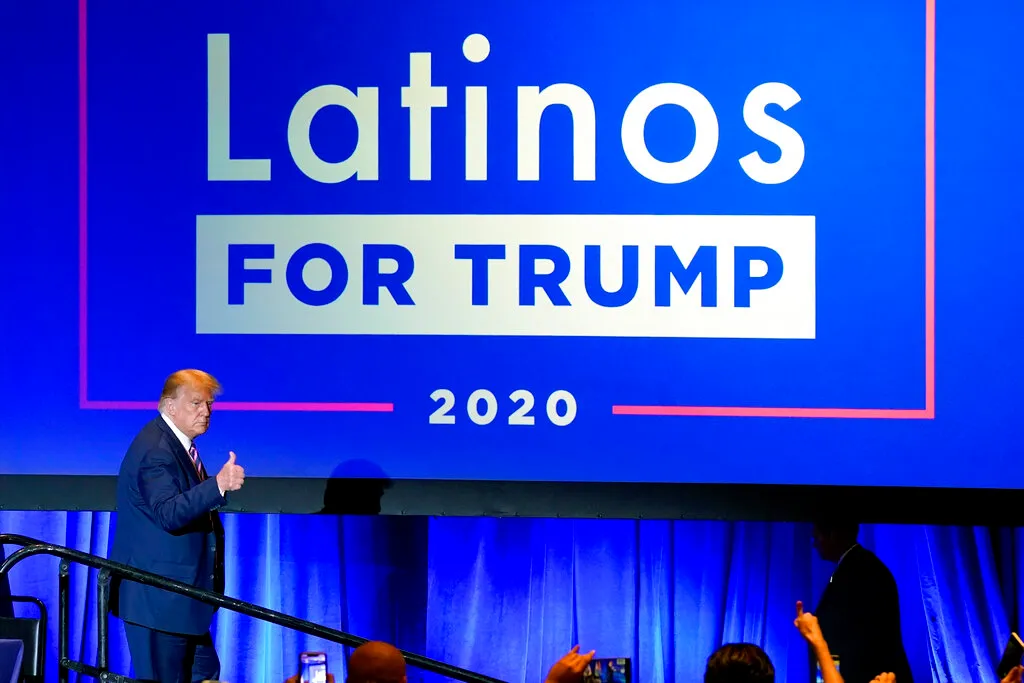
President Trump’s gains amongst Hispanic/Latino voters, Black voters and young men dominated headlines after his successful reelection in 2024 – offering a bright red warning sign for Democrats about some of the voting blocs they needed to gain ground with heading into 2026 and 2028.
Trump’s historic inroads with these historically blue-leaning constituencies helped propel him back to the White House, while former Vice President Harris underperformed in comparison to former President Biden’s 2020 numbers.
But those very voting blocs are now souring on the president and GOP amid increasingly high costs of living, a nagging war with Iran, a trade war with Canada and the administration’s immigration crackdown — complicating the GOP’s path to victory in the midterms.
“There’s no question that that Republicans and President Trump are not polling nearly as well among, say, Hispanics or younger people” as they were in 2024, said Geoffrey Skelley, chief elections analyst for Decision Desk HQ. “The economy is definitely the main driver.”
Voters “no longer view President Trump as a good steward of the economy, and therefore Republicans are also going to suffer for it too,” Skelley said. “At least, that seems to be the most likely outcome at this point.”
Hispanic voters, who make up roughly 16 percent of the national electorate, sided with Biden by a comfortable 25-point margin back in 2020, but that shrunk to a 3-point edge for Harris in 2024, according to Pew Research Center analysis.
Trump made big gains with both Hispanic men and women, according to Pew Research Center’s analysis. He won Hispanic men by 2 points in 2024 compared to Biden’s 18-point edge in 2020. And while Harris won Hispanic women by 6 points, it’s a far cry from the 32-point margin Biden had.
Experts on both sides of the aisle saw Trump’s promises to ease pocketbook pressures as the main driver behind the bloc’s rightward lurch last cycle. But this time around, several recent polls have signaled Hispanic or Latino voters are looking elsewhere for solutions.
A recent Cook Political Report/Televisa Univision survey found that 18 percent of Hispanic voters who supported Trump in 2024 disapprove of the job he’s doing. And in the latest Decision Desk HQ polling averages, Hispanic voters favor Democrats for Congress by 20 points on a generic ballot, up from margins of around 10 points at the start of last year.
That movement could be pivotal in Texas and Florida, the red states with the highest Hispanic populations, and where Republicans looked to the 2024 results when redrawing congressional maps in their favor.
Along with the economy, the administration’s controversial crackdown on immigration has also put Republicans’ standing with Hispanic voters on the rocks.
“The same Hispanics who helped you get to the White House in 2024 feel betrayed today,” Rep. Maria Elvira Salazar (R-Fla.) said in a recent campaign advertisement, alleging that Trump had gone “too far” with immigration enforcement.
“We saw early when that immigration — the deportation enforcement policy — seemed obviously to disproportionately impact the Hispanic community, and that immediately started driving down his numbers in that space, and now we’re seeing that vote breaking for the Democrats two to one,” explained Spencer Kimball, director of Emerson College Polling.
Trump also saw 2024 gains among Black voters, though the bloc is still overwhelmingly Democratic. He won 8 percent of the demographic in 2020, and that support nearly doubled to 15 percent when he won a second term.
That was driven largely by Black men – the demographic swung 21 points toward the GOP between 2020 and 2024, according to Pew Research Center. Meanwhile, there was only an 11-point swing toward Trump among Black women between the two election cycles.
In DDHQ’s averages, African Americans’ disapproval of the president was in the high sixties this summer, but that’s climbed to 75 percent in the latest numbers.
“This was already a group that was pretty, even if it had shifted toward Trump to some extent, it was still pretty, pretty overwhelmingly Democratic leaning, and so therefore was not inclined to approve of Trump to begin with, but it has worsened,” Skelley said.
“I think the real question mark surrounding black voters in this election is going to be in a lot of those southern states, in particular, where redistricting happened. And is there going to be some sort of reaction to that?”
Young voters, who narrowed from Biden’s 25-point advantage to favor Harris by just 4 points in 2024, are also now giving Trump low marks. A Yale Youth Poll conducted in March showed 27 percent of voters between 18 and 22 years old giving Trump a thumb’s up as president while 68 percent said they disapproved of his job.
Meanwhile, Trump held a 27-point approval rating with voters aged 23 to 29, with a higher 72 percent disapproval rating.
A Cygnal poll released last month , commissioned by The Lafayette Company, found 55 percent of young men between the ages of 18 and 30 had an unfavorable view of the president with just under half – 49 percent – feeling the same about GOP.
Alex Tarascio, principal and pollster at Cygnal, told The Hill much of that sentiment is being driven by cost of living, job security and money. Tarascio pointed to the poll’s findings, where 21 percent of young men ranked the most important issue to get right as earning enough money to cover their costs, followed by 17 percent saying mental health and 14 percent saying physical health.
Young men also ranked inflation and cost of living as the top issue again – at 29 percent — when asked about which issue would matter most in deciding how they voted. Housing affordability placed second at 14 percent and immigration in third place at almost 10 percent.
“So much of this age group is about milestones that you achieve,” Tarascio said. “It’s not necessarily about if you’ve made it to the mountaintop, but if you are on the way, if you’re on that pathway. And if you have a job that puts you on a career track, those men are doing much better.”
“It’s coming down to unmet promises,” echoed Jack Dozier, director of the Yale Youth Poll.
Since the 2024 election, there’s been “a detraction from that clear-cut economic agenda,” Dozier said, pointing to items like the White House’s ballroom construction and the administration’s intervention in foreign conflicts.
Meanwhile, Trump has also lost ground among groups that have long been solidly in his corner. In DDHQ’s averages, he’s now more than 14 points in the red among white voters, after spending most of last year above water.
The president has also lost ground broadly among those who voted for him 2024. Tarascio said his polling has shown that Trump has a favorability rating of 73 percent among self-identified ‘24 Trump voters. Meanwhile, ‘24 Harris voters unfavorability toward Trump sits higher at 88 percent.
The latest numbers are a promising sign for Democrats in the fight for control of Capitol Hill, but the big question is whether voters who are voicing their frustration with Trump in polls actually turn out for Democrats at the ballot box in November.
“Democrats are sort of the default other option, and some voters are not going to be willing to take it because partisanship is still strong, and if you tend to vote Republican, you’re going to probably vote Republican for the most part,” Skelley said.
But if there’s “enough erosion among Republican-leaning voters who actually turn out to vote,” coupled with strong turnout from Democrats “angry at the status quo,” Skelley said, “that can end up mattering at the margins.”
Welcome to The Hill’s On The Ballot. We’re Julia Mueller and Caroline Vakil — reach out to us on X ( @jmthewriter + @CarolineVakil) or via email ( jmueller@thehill.com + cvakil@thehill.com.)
The spending and fundraising from Elon Musk’s America PAC on our watch:
Elon Musk spent at least a quarter of a billion dollars supporting President Trump’s second White House bid in 2024 – a feat that paid off. But months later, he was dealt a blow in the 2025 Wisconsin Supreme Court race after his super PAC spent $12 million to support a conservative judicial candidate who ultimately lost to Justice Susan Crawford.
While the Tesla CEO signaled at one point that he might pull back his political spending ahead of the 2026 election, campaign filings have shown that Musk is deeply involved in this year’s midterms.
Musk’s super PAC, America PAC, has poured money into both battleground House races and competitive Senate elections. America PAC has so far spent $7.5 million on the Texas Senate race to boost Republican Ken Paxton and oppose Democrat James Talarico, according to a Tuesday campaign filing report.
America PAC has spent nearly $4 million each in heated Senate races in Ohio, between Sen. Jon Husted (R) and former Sen. Sherrod Brown (D), and in Michigan between Republican Mike Rogers and Democrat Abdul El-Sayed.
Meanwhile, Musk’s super PAC is eyeing a number of congressional matchups, most notably spending close to $275,000 in Virginia’s 2 nd Congressional District represented by GOP Rep. Jen Kiggans; more than $210,000 in Rep. Marie Gluesenkamp Perez’s (D-Wash) seat in Washington’s 3 rd Congressional District and over $200,000 in Texas’s 35 th Congressional District between Democrat Johnny Garcia and Republican Carlos De La Cruz.
Even in a favorable environment for Democrats, here are 10 blue seats the GOP is most likely to flip in November. The Hill’s Julia Mueller has more.
A number of Republicans have come out in support of Democratic candidates ahead of the November elections. The Hill’s Ryan J. Karlin has a look at the phenomenon.
Rep. Mike Lawler (R-N.Y.) trails Democratic opponent Cait Conley in New York’s 17th Congressional District by 2 points per a new Emerson College poll, The Hill’s Sarah Davis reports.
As the midterm cycle heats up, we’re asking folks in the elections space what they’re consuming on and off the campaign trail.
Rep. Kevin Kiley (I-Calif.) won his House seat in the 3 rd Congressional District as a Republican back in 2022 – but, after Democrat-friendly redistricting reshaped the state, he’s running as an independent for a third term on Capitol Hill.
Kiley left the Republican Party in March and has said he won’t caucus with Republicans if he wins his longshot bid this fall. He’ll face off in November against Democratic challenger Richard Pan for California’s new 6th Congressional District around, which Cook Political Report considers solidly Democratic.
What’s the last book you read? The Infinity Machine
What album or podcast do you have on repeat? Lex Fridman
What’s your go-to caffeine source? dark roast coffee with oat milk
What TV show are you watching right now? Dark Matter
What’s your go-to restaurant in your state? Fat’s
Lawler trails Conley in battleground New York House contest: Poll
Democratic candidate Cait Conley inched ahead of incumbent Rep. Mike Lawler (R) in New York’s 17th Congressional District House race, up two percentage points in polling results released Thursday.
The Emerson College and PIX 11 survey found around 48 percent of likely voters in the district supported Conley, while 46 percent backed the Republican lawmaker. The remaining respondents were still undecided less than five weeks out from the November election.
The Democrat’s lead notably fell within the poll’s almost 5 percent margin of error.
Thursday, Oct. 1: Trump attends midterm rally in Oklahoma
Friday, Oct. 2: Trump visits Alabama for midterm rally
Friday, Oct. 2: Kentucky Gov. Andy Beshear (D) heads to South Carolina for campaign stops with state party
Friday, Oct. 2: Maryland Gov. Wes Moore (D) campaigns for former Rep. Elaine Luria (D) in battleground Virginia race
Saturday, Oct. 3: Trump attends midterm rally in Ohio
Saturday, Oct. 3: Abdul El-Sayed & Sen. Elissa Slotkin (D) hold a town hall in Macomb County, Mich.
Monday, Oct. 5: Trump visits Nebraska for midterm rally
‘It’s not an issue’: Crime as a GOP line of attack loses traction ( The New York Times )
Democrats’ influencer era has arrived ( Politico )
The Brooklyn Democrats’ brawl is far from over ( New York Magazine )
Topics in this story
Gathered from external sources. Rights to this text belong to whoever originally published it.