When bureaucracy kills: When will our government act to keep women safe?
Women are 17 percent more likely to be killed than men in car accidents, and 73 percent more likely to be seriously injured.
In 2019, my family suffered a head-on collision with a wrong-way driver, when he tried to pass a motorcycle up a hill and smashed his Ford F-150 truck head-on into our car. The crash left my husband and son with a few broken bones, while my daughter and I were gravely injured.
Our seatbelts tore through our abdomens and into our internal organs. My head slammed into my airbag with enough force to cause a traumatic brain injury. Why had my son and husband been protected by their seatbelts and airbags while the same safety devices almost killed me and my daughter?
Soon after the car crash, a story from Consumer Reports sent me on a journey to better understand what had happened. I discovered our injuries weren’t random: women are 17 percent more likely to be killed than men, and 73 percent more likely to be seriously injured .
At the time, I worked for a think tank advocating the use of data and design to solve public problems, a practice we called “public interest technology.” I earned a living telling people the government was capable of solving hard problems, so I assumed, given my connections, I could help save women’s lives. Especially because a well-engineered solution already existed.
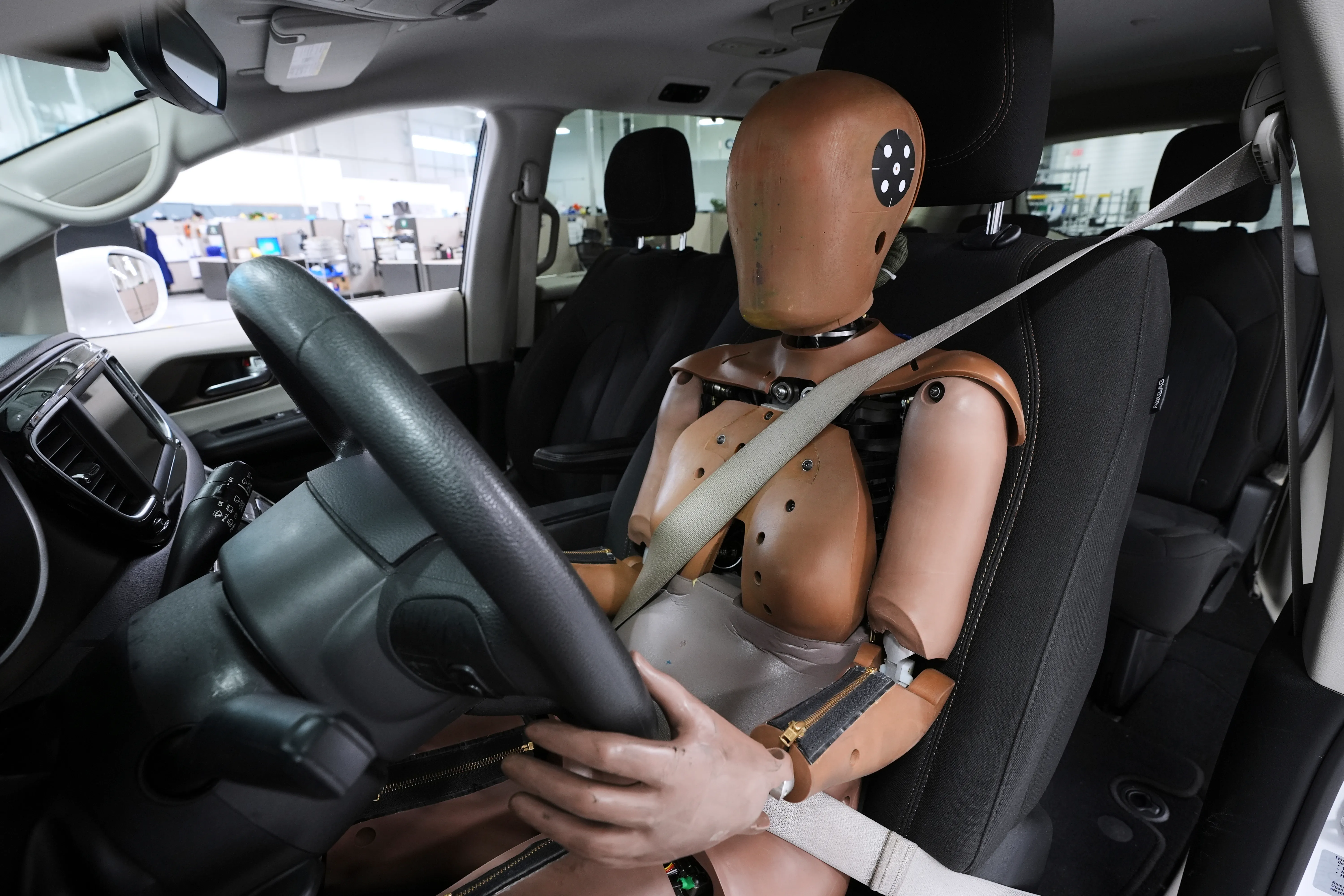
There is a company builds “biofidelic” crash test dummies. At the facility, a display case illustrates the evolution of crash test dummies since the 1950s. The earliest female dummy had pointy breasts, a wig and lipstick. Otherwise, it was simply a scaled-down version of a male dummy.
But its latest model accurately represents 95 percent of the female population. Biofidelic dummies account for the anatomical differences between men and women that matter in car safety design.
Men have stronger neck musculature, which prevents brain injuries when their heads hit airbags. Men tend to be taller and broader, so they sit in the purportedly correct position for safety technologies. Women, in contrast, are considered “out of position” drivers.
Seatbelts sit across men’s hip bones, rather than slicing into their internal organs. Men’s necks are protected from whiplash because they reach headrests at the right spot. And the spacing of women’s spinal columns are different, which explained my spinal fractures.
Until 2011, female dummies were not required in crash tests. Today, no American car manufacturer uses biofidelic female dummies, because they can obtain a five-star crash test rating without them.
I emailed the chief data officer in the Biden White House after learning about this issue. We had worked together at the same think tank, so I thought she would be shocked to hear about a data problem that was killing women. Unfortunately, that administration was bogged down in a sea of ideological commitments guided by political expediency, pursued at the expense of common sense and public safety.
I tried to explain that if the car industry did not address its longstanding car crash safety bias before the doomed electric vehicle rollout my former co-worker was assigned to, more electric vehicles on the road would mean more female fatalities. Former President Joe Biden lost a wife and young daughter to a car crash . I thought that surely this issue would grab the White House’s attention.
But it did not. My acquaintance was not going to tell Biden to halt his big EV project, even if it meant saving lives. First she would save the environment, then she would get around to women eventually. Sadly, 44,000 women would die over the course of her term.
Next, I met with several high-ranking Department of Transportation officials, including the deputy head of the National Highway Traffic Safety Administration, which awards crash test safety ratings. The agency’s dummies are modeled on the standard size American 1970s-era American male . Their female dummy represents only 5 percent of women.
Anyone who deviates from that standard — Americans who are taller, shorter, heavier, lighter, female or pregnant — well, you’re on your own if you get into a crash.
Worse, the federal agency does not mandate testing with a female dummy in the driver’s seat. Surely, this was an oversight, or else the five-star crash test safety rating was a bald-faced lie.
Department of Transportation officials listened as I presented my data. Then they shared their own data demonstrating that women weren’t injured or killed at a rate higher than men, if you assumed men were “normal” drivers and women were an aberration.
“Why don’t you mandate tests with women in the driver’s seat?” I asked. Their reply: “We can’t mandate every test.”
They were doing great things with automatic braking, they added, which was saving lives left and right. I ran my hand over the scar that bisects my torso, which automatic breaking had failed to prevent.
How did the department decide testing with women in the driver’s seat was too expensive, but that investing in automatic breaking was the way forward? How did they decide who should live and who should die?
Last November, the Trump Transportation Department issued a press release advocating for the use of biofidelic dummies. Finally.
If the administration really wants to change the regulations, it should mandate their use rather than simply acknowledging their existence. But hey, progress is progress. And the bipartisan She DRIVES Act , sponsored by nine congresswomen and five congressmen, has been introduced into the last two congressional calendars.
No one’s family is supposed to get hit by a wrong-way driver on a sunny day in the U.S. When the government learns that thousands of women die each year because they have been looking at the data wrong, bureaucrats are supposed to say, “thank you for bringing this to our attention — we’ll get right on a solution.” Instead, they dissemble.
I no longer trust the government to act in my best interest or to prioritize my health and wellbeing. Is this the America that was once the crown jewel in the pantheon of innovation?
Today, U.S. road deaths per 10,000 drivers rank just slightly above India . Drivers in Mexico and Sierra Leone are less likely to die on the road than drivers in Ohio. Is it any mystery why this is the case?
Hana Schank is a journalist, technologist and policy strategist. Previously she worked in the Obama White House as a digital expert, and ran the Public Interest Technology team at New America .
Topics in this story
Gathered from external sources. Rights to this text belong to whoever originally published it.