Army grapples with higher cadet standards after yanking memo
The Army is eyeing new minimum academic standards for college students in the Reserve Officers’ Training Corps (ROTC), but not without some internal drama. The service branch issued fresh standards earlier this month, only to pull them days later amid differing opinions and an apparent lack of consultation with some senior leaders. Under the withdrawn…
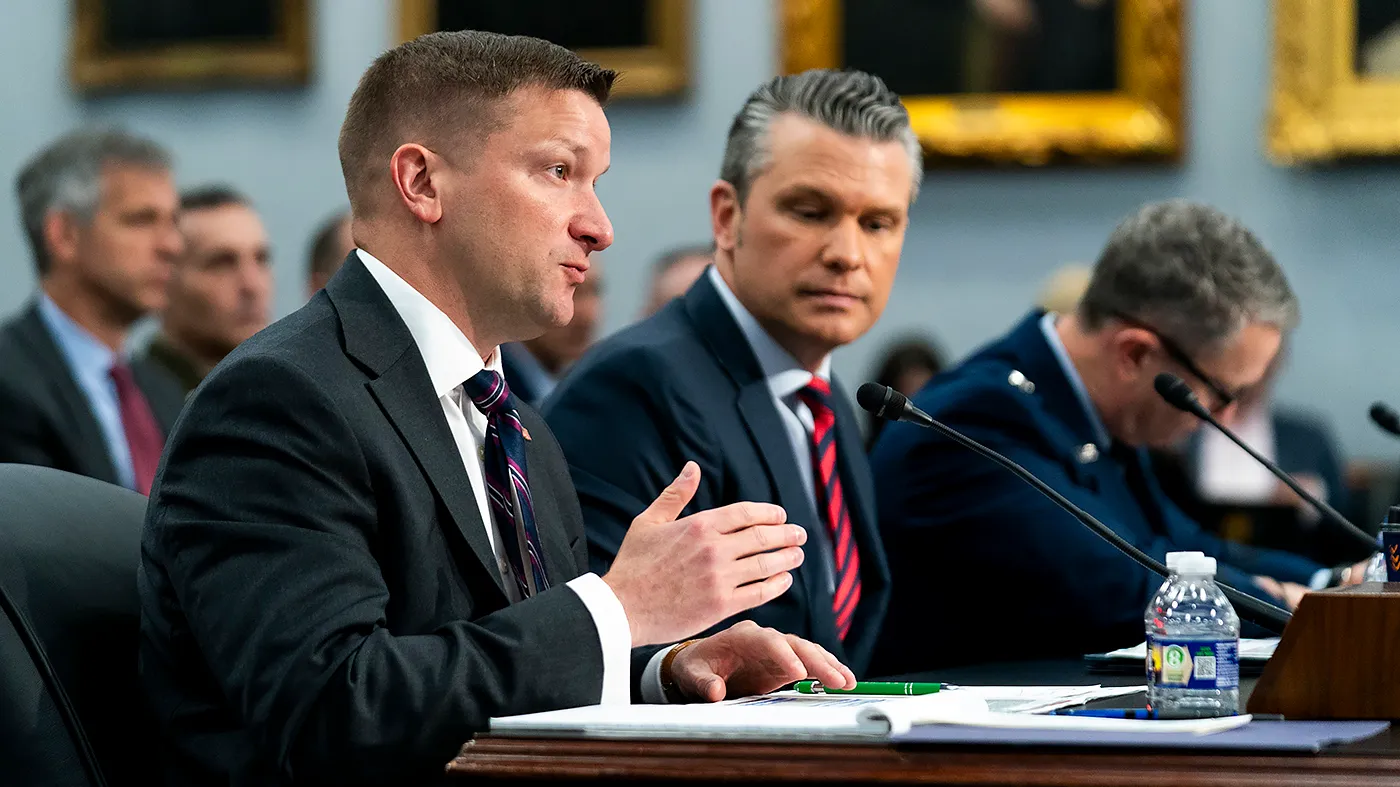
The Army is eyeing new minimum academic standards for college students in the Reserve Officers’ Training Corps (ROTC), but not without some internal drama.
The service branch issued fresh standards earlier this month, only to pull them days later amid differing opinions and an apparent lack of consultation with some senior leaders.
Under the withdrawn standards, incoming ROTC cadets would have to meet one of three academic benchmarks: score a 20 on the ACT, a 1000 on the SAT or test in the 50th percentile on the Armed Services Vocational Aptitude Battery (ASVAB), a standardized test on science, math and language.
“The Army must cultivate intelligent and adaptive officers to build a lethal and ready Army prepared to deter, fight, and win our nation’s wars. The strength of our Officer Corps is the strength of our Army,” Jay Hurst, who formerly served as the assistant secretary of the Army for manpower and reserve affairs, wrote in an internal Aug. 5 memo, which was obtained by The Hill.
The Army requires enlisted soldiers to score 110 on the ASVAB “line scores” to participate in Officer Candidate School, which trains civilians and enlisted personnel to gain a commission as officers in the armed forces. Line scores are a combination of subtests in the ASVAB that qualify candidates for certain career tracks in the military.
No equivalent standards exist for cadets to contract into the Army Senior Reserve Officer Training Corps, (SROTC) Hurst said in the internal document. Two days after signing the memo, Hurst was confirmed by the Senate as the Pentagon comptroller .
The new requirement was set to take effect in January next year. Starting Jan. 1, 2027, all students seeking to contract into SROTC must get a 110 on the ASVAB or provide proof that they met or exceeded “prescribed scores” on the SAT and ACT, the internal document said.
“SROTC Cadets already under contract are excluded from this requirement. This policy will only apply to undergraduate students,” the memo’s text said, adding U.S. Army Cadet Command would revisit the standards annually.
The under secretary of the Army, Mike Obadal, said it requires “further staffing and analysis,” according to an internal Aug. 12 memo, which was reviewed by The Hill.
The New York Post reported on Friday that Defense Secretary Pete Hegseth was angry that the memo was rescinded. Hegseth’s office referred The Hill to the Army.
The rescission prompted gripes among some defense officials, who privately argue the service branch should have minimum standards in line with Hegseth’s push to raise standards for military officers, which has also included a focus on fitness and grooming.
The Army indicated that imposing standards is not dead but would require more input from senior leadership.
“The Army is in lock-step with Secretary Hegseth and the President’s direction regarding military standards and readiness,” an Army spokesperson said in a statement to The Hill. “The Army is evaluating proposed changes to ROTC cadet standards for review by appropriate senior leaders and approval by the Secretary of the Army and the Acting Chief of Staff of the Army.”
When reached for comment, the U.S. Army Recruiting Command said it had nothing further to add.
Will Thibeau, an Army veteran and director of the American Military Project at the Claremont Institute’s Center for the American Way of Life, said it is a “really positive sign” the Army is “considering establishing modest minimum standards for standardized tests that reinforce existing ROTC evaluation metrics.”
“The minimum standards outlined in the now-rescinded policy are below national averages, and we should expect more from those who will lead Americans in military service. I take the Army at their word that the step to rescind those standards is a step to double-check the timing and specific metrics of the policy,” Thibeau told The Hill on Wednesday.
Privately, some within the Pentagon saw the confusion around the Aug. 5 memo as evidence of disorder within the service branch. But others said Army leadership was not clued in, noting that Hurst is a Hegseth ally.
Not all of the “right” Army leaders, including Army Secretary Dan Driscoll, were given a chance to weigh in on standards in the memo before it was issued, two U.S. officials familiar with deliberations who spoke on condition of anonymity told The Hill.
“Part of the discussion was if the standards were high enough,” one U.S. official said, adding there is a desire within the service branch to make standards more “stringent.”
Gen. Christopher LaNeve, who is close with Hegseth and is nominated to be the next Army chief of staff , was not satisfied with the standards outlined in the Aug. 5 memo, a second U.S. official told The Hill.
LaNeve’s spokesperson declined to comment and referred The Hill to the Army. Hurst, through a spokesperson, declined to comment, referring The Hill to the Army.
Backers of the Aug. 5 memo say cadets should show intellectual agility before becoming officers. Others question if ACTs and SATs are reliable measures to assess an officer’s future performance.
“The SAT has not historically been a measure that is predeterminative of officer performance, and would serve to exclude candidates that would benefit from Army training, and the Army would benefit from developing the talent,” a former senior defense official, granted anonymity to speak candidly, told The Hill on Wednesday.
Students in ROTC, upon completion of the program, can become second lieutenants in the U.S. Army Reserve, Army National Guard and Army.
Current Army rules already include academic, physical and other requirements. To secure an Army ROTC scholarship, applicants need to meet physical standards, have a minimum of a 2.5 unweighted high school GPA and take the SAT or ACT, but no minimum score is required.
But most cadets are not on scholarships, and the new standards would cover all Army SROTC enrollees. In 2024, just over a third of ROTC cadets were on scholarships.
Gathered from external sources. Rights to this text belong to whoever originally published it.