US Yield Surge Adds to Bessent’s Grow-Our-Way-Out Debt Challenge
Treasury Secretary Scott Bessent has insisted faster economic growth can wipe away concerns about troubling fiscal trajectories, a key theme of his recent G2...
(Bloomberg) -- Treasury Secretary Scott Bessent has insisted faster economic growth can wipe away concerns about troubling fiscal trajectories, a key theme of his recent G20 leadership. History suggests otherwise.
Ahead of hosting the Group of 20 major world economies, Bessent said in August that "global growth is the way to take care of this mountain of debt." With US federal spending restraint and "3% growth, we grow our way out of this," he reiterated last week at a Texas event.
As recently as 2023 and 2024, the US was clocking near-3% growth rates, after adjusting for inflation. Yet debt held by the public climbed by roughly 10% and 7% respectively in those years — fueled by annual deficits topping $1.6 trillion — and debt as a share of economic output rose.
Back in the late 1990s, when US gross domestic product sustained gains of more than 4%, a dramatic turn to fiscal surpluses came alongside higher taxes and slower defense spending in a post-Cold War world.
Today, those dynamics are flipped. Tax rates are much lower after multiple waves of Republican-led reductions, and lawmakers from both parties in recent years have generally voted to raise, not lower, federal spending. An aging population is boosting outlays in giant entitlement programs. And amid geopolitical tensions, President Donald Trump wants Congress to approve $1.5 trillion in defense spending, a 44% boost.
"You can't grow your way out of it," said Douglas Holtz-Eakin, president of the right-leaning American Action Forum and a former director of the Congressional Budget Office. "It's not numerically reasonable."
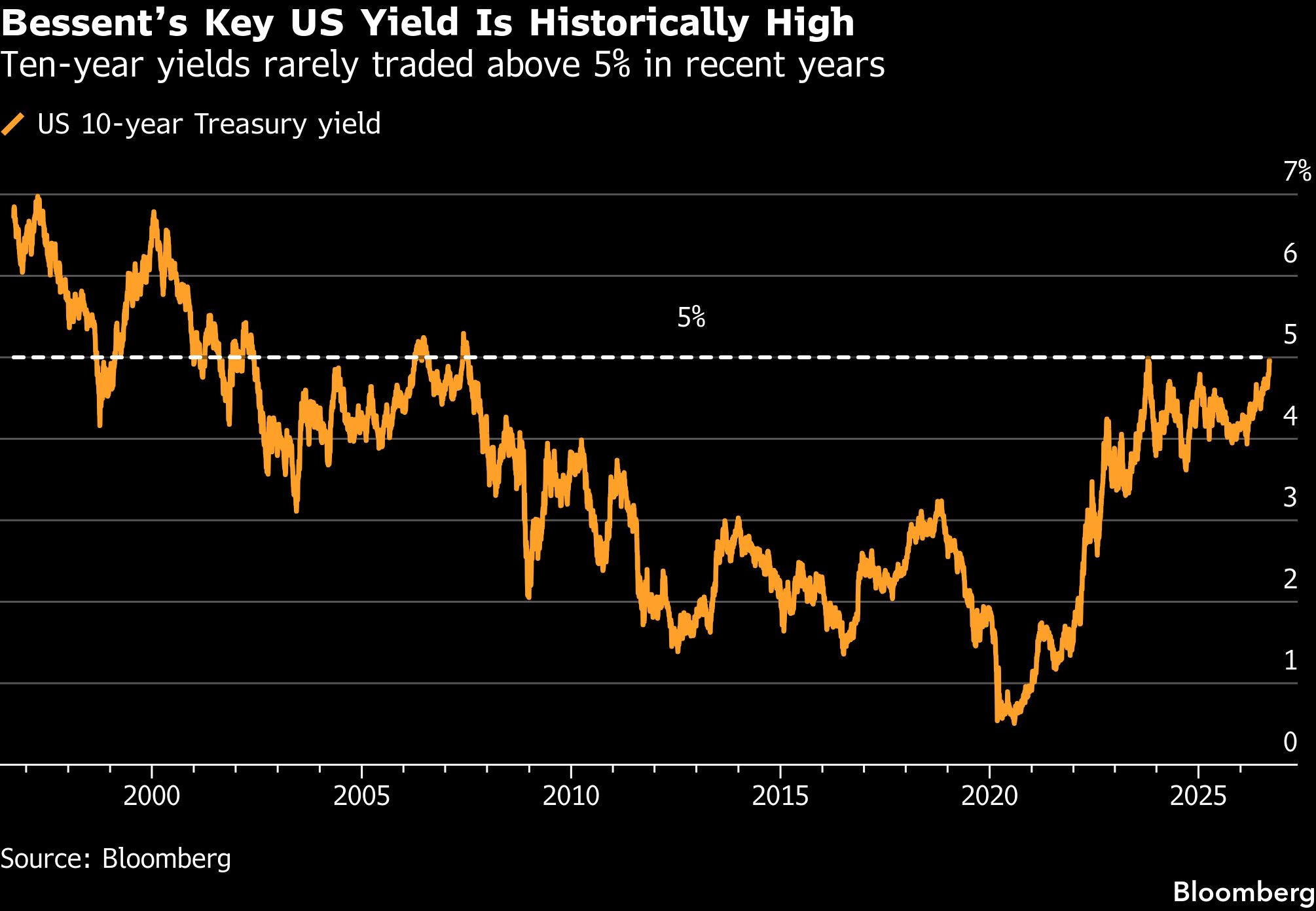
The rapid recent increase in Treasury yields has added to angst over long-term US debt sustainability. Bessent's self-identified benchmark, the 10-year rate, exceeded 5% on Monday. That's a level it's rarely traded at since the early 2000s. Bessent may face questions over his strategy at a House Financial Services Committee hearing Tuesday morning.
While Bessent predicts the artificial intelligence boom will help US growth accelerate, the consensus view is 3% gross domestic product rises aren't in the offing soon. Both the median forecast of economists surveyed by Bloomberg and the International Monetary Fund's latest projections show little more than 2% for 2027 and 2028.
Topics in this story
Gathered from external sources. Rights to this text belong to whoever originally published it.