Meet the MIT students who built a system that turns lunar waste into useful materials for future Moon missions, winning both tracks of NASA’s LunaRecycle Challenge and $925,000 in prizes
The Moon has a few things in common with Earth. No, we’re not talking about craters or imperfections, but trash.
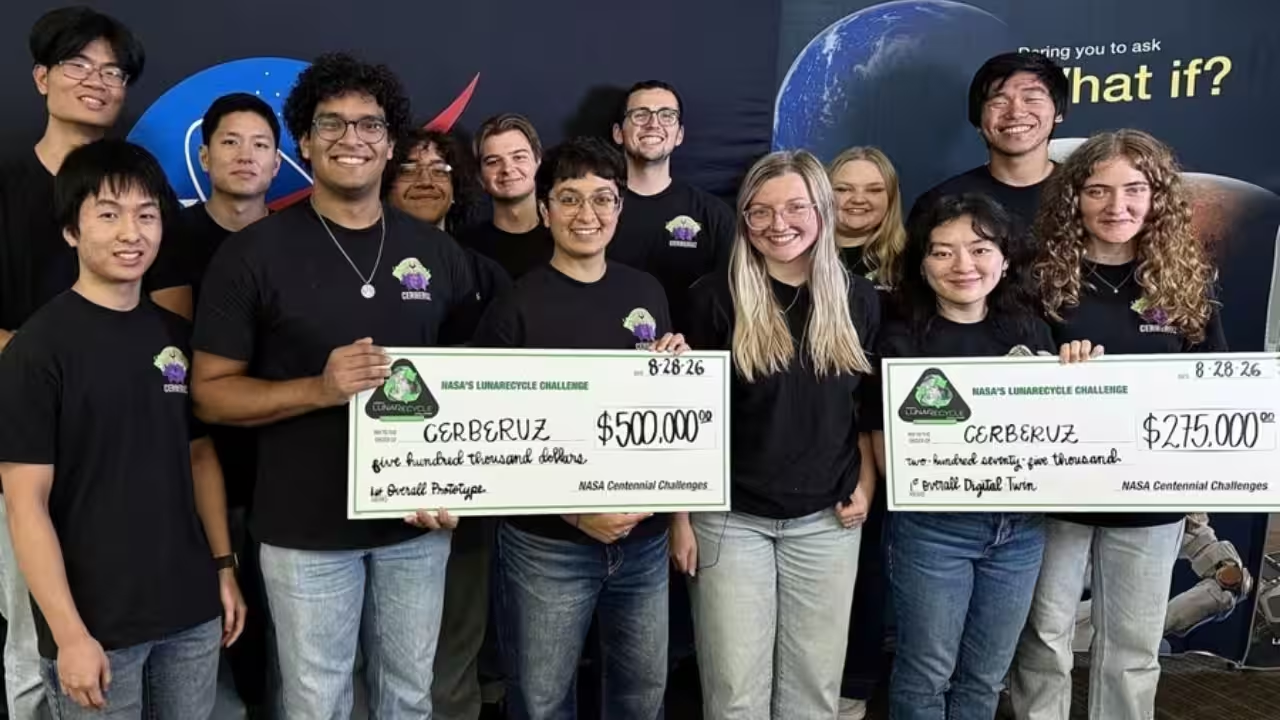
The Moon has a few things in common with Earth. No, we’re not talking about craters or imperfections, but trash. Building a home for humans on the Moon is a dream that many scientists are working to make a reality. But as supplies arrive from Earth, so will packaging and other waste. With astronauts also needing tools and spare parts to maintain their lunar base, an MIT student team has developed a system that turns lunar waste into useful materials. The student team CERBERUZ has won both tracks of NASA’s LunaRecycle Centennial Challenge and $925,000 in prize money.Trash that has nowhere to goThe future lunar base will receive a steady stream of supplies, most of which will arrive wrapped in material that gets tossed once opened. The base will also need tools, spare parts and building materials. George Lordos, a research scientist at MIT and the team’s lead adviser, says that waste will keep building up while maintenance demands new materials. Turning trash into useful materials means fewer items have to be launched from Earth.“Waste packaging materials will inevitably accumulate when a lunar outpost is built, and at the same time, outpost construction and maintenance will require a steady supply of new materials, including replacement parts. Recycling waste materials into such parts can help reduce the materials needed to be launched from Earth,” said Lordos, a research scientist in MIT’s Department of Aeronautics and Astronautics and System Design and Management, in a statement.Now the million-dollar question: how do they turn this waste into useful materials for lunar living? The system splits non-biological waste into two groups: plastics that melt when heated and everything else. All of it is ground into a fine powder and mixed together. That powder goes into an injection moulding machine, where the plastics melt and hold the other pieces in place. The mixture is pushed into a mould, producing a solid part that can be made again and again.Recycling the impossibleThe team even recycled something that nobody knew how to recycle. The material in question is Zotek F30, a lightweight foam used in aerospace packaging. Mixed plastics and foams like it have no proven recycling method, even on Earth. CERBERUZ takes a different route, mixing the foam into the melted material as a filler. The catch is that it weighs almost nothing. José Soto, a graduate student and the team’s pre-processing lead, said, “We had big shipments of Zotek coming in, and one person can carry them on their head like it’s nothing. The box is the size of a person.”Designed for life far from EarthLanie McKinney, a graduate student who leads the team, says the system had to work within strict limits. “We set out to build something that would actually make sense on the Moon, not just in a lab,” said McKinney, a graduate student in AeroAstro and team lead for CERBERUZ. “That means no water and no chemicals you can’t replace. Every design choice we made was driven by those constraints. And we don’t want to recycle just for recycling’s sake; we want to make useful things. Part of how we framed the problem was to create a system that can process nearly any feedstock and turn it into a wide array of components, giving more utility than producing a single item.”The team also built DEIMOS, short for Digital Environment for Intelligent Modeling of Operational Systems, alongside the hardware. It is a digital copy of the moulding machine, built from data collected during real production runs. It predicts how a given mix of recycled material and part shape will fill the mould, warp and shrink. Before astronauts spend scarce materials on a part, they could test it on a computer first.Winning the $925,000 challengeThe team grew out of the MIT Space Resources Workshop, a student group founded in 2017 that builds systems for future Moon and Mars missions. CERBERUZ draws students from four departments: Aeronautics and Astronautics, Mechanical Engineering, Electrical Engineering and Computer Science, and Materials Science and Engineering. Professor Jeffrey Hoffman, a former NASA astronaut, advised the team alongside Lordos.The team was named a Phase 1 winner in 2025, progressed through Phase 2 and earned milestone prizes in both tracks before the final demonstration in summer 2026. The prize money totalled $925,000.“If we’re able to reduce the amount of waste that’s inevitably going to be left on the Moon, rather than letting it pile up like a landfill, we can preserve both the beauty of the Moon and make exploration more efficient and sustainable. And perhaps we can inspire people back on Earth to take another look at our trash and find more ways to recycle or reuse it,” Soto concluded.
Topics in this story
Gathered from external sources. Rights to this text belong to whoever originally published it.