With Protect College Sports Act on brink of Senate passage, conference leaders working on a 'Plan B'
History will be made Monday with a Senate vote on the PCSA bill. Meanwhile, college sports executives are already drumming up an alternative approach.
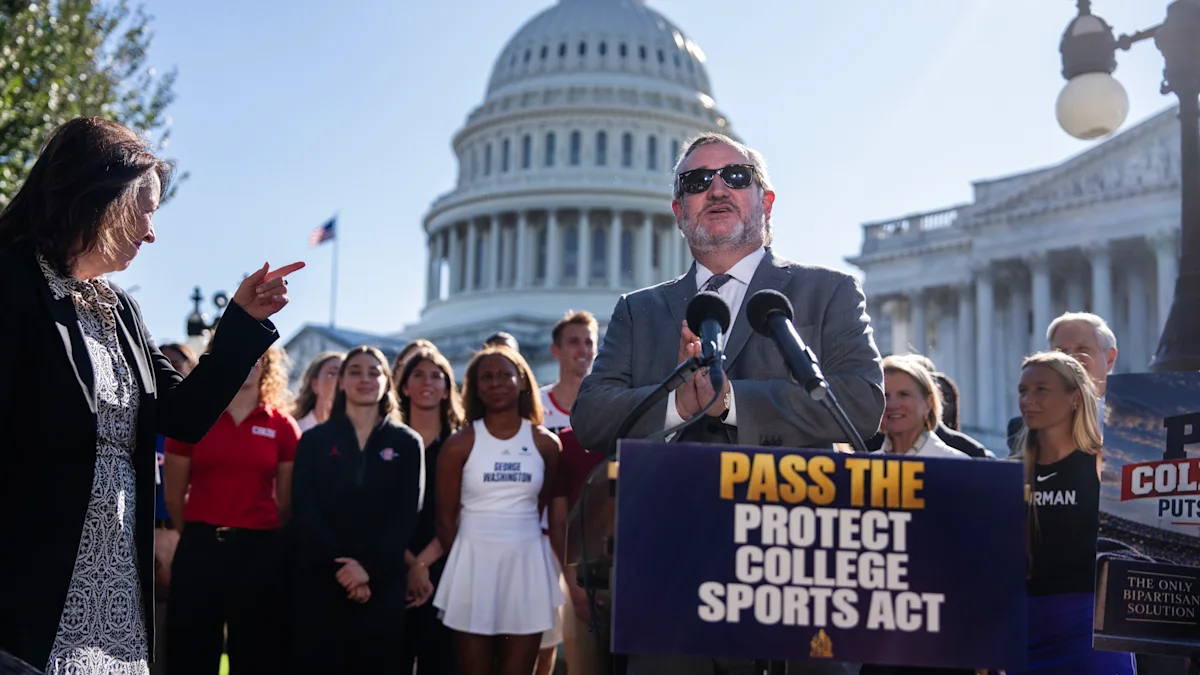
WASHINGTON — On Monday, within the United States Senate, history will be made.
Lawmakers are poised to pass a piece of college sports legislation intended to regulate an unruly industry — a historic moment in the NCAA's century-plus existence that moves the federal government one step closer to its most involvement ever in college athletics.
At least two-thirds of the 100-member chamber is expected to support the bill, according to procedural motion votes over the last week. The legislation would grant the NCAA an antitrust exemption to limit athlete transfer movement (one transfer without penalty); standardize a five-year eligibility policy; more strictly regulate a new, increased player revenue-share cap; create an agent registry with a maximum 5% fee, and plenty more.
The bill also paves the way for Football Bowl Subdivision conferences to pool their media rights; features an anti-conference expansion section ; and prevents coaches who have left before a team's season ends from performing duties at another university (the so-called Lane Kiffin Rule).
But as the legislation sits on the brink of Senate passage — the vote is expected Monday evening — conference executives and high-level school administrators are busy crafting what is often referred to as "Plan B": a conference-based governance and athlete-compensation framework that mirrors many of the bill's concepts.
Power conference leaders are seriously discussing adopting the bill's new, increased $48.8 million revenue-share cap and more strictly enforcing that cap through the College Sports Commission by limiting NIL deals from school-affiliated entities, according to messages and memos sent to school personnel over the last two weeks. The goal is to establish a harder cap than the soft cap now permitting programs to spend well above the current $21.3 million limitation per school.
Conference officials are also discussing the possibility of independently establishing league-only governance policies, such as an agent registry and fee cap and a transfer limitation. At the very least, they are gearing up to operationalize the bill's provisions — whether it passes or not.
There is urgency to implement such a structure. Time is ticking, college stakeholders say.
Most university coaches, staff members and athletic directors will soon find themselves, if they aren't already, attempting to renegotiate contracts with football players ahead of the January transfer portal. They are making offers without knowing details of a future compensation framework.
In fact, says one power conference athletic director last week, "every one of our players is negotiating their deals now."
"Agents are already calling," says another.
One thing is becoming more clear: College sports' athlete compensation system is changing.
There are three most likely mechanisms to alter the revenue-share cap, which was established within the NCAA's settlement of three antitrust cases, often referred to as House:
(1) within the settlement itself, which is complicated by several issues, including that it requires approval from House plaintiff attorneys and the judge herself, Claudia Wilken, and it may not even be possible as the case remains in an appeals process.
(2) from the conference level, which is a murkier option, as league leaders must be careful not to violate the settlement agreement.
(3) through the Protect College Sports Act, which, as federal law, would codify the settlement but still faces a high hurdle of passage in the House of Representatives.
A level of doubt lingers in all three options, especially changing terms within the settlement — a process that could take many months, perhaps even as much as half a year, says Jeffrey Kessler, one of two lead plaintiff attorneys. That would surpass what college leaders say is a deadline of sorts for a new compensation structure: the football transfer portal.
"We have to get something by January," says a third power league athletic director.
In interviews this week, Kessler's co-lead plaintiff lawyer in the case, Steve Berman, expressed a willingness to increase the cap within the settlement — as long as it remains a "soft cap," he said.
"There is no cap on the amount of NIL deals. We would not agree to change that," he told Yahoo Sports. "That would be trying to restrict competition. We wouldn't favor that."
But what if the leagues developed their own cap in a self-governance model?
Berman warns that it's "not possible without our permission."
"They have to come to the table," he insisted. "[Wilken] would be very suspicious of conference-generated changes, in particular the cap."
Under the industry's athlete-compensation system, there is a soft cap, much like Major League Baseball. Each school is permitted to directly pay athletes $21.3 million this academic year (the cap increases by 4% annually). The cap amount is for athletes across an entire athletic department, not just football.
However, third-party NIL deals are not included in the cap. This opens a path for universities to exploit a loophole in the system and exceed the cap by arranging NIL deals for their athletes with school-affiliated corporate sponsors, apparel brands, etc. disguised as commercial and endorsement contracts — a practice that's resulted in a majority of power conference programs spending well over $30 million in total athlete compensation.
Schools are redirecting sponsorship funds to the roster and are, cleverly, arranging the deals in a way that many of them are passing through the College Sports Commission, the enforcement entity charged with rejecting phony NIL deals.
Over the last few months, however, the CSC's scrutiny of school-affiliated NIL deals has increased, those with knowledge of the latest submissions say. This is a point of contention with plaintiff attorneys, Kessler and Berman, who have requested documents from the organization. They believe the CSC is being too restrictive by denying deals that should be approved. In its latest report released Sept. 9, the CSC revealed that it had denied nearly 500 deals from July 1-Aug. 31 with a value of $67 million, which eclipses the combined denied value of all deals over the previous four months. Over the two-month timeframe starting July 1, it cleared over 12,000 deals at more than $225 million.
"We are very skeptical of anything that restricts the amount of legitimate NIL deals," said Kessler. "We've had disputes with them about holding up deals like Panini [the trading card company]."
It's true: As college leaders work to establish a stricter cap, House attorneys plan to fight against that effort. But that's not necessarily the case with other potential conference-wide restrictions. For instance, Berman acknowledges that if individual leagues independently establish a transfer policy limiting athletes within the conference to one free transfer "they may have a good argument that there's no price fix," he told Yahoo Sports.
The SEC has been most aggressive in its conversations toward a self-governing model, where leagues establish and enforce their own rules as opposed to the NCAA model, which is more subject to litigation as the association holds "market power." The SEC's move, in theory, is intended to limit legal challenges by governing a smaller cohort.
Something similar transpired last month, when all four power conferences, one by one, created penalty structures to ban players who have previously signed professional contracts. Can conferences separately establish a one-time transfer rule?
"It will be subject to the 'rule of reason' review," Kessler said. "You'd have to look at what is the market power of the conference and the justification of the restriction."
Meanwhile, on Capitol Hill, senators are poised to pass legislation intended to regulate the industry. However, detractors believe the Protect College Sports Act unfairly restricts athletes without having included enough of their voice in the development of the text.
In fact, even some Republicans push back against the government's involvement, including Kentucky Sen. Rand Paul.
For these reasons — and others — the bill's prospects to pass the House remain uncertain and, some believe, doubtful.
"This bill is the culmination of a slow march towards federal control of college sports that began almost one-hundred and forty years ago in the courts," Paul wrote in a recent Op-Ed. "Government has shirked its real duties — deciding issues of national importance — to focus on something it knows nothing about."
Topics in this story
Gathered from external sources. Rights to this text belong to whoever originally published it.