Is Jeremiah Smith the Best College Football Wide Receiver Ever?
Each and every week, regardless of the opposition, Jeremiah Smith does something absurd. And it all looks completely normal.
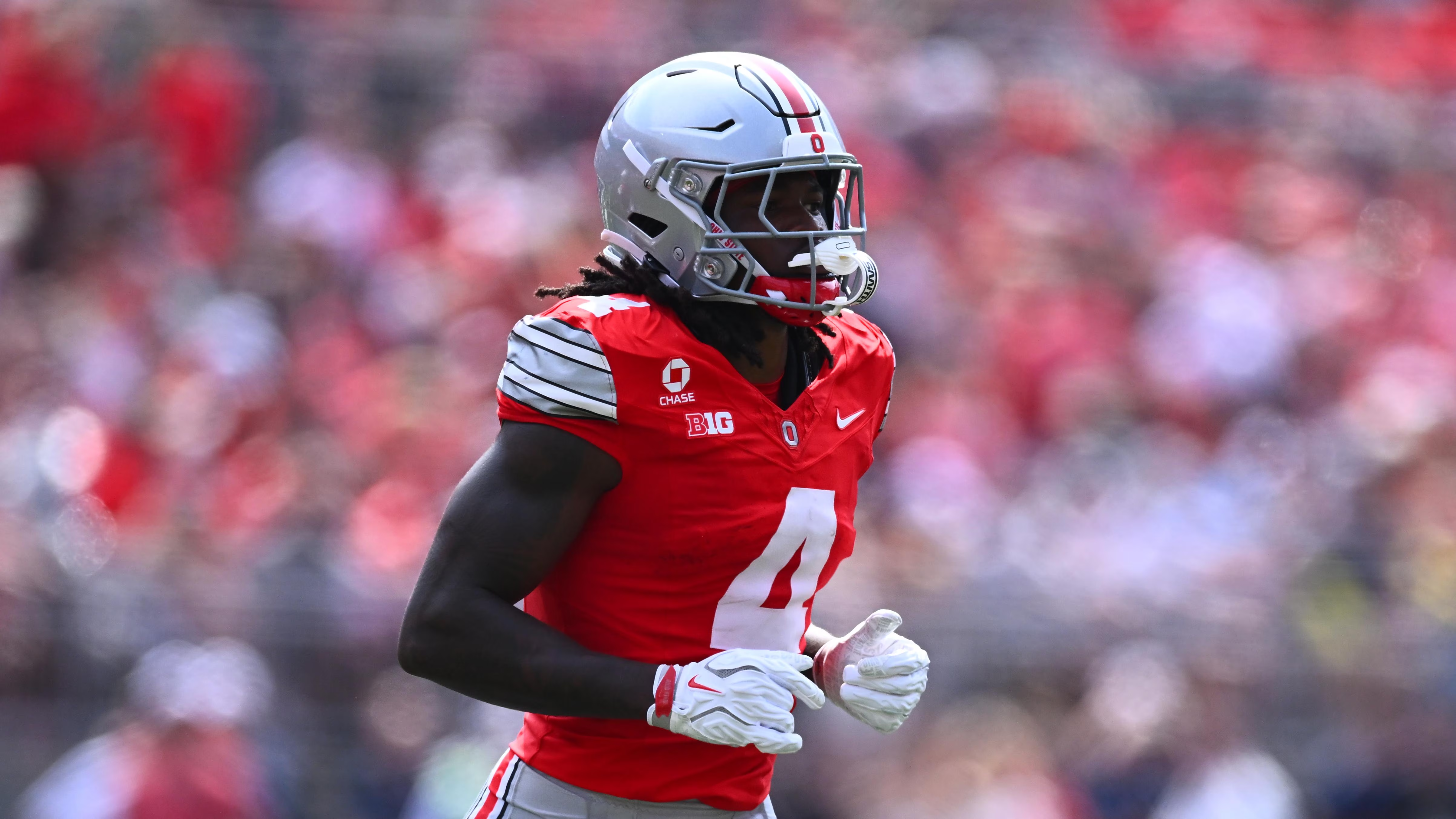
Each and every week, regardless of the opposition, Jeremiah Smith does something absurd. And it all looks completely normal.
This isn't exactly a new revelation. Ohio State's star wide receiver has been producing jaw-dropping moments since his very first game as a true freshman.
Years later, and we're struggling to quantify what it all means and how the staggering production stacks up. Forget about comparing him to other wide receivers and players currently playing each and every Satur
day. With all due respect, it's not close.
He's the best player in the sport, and there isn't much debate at this point.
Instead, we find ourselves drifting toward nostalgia and something more historic. More specifically, we're already comparing Smith, whose legacy is still very much unfolding, to the best wide receivers to ever grace a college football sideline.
How close is he to being the best wideout college football has ever seen? Let's explore.
Presently, Smith is the favorite to win the Heisman, and it feels like it will require a gargantuan effort to dethrone him from his post.
Sure, that seems like a hasty thing to declare in early October, although we've rarely seen a start to the college football season quite like this.
In five games, Smith has amassed 823 yards receiving and nine touchdowns. He's also averaging a ridiculous 18.7 yards per catch.
He torched Texas. He torched Iowa. The only team he didn't exactly torch was Kent State, and that's because he barely played once it quickly became a blowout.
At 6'4" and 225 pounds, Smith is an athletic anomaly. Despite his size, he's still one of the fastest players on the football field. It makes him an impossible cover, and it's been that way for years.
The No. 1 recruit in the country, Smith was an instant star. As a freshman, he scored 16 touchdowns. He also helped lift Ohio State to a national championship.
As a sophomore, he scored 13 times. Each time he found the endzone, his reputation grew.
Smith's 3,381 receiving yards currently rank eighth all time in the Big Ten. He's currently 407 yards away from the No. 1 spot, which he should obliterate if he stays healthy.
Again, he's just a junior. And we're not yet in the middle of October.
Physically and statistically, he is a unicorn. The position has seen its fair share of unique athletes, but this is something different.
He has the build, the hands, the stats and the hardware.
He won the Heisman, which is an appropriate place to begin.
Only four players to play wide receiver have won that award, and DeVonta Smith's triumph in 2020 was the first time a wideout had won in nearly two decades.
That alone puts the Alabama star in rarified air, and he earned it. In 13 games that season, he totaled 117 catches for 1,856 yards. He added 24 touchdowns. And in the College Football Playoff, taking on Notre Dame and Ohio State, Smith scored six touchdowns in two games.
Oh, and Alabama won the national championship.
In terms of individual seasons, given everything that was accomplished, it's hard to find any blemishes. And while many of these players possess an incredible frame, Smith dominated opposing defenses despite weighing roughly 170 pounds and at six feet tall.
Smith caught 235 passes for 3,965 and scored 47 touchdowns in his decorated Alabama career, which was one of the most productive in SEC history. The fact that he won a Heisman and a national championship lifts his resume in a special place.
Fitzgerald's college football journey began at Valley Forge Military Academy, largely because his academic situation demanded him to do so.
A year later, the Pitt freshman caught 69 passes for 1,005 yards and 12 touchdowns. But this was just the start.
Fitzgerald's sophomore year is widely regarded as one of the best the position has ever seen: 92 catches, 1,672 yards and 22 touchdowns.
Oh, and he set a record by catching a touchdown in 18 consecutive games, which is a feat that is hard to wrap your head around. At the time, it seemed like an impossible stretch to maintain, but he did just that.
In 2003, Fitzgerald's season earned him a runner-up finish in the Heisman. And at 6'3" and nearly 220 pounds, the wideout had the size and athleticism to do anything on the football field. It's this frame that made him so coveted by NFL scouts, which translated to becoming the No. 3 pick in the 2024 NFL Draft.
Expert CFB Predictions for the Biggest Week 6 Games 🔒
No player has ever made the position look easier or cooler; this much we know for certain. And if you were to ask the many defensive backs he ran past and jumped over, they would likely provide an expected answer.
Before Randy Moss began terrorizing NFL defensive backs, he was Chad Pennington's favorite target at Marshall.
Before getting to Marshall, Moss was committed to Notre Dame. Then he decommitted and wound up at Florida State. Off-the-field issues ultimately resulted in Moss's dismissal, prompting to land at Marshall.
Over the next two seasons, Moss evolved into one of the greatest deep threats the sport has ever seen, catching 174 passes for 3,529 receiving yards.
Even more staggering, however, is his 54 touchdown catches.
His 1997 season earned him a fourth-place finish in the Heisman, finishing behind Ryan Leaf, Peyton Manning and Charles Woodson.
Moss used his 6'4" frame to regularly leap over opposing defensive backs, and he had the speed to run past any defender. His incredible NFL career certainly plays a role in the general assessment of the player, which is remarkable.
One thing is abundantly clear. He's in a genre of his own creation.
If we're simply looking at the numbers, Julio Jones probably doesn't belong in this conversation. Let's address that from the start/
In his three-year career at Alabama, Jones finished with 15 touchdown receptions. In his best (and final) season in 2010, Jones caught 78 passes for 1,133 yards and seven touchdowns.
Compared to others, he falls well short on the box score side.
But to simply define Jones' success as college wide receiver to his overall numbers would do him a great injustice.
For starters, no player meant more to Nick Saban and Alabama's dynasty than Jones. His commitment alone sent shockwaves through the recruiting world, and his imposing presence and rare physical gifts made him an enormous piece of Alabama's plans.
Jones was 6'3" and 220 pounds when he played in Tuscaloosa. In many respects, no player over the past 15 years had a body type and playing style to Jeremiah Smith than Jones, who could also do it all.
The only difference is Alabama's offense required him to do less. To the surprise of no one, he was also a superb blocker.
This one is more difficult to quantify. Jones helped Saban win his first national championship in Tuscaloosa, the start of a movement that changed college football.
If he played for a different school or in a different system, things would have been different.
One of the few players larger than Jeremiah Smith, Calvin Johnson spent his college football career at Georgia Tech, playing in run-heavy systems that struggled to throw the ball.
Despite that, he was a two-time All-American with the Yellow Jackets, the 2006 Biletnikoff Award winner and still managed a 15-touchdown season. He finished his career with nearly 3,000 yards receiving and 28 receiving touchdowns.
But again, stats aren't the argument. Johnson was a human highlight machine.
At 6'5" and 239 pounds, Johnson ran the 40-yard dash in an eye-popping 4.35 seconds. While this isn't a story dedicated to the best NFL Combine performances of all time, this showcased the kind of athlete he was.
On the football field, few players have ever been more unguardable. If that were the criteria, it would be hard to justify picking anyone else.
Michael Crabtree played two seasons at Texas Tech. He won the Biletnikoff Award in both of those seasons.
As a redshirt freshman, Crabtree racked up 134 catches, 1,962 receiving yards and 22 touchdowns. Playing in Mike Leach's Air Raid offense certainly helped. As did catching passes from Graham Harrell, who was the perfect QB for Leach's pass-heavy system.
But Crabtree was more than just a system player. He was on the receiving end of a Harrell touchdown pass that upset unbeaten Texas in November of 2008 with only a second left—a result that felt larger than life in the moment.
To this day, it remains one of the most iconic plays in CFB history.
In his two seasons, Crabtree totaled 231 catches, 3,127 yards and 41 scores. He produced these numbers despite being only 6'1" and not possessing overpowering speed.
When it comes to video game numbers and iconic moments, this is your guy.
The list of talented wide receivers is far too long to mention just a select few. Here are a few others worthy of consideration.
Desmond Howard, Michigan: He won the Heisman in 1991, and he was capable of flipping a game with hands, feet and on special teams. Howard's unique list of contributions made him a truly unique threat.
Tim Brown, Notre Dame: Speaking of Heisman winners, enter Tim Brown. The winner in 1987, Brown was a dynamic player for the Irish on offense and as a returner.
Justin Blackmon, Oklahoma State: With 253 catches, 3,564 yards and 40 touchdowns, Blackmon was a two-time Biletnikoff Award winner. He also finished in the top five for Heisman voting twice.
Jerry Rice, Mississippi Valley State: Sure, he played at a smaller school, but he was (unsurprisingly) wildly productive. Before he dominated in the NFL, Rice caught 27 touchdown passes in one season.
The only certainty surrounding Jeremiah Smith's future is that this will be his final collegiate football season. That decision has yet to be officially announced, of course, but it has never been easier to connect these dots.
Statistically speaking, Smith is operating at a pace few players have ever approached, even if he forgoes one year of eligibility entirely. And if it continues throughout this season, with massive games against Indiana, USC, Oregon and rival Michigan still to come, we could be looking at one of the greatest seasons the sport has ever seen.
If he ultimately wins a Heisman, and he'll be a difficult player to unseat, it will only elevate his accomplishments. Adding another national championship to his resume would only beef up his case further, and the possibility of doing so is very real.
Indeed, the position has seen its fair share of great players. Plenty have earned the right to be considered the greatest to ever play the position for a variety of reasons. Accomplishments are celebrated differently depending on who you ask, and there will never be consensus on such a heavy proclamation.
But Smith is clearly in the discussion. This much we know.
It's his physical gifts. It's the moments he produces. It's the numbers he accumulates. It's his impact on every game and play. Ohio State has grown accustomed to producing star wide receivers, although it's never had one like this.
In time, we'll have a clearer picture of what it all means and where Smith truly sits among the all-time greats. But thankfully, we have just that.
Topics in this story
Gathered from external sources. Rights to this text belong to whoever originally published it.