‘Decades in Sports’: How Colin Kaepernick taking a knee in 2016 revived athlete activism in sports
Nearly a decade after Colin Kaepernick first took a knee, his silent protest continues to define athlete activism across modern sports.
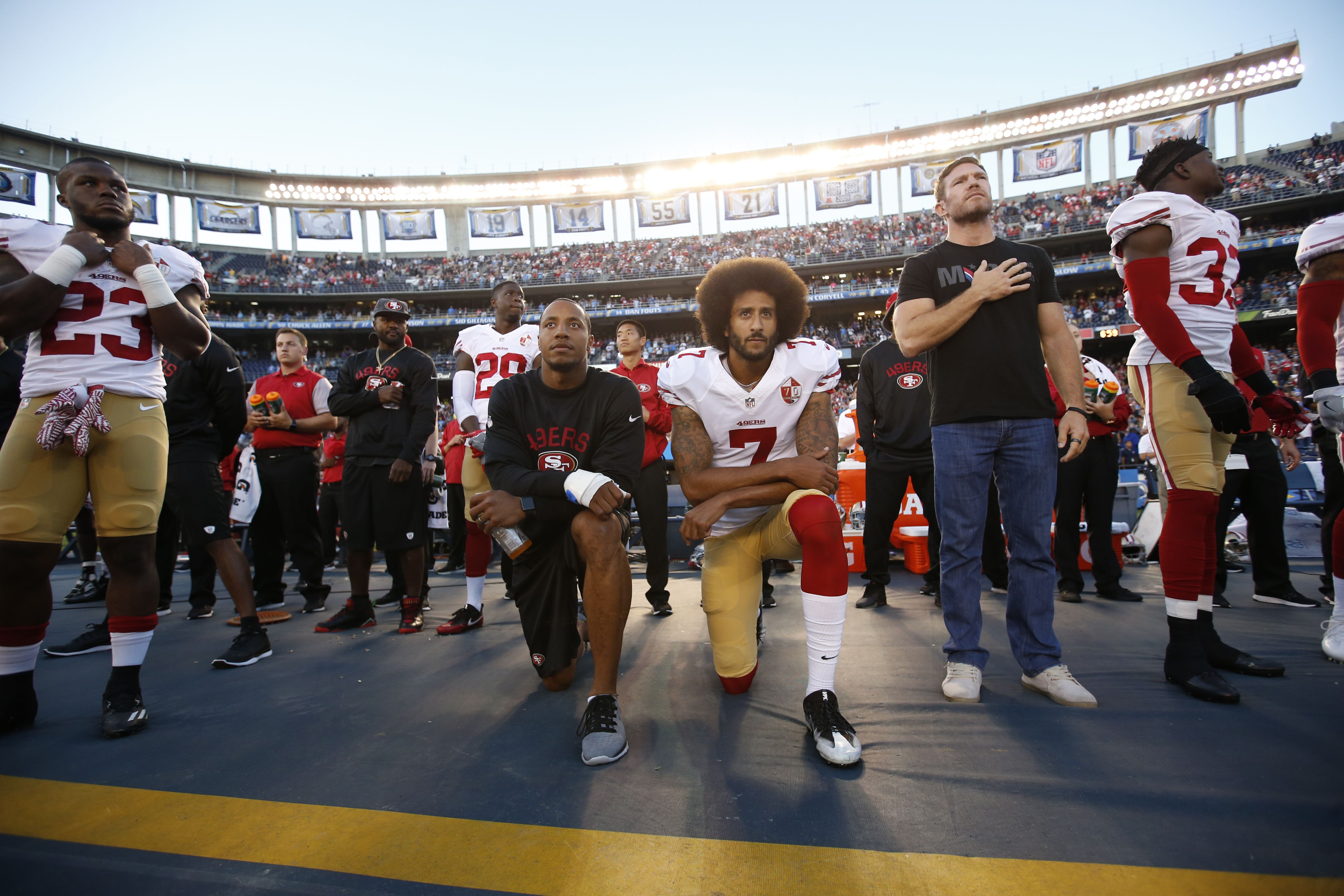
Editor’s note: Watch CNN Original Series “Decades in Sports” on the CNN app. Across six episodes, the series explores the defining moments, athletes and cultural shifts that shaped sports over the past six decades, from the television revolution and Civil Rights Movement of the 1960s to the impact of social media on today’s biggest stars. Almost 10 years have passed since former San Francisco 49ers quarterback Colin Kaepernick first took a knee during “The Star-Spangled Banner” before a preseason game against the San Diego Chargers on September 1, 2016. Before ever taking a knee, Kaepernick’s protest actually began when he remained seated during the national anthem prior to the 49ers’ first preseason game against the Houston Texans on August 14. Although he did the same the following week against the Denver Broncos, few took notice, as the quarterback didn’t suit up against Denver or Houston. That all changed on August 26. Kaepernick was back in uniform and set to make his first preseason appearance against the Green Bay Packers. As he had done before the previous two games, he remained seated during the national anthem. Only this time, it caught the attention of millions across the country. When asked after the game what drove his demonstration, Kaepernick didn’t pull any punches: “I am not going to stand up to show pride in a flag for a country that oppresses Black people and people of color,” he told longtime NFL reporter Steve Wyche. “To me, this is bigger than football and it would be selfish on my part to look the other way. There are bodies in the street and people (are) getting paid leave and getting away with murder.” His message could not have been clearer. After opting to take a knee alongside teammate Eric Reid against the Chargers, the entire sporting world took notice of what would become one of the defining images of 2010s sports culture. The then-28-year-old was coming off a disappointing, injury-riddled 2015 season in which he lost his starting job. But football was no longer his primary concern. America at a Breaking Point It is easy to forget just how high racial tensions ran in America during that decade. The Black Lives Matter movement gained national prominence in 2013 following the acquittal of George Zimmerman, a 28-year-old neighborhood watch volunteer who fatally shot 17-year-old Trayvon Martin in Sanford, Florida, the previous year. Nearly 50 years had passed since Martin Luther King Jr. stood on the steps of the Lincoln Memorial and shared his dream with the world. Yet in the 2010s, that dream remained unfulfilled as racial inequality and police brutality remained widespread across the U.S. Racial tensions peaked in July 2016 following the deaths of Alton Sterling and Philando Castile at the hands of law enforcement just a day apart. Castile’s death prompted then-Minnesota Governor Mark Dayton to publicly question the role race played. “Would this have happened if the driver and passenger were white?” Dayton asked rhetorically at a press conference. “I don’t think it would have. So I’m forced to confront, and I think all of Minnesota is forced to confront, that this kind of racism exists.” Kaepernick had been outspoken about both killings on social media, describing Sterling’s death as a modern-day “lynching” and stating he had been “executed.” After Castile was killed less than 24 hours later, Kaepernick said it was “clear as day” that African Americans in the country were “under attack.” It was against this backdrop that he decided to act during the 2016 NFL preseason. Although “it was a quiet protest and he wasn’t being disruptive, people focused on it, (and) it just took on this sort of life of its own,” says Renée Graham, Associate Editor & Columnist at The Boston Globe. When the regular season began, the former 49ers quarterback continued his silent boycott of the national anthem. It led to him being booed in stadiums across the country, receiving several death threats, and facing sharp criticism from then-Republican presidential candidate Donald Trump, who called the protest a “terrible thing” during an interview with KIRO radio in Seattle, suggesting Kaepernick should “find a country that works better for him.” It was clear that “the whole country was wrapped up in this controversy,” says Sam Farmer, sports journalist at the Los Angeles Times. Yet Kaepernick remained unfazed. It quickly became apparent that no one would stop him in his mission—not even the man who would become the most powerful leader in the nation a few short months later. The Sporting World Follows Suit It didn’t take long for other athletes across the country to join the movement. During the first four games of the 2017 WNBA Finals between the Minnesota Lynx and Los Angeles Sparks, the entire Sparks team remained in the locker room during the national anthem, while Lynx players linked arms on the court before the opening game. “We need to make sure that Colin knows that we have his back,” says Diana Taurasi, former Phoenix Mercury star and three-time WNBA champion. “And at the time, with so much social unrest, that was one of the things as a league we stood strong on.” Kaepernick’s protest spilled into baseball with Bruce Maxwell, ice hockey with J.T. Brown, women’s soccer with Megan Rapinoe, the NBA—where several teams locked arms during the national anthem throughout the 2016–17 season—and, of course, the NFL, where silent boycotts continued throughout the 2016 and 2017 seasons. As Jonathan Abrams, journalist at The New York Times, put it: “He really lit something that was felt through just about every sport.” And again, he was a backup quarterback fighting for a roster spot at the time. He won’t be remembered for game-winning drives like Tom Brady or impossible throws like Aaron Rodgers, but few athletes have impacted sports—and society at large—quite like Kaepernick. “His protest forced a lot of people to think deeply about patriotism,” says author and historian Timothy Naftali. “If your country is doing something you find morally offensive, should you be a party to that? Kaepernick wanted to spark that debate.” And he certainly did. Kaepernick’s protest ultimately cost him his NFL career, as he was never signed by another team after becoming a free agent in 2017. Because of this, “I haven’t watched a snap since,” says Graham. Despite losing his place in the league, he helped usher in a new era of athlete activism in U.S. sports. In the years that followed, athletes increasingly used their platforms to speak out against racial injustice and police brutality, especially after the murder of George Floyd in May 2020 triggered global protests. The image of Kaepernick taking a knee alongside Reid against the Chargers will never be forgotten—nor will the lives lost that compelled him to act in the first place.
Topics in this story
Gathered from external sources. Rights to this text belong to whoever originally published it.