How Arizona Cardinals can make 2026 season a success
The Arizona Cardinals may not be heading for the playoffs in 2026. But that doesn't mean this season can't be a success. Here's the blueprint.
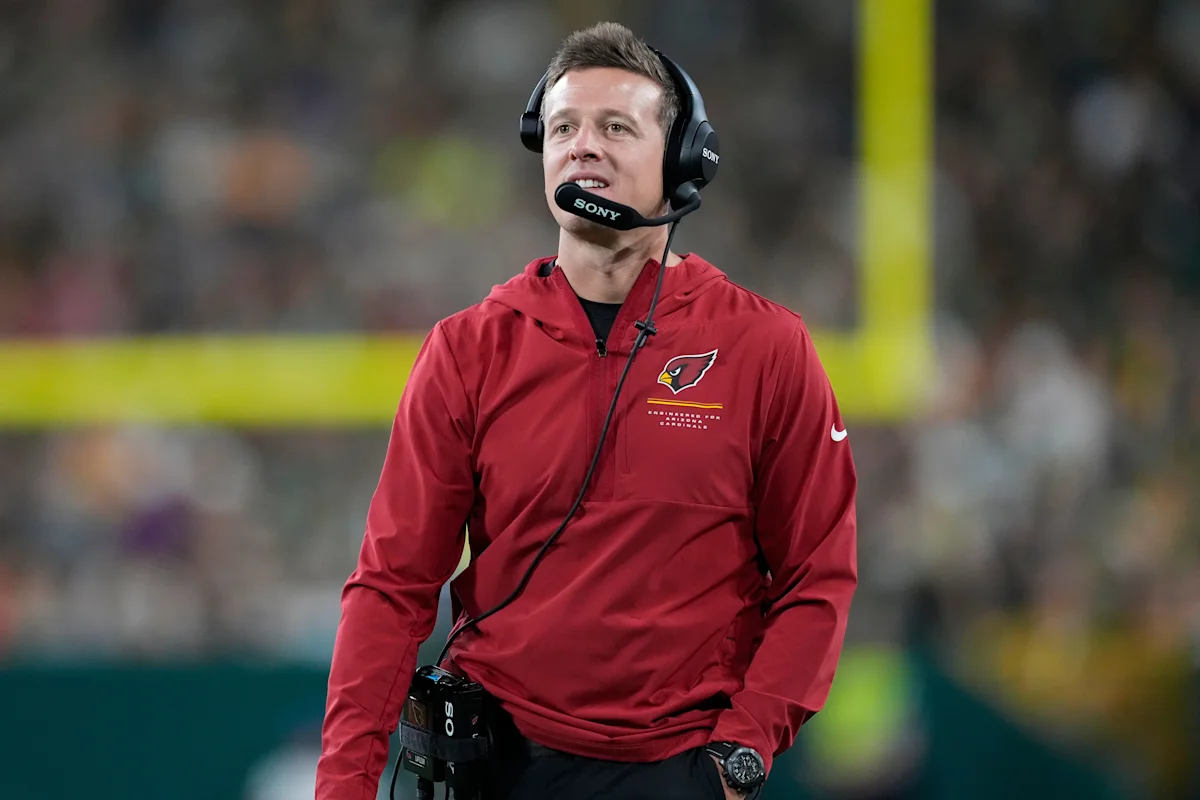
If there's one thing Cardinals head coach Mike LaFleur has made clear since arriving in Arizona , it's this: He knows the challenge ahead.
It would be difficult not to. LaFleur spent the majority of his NFL career working for Kyle Shanahan and Sean McVay, with a daily view of their brilliance as offensive minds. And he spent the past two seasons preparing game plans to face Mike Macdonald, the defensive wizard who forged the Seahawks into a Super Bowl champion.
Compared to those rivals, the Cardinals have spent recent seasons operating in a different orbit. So when asked last week about the NFL's constantly expanding schedule, LaFleur acknowledged as much.
"We play 17 Sundays in the daytime, and I think we all understand why," LaFleur said. "If we want to play in those primetime slots and on Wednesdays and Thursdays and Netflix and all those things, we've gotta go earn those spots."
Arizona Cardinals uniforms through the years
That begs a follow-up question: What would it take for the Cardinals to "earn those spots?" In other words, what does a successful season look like in Arizona?
In this division — with this roster and this schedule — asking for a playoff push is asking for disappointment. But that doesn't mean there's nothing to play for — far from it.
One answer is obvious: If Carson Beck emerges as the franchise quarterback, little else matters. The history of third-round quarterbacks, though, tells us that's a long shot. So for the sake of this exercise, let's focus elsewhere.
The other simple answer would be landing the No. 1 pick. Certainly, if either Arch Manning or Dante Moore establishes himself as a generational prospect, that would be appealing.
But it's also a risky path. Excluding Fernando Mendoza — since he hasn't yet played an NFL snap — seven quarterbacks have been drafted No. 1 overall in the past decade. Only one of those players, Joe Burrow , has successfully and lastingly transformed a franchise. The median outcome from those selections is arguably Kyler Murray , living proof that the No. 1 pick is not a silver bullet, at least not without sufficient supporting infrastructure.
For the Cardinals, though, there's another path that may be both more sustainable and more attainable.
Imagine a world where, come January, the Cardinals look to be a quarterback away from contention. It might not be as far-fetched as it sounds.
By the end of the season, Mike LaFleur could look like the next standout playcaller to have served as McVay's offensive coordinator.
History is on his side, given that the previous three were Matt LaFleur, Kevin O'Connell and Liam Coen. So too was the Cardinals' preseason performance, when their offense led the NFL in yards per game. LaFleur poured cold water on that, saying he puts "zero" stock in preseason numbers, but his players disagree.
"I think a lot of that is coaching," Michael Wilson said. "… It's getting the right calls in, the way that Mike and the offensive staff are detailing things up in the pass game, getting guys open, getting guys advantageous 1-on-1s."
And if LaFleur's playcalling success can translate to the regular season, could the Cardinals prove to have a top-10 offensive infrastructure surrounding their quarterback? Again, it's more realistic than it may seem.
After Jacoby Brissett took over as the starter last season, there were four games in which Marvin Harrison Jr. played more than 60% of offensive snaps. In those games, the Cardinals ranked 15th in expected points added per dropback, despite virtually no rushing threat. With their top two running backs sidelined, they ranked 26th in EPA per carry in those same games.
Now, a prodigiously talented Jeremiyah Love enters the mix, along with a reliable veteran in Tyler Allgeier . That's a significant upgrade on the three-headed committee of Bam Knight , Michael Carter and Emari Demercado .
Plus, the offensive line should be improved. In those same weeks, the most common configuration up front was Paris Johnson Jr. , Evan Brown , Hjalte Froholdt , Will Hernandez and Jonah Williams . Using PFF grades as a proxy, each of the Cardinals' three new starters is an upgrade.
And it's the second year under offensive line coach Justin Frye for that group, at the position where coaching matters most.
"He's found his way of doing it," Froholdt said. "And I think we've all bought into it."
Put it all together, and the Cardinals can reasonably aim to be a top half offense. And that's with Brissett, who may be a reliable distributor but is far from a true franchise quarterback. If the Cardinals finish, say, 15th in total offense this season, it would be easy to envision something grander in 2027, with a new quarterback in town.
The picture is no doubt murkier for the defense.
The state of the roster is especially troubling up front, where only one current player recorded more than two sacks last season. If the Cardinals finish bottom five in both pressure rate and yards per carry allowed, it won't come as a surprise. And at linebacker and safety, they are set to start a pair of players who commanded a combined $6.7 million in free agency — players whom the league has revealed it doesn't value. Whereas the offense may be top 15, the defense clearly projects as bottom 10.
But a few factors could still stoke optimism.
The first, naturally, is health, after the 2025 Cardinals set unwanted records in that department. That situation fully unraveled in Week 9, when linebacker Mack Wilson Sr. and cornerback Will Johnson both went down. Wilson missed the rest of the season, while Johnson turned into a shell of himself. Before the injury, he had an 85.7 passer rating when targeted. After the injury, that number was 139.4.
The impact of those injuries was clear. In Weeks 1-9, the Cardinals ranked 10th in Defense-adjusted Value Over Average (DVOA), which accounts for strength of opponent. In Weeks 10-18, they ranked 28th.
Finishing anywhere near 10th is likely unrealistic, given that the Cardinals lost Calais Campbell and Jalen Thompson without acquiring clear replacements. Still, they should avoid being as woeful as they were down the stretch.
Plus, defense is volatile. Among the 10 worst defenses (based on DVOA) in 2024, three became top-10 units last season. A poor 2026 on that side of the ball wouldn't spell doom for 2027 and beyond.
And with Josh Sweat , Walter Nolen , Will Johnson and Budda Baker , the Cardinals may end the year with two high-level players in both the front and the secondary. That's a useful foundation, even if that quartet is currently surrounded by worrisome cracks. Add in some development for young players like Jordan Burch , Cody Simon and Max Melton , and the list of needs may be short enough to address in one offseason.
Play this scenario out: The Cardinals enter the offseason in need of a defensive tackle, an edge rusher and a safety. With $108 million in projected effective cap space, per Over The Cap, that's a realistic shopping list, even if Michael Wilson commands a healthy extension.
What could this mean for the future Cardinals?
So let's put the pieces together here. The Cardinals could have a promising new play-calling head coach, with a top-10 offensive infrastructure and defensive building blocks at the most important positions. And because of their current flaws, those strengths could still be paired with abundant cap space and a top-five pick in what's expected to be a strong quarterback class.
Instead of drafting a quarterback first overall with no supporting cast, this could be a case of drafting a top-10 quarterback into a situation built for a quick turnaround.
That certainly wouldn't erase every question surrounding the Cardinals. If they finish, say, 5-12, general manager Monti Ossenfort would be entering the offseason with a 20-48 record at the helm. That's uneven footing for a decision-maker tasked with drafting a new franchise quarterback.
But it's not a bad outlook. And it may be more attainable than it seems today, on the eve of a season that arrives with historically low expectations.
Topics in this story
Gathered from external sources. Rights to this text belong to whoever originally published it.