What happened to Cardinals' creative defense? And will it return?
The Arizona Cardinals defense was once characterized by its creative blitz and coverage schemes. But over the past two years, that has gone away.
Remember the Arizona Cardinals defense, just two years ago? The Cardinals entered the season low on expectations, with few blue-chip talents. It was difficult to see where high-end production would come from. And yet, they finished 15th in scoring, outpacing all expectations.
They did it by disorienting the opponent at every turn. Their defense was weird, in the best way possible. Up front, they relied on complex pressure schemes, making it difficult for offenses to know who was rushing the passer and who was dropping into coverage. In the secondary, they rotated into new looks when the ball was snapped, changing the quarterback's picture as he readied to throw.
That spring, defensive coordinator Nick Rallis was widely viewed as one of the sport's emerging young playcallers. Mike McDaniel highlighted him, unprompted, as an underrated coach, defined by his "non-traditional approach." George Kittle described it as a "very different defense than anything I've really experienced in the NFL."
But over the past two years, some of what made the Cardinals unique has disappeared. They bring less pressure, with fewer disguises. Some of the funky schematics, with the way Rallis deploys his defensive backs, have remained. It's pared down, though, from what it once was.
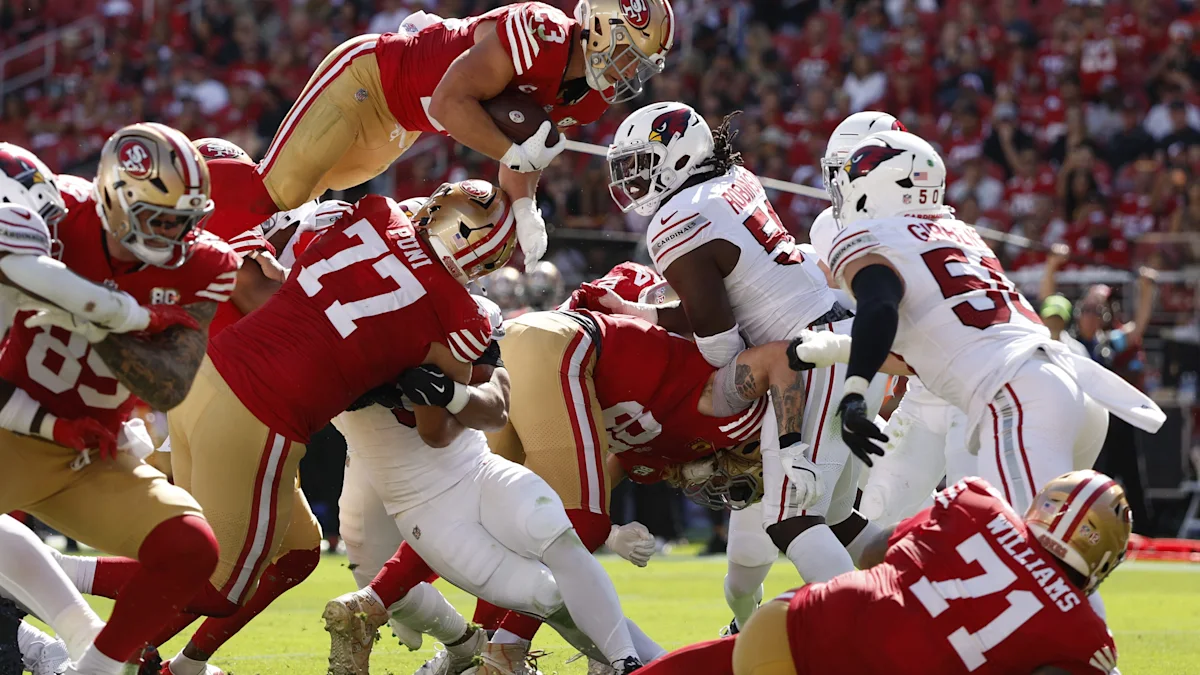
Arizona Cardinals' Week 3 game at San Francisco 49ers in photos
Last year, that felt understandable. With the additions of Josh Sweat and Calais Campbell up front, they didn't have to do as much to manufacture pressure. To some extent, Will Johnson had that effect on the secondary.
And through October, the Cardinals were once again a top-half defense. But after being battered by injuries, they were horrendous down the stretch. It's difficult to be creative with three new players in the lineup each week.
This year, though, the trend of Arizona's diminished creativity has only continued.
Here is how their usage of different schematic tendencies has changed over the past three seasons, per Fantasy Points Data. Blitz rate measures sending an extra pass rusher; disguise rate measures changing the secondary's shape after the snap; stunt rate measures swapping rush lanes for two or more defensive linemen.
Blitz rate: 33.8% (4), 23.3% (27), 23.3% (24)
Disguise rate: 34.9% (11), 36.7% (10), 20.0% (30)
Stunt rate: 23.3% (11), 24.0% (20), 17.8% (29)
In all three areas, the trend is clear: The Cardinals have become less creative. Even Rob Fredrickson, the former Cardinals linebacker and current radio analyst, acknowledged the difference on social media this week.
"Hey Nick, blitz Mack (Wilson) and Budda (Baker)," Fredrickson wrote. "They excel going forward.. struggle in coverage. Put Mack on the edge and bring in Cody Simon. Give the DL stunts to help them penetrate. Let's see what our DBs can do in Man"
Now, there is more nuance here than simply looking at the big picture numbers. Posed this week with a question about the Cardinals' lack of blitzes, Rallis pointed out a component of how those are measured.
Often — as is the case above — a blitz is charted as any time an extra pass rusher joins the rush. Sometimes, that can come with a dropping defensive lineman, meaning you're still rushing with four players.
Indeed, the Cardinals are rushing with five or more players at effectively the same rate as in 2024. The real change is in how their four-man rushes look. Whereas those rushes were once unpredictable — anyone could rush the passer from anywhere — they are now much more static.
"You get good at what you rep," Rallis said. "So people that major in those, I see those very effective still across the league. And if you're not majoring in it, it's probably not as effective for you."
So, why do the Cardinals no longer "major" in those looks?
"A big thing with simulateds is just, what's your personnel?" Rallis said. "And how well can those guys beat running backs? And can you find ways, within your simulateds, to get them on running backs?"
Two years ago, the Cardinals blitzed their linebackers like crazy. Wilson rushed the quarterback 9.9 times per game. Kyzir White was at 6.3. It worked because White was the defensive signal caller, patrolling the second level when Wilson blitzed, an area in which he excels.
This season, Wilson has rushed just seven times in three games. Jack Gibbens has rushed nine times in three games. That's partly because Wilson is now the signal caller, relied upon in the role that White once filled. And Gibbens is not as explosive off the edge as a pass rusher.
"Yeah, I miss blitzing, obviously," Wilson said recently. "But at the end of the day, we play whatever coach calls, and we believe in the plan he puts in every week."
If this is what the Cardinals defense does best, why did they not build around that philosophy? Since general manager Monti Ossenfort arrived, they've addressed their linebacker spots with cheap free agents and Day 3 draft picks. How could Wilson's role be different if the Cardinals paired him with a high-end coverage linebacker?
The Cardinals' player-acquisition strategy also helps explain another strange defensive trend.
So far this season, they've played base defense (looks with just four defensive backs) on 56.5% of snaps, the second-most in the NFL. Two years ago, that number was at 23.0%, the 21st most.
"We've played three teams that have very similar philosophies," head coach Mike LaFleur said. "… So just the ability to take some air out of some of the coverages that can happen in those (single linebacker) packages."
Essentially, the Cardinals have faced teams that prefer to deploy an extra running back or tight end. So to fill potential gaps in the run game, they've responded with an extra linebacker on the field.
That's a risk they might not need to take if they had more game-altering presences along the defensive line. But that group lacks players who can change the proverbial math in the run game, single-handedly filling two gaps.
And the Cardinals are paying the price. In those base packages, they're allowing 10.8 yards per pass attempt, the fifth-worst mark in the league.
Now, this is one element of the Cardinals' early-season defensive philosophy that could soon change.
"That, just by nature of the teams we were playing, feels like it's a little bit of a higher number," Rallis said.
As for Rallis' old blitzing tendencies, those might not be coming back. He denied that there has been a "philosophical change across the board," so maybe there's a chance.
"It's a game-by-game basis," Rallis said. "And then even into the flow of the game, how things are going. … There's always a time for it. And sometimes there's a time to just four-man rush and cover. And sometimes there's a healthy blend."
The challenge is finding that blend. For three weeks, it has evaded the Cardinals.
Topics in this story
Gathered from external sources. Rights to this text belong to whoever originally published it.