A Dramatic Autonomous Racing Crash Showed How Far Self-Driving Race Cars Have to Go
A late-race collision at the 2026 A2RL (Abu Dhabi Autonomous Racing League) event in Imola wasn't caused by AI alone. Here's what the hardware failure reveal...
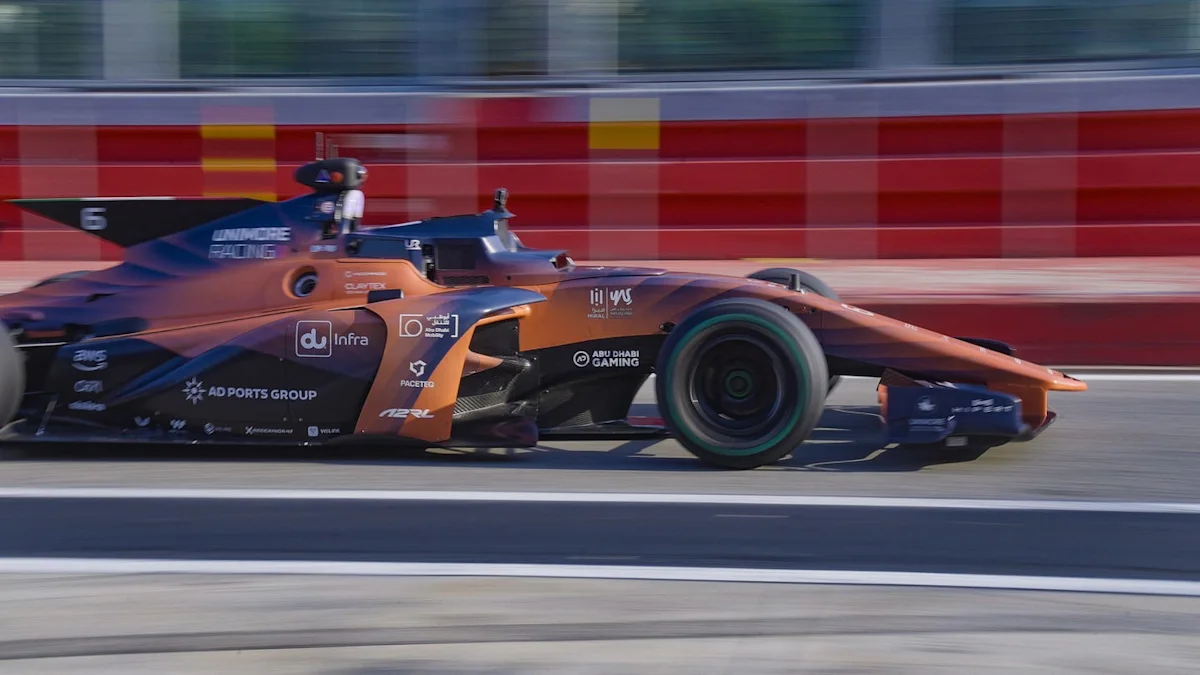
The inaugural round of the Abu Dhabi Autonomous Racing League, known as the A2RL, came to something of an ignominious end at Imola during Formula 1's 2026 Italian Grand Prix weekend when the race-leading car suddenly lurched to a stop and was subsequently smashed into by the competitor chasing behind. It was a big hit, the kind that usually results in trackside gasps and expressions of concern. Instead, the collision earned guffaws and glee, even from the supposedly objective journalists who were there to cover the racing action.
It may have been a joke to them, but for the hundreds of engineers who designed and implemented the software that powers these cars, mostly college kids from all walks of life, the A2RL is serious business. The crash was a sad result after years of refinement and weeks of on-site testing, and yet more proof of how punishing the Autodromo Enzo e Dino Ferrari can be for both humans and machines.
We covered the launch of the A2RL back in 2024 at the Yas Marina Circuit in Abu Dhabi, but you're more than forgiven if you haven't been following along. The series has only had one proper race since then, but it was an impressive one.
The 2025 event, also at Yas Marina where Formula One races, started more smoothly than the 2024 event, but like what just took place at Imola, it too ended rather spectacularly. Team Unimore Racing passed TUM for the lead on the second lap and held it until it came upon the car from Constructor. In trying to put it a lap down, the two collided. TUM avoided the carnage and took the win.
As he had at the 2024 event, Formula One driver Daniil Kvyat again faced off against an A2RL machine. This time it was German team TUM's digital driver. The robo car was given a 10-second head start and Kvyat 10 laps to catch it. That he did, but without much time to spare.
So, it still wasn't a demonstration of the omnipotence of machine learning, but still some impressive progress. In one year, the robo racers had evolved from being upwards of 10 seconds off the pace to a 1.5-second deficit behind Kvyat—still uncompetitive but approaching respectable.
Five teams qualified for the trip to Italy. They were, in qualifying order:
Unimore: Part of the University of Modena's High-Performance Real-Time Laboratory, and a previous competitor in the Indy Autonomous Challenge.
Polimove: Another home team, and another former Indy Autonomous Challenge player. Part of Politecnico di Milano.
TUM: A German team that spun out of the Technical University of Munich. Like Polimove, TUM has experience in Roborace and the Indy Autonomous Challenge.
Kinetiz: A multinational affair, with a team built of members from Singapore and the UAE.
C onstructor: Another German team, this one based at Constructor University in Bremen, Germany.
Each team runs an identical car, the same Dallara-built chassis used in the Japanese Super Formula series, specifically the SF23, but here running Honda K20C1 engines, turbocharged and making around 500 horsepower.
At least, that is, when they're not in the lead.
A2RL has devised a means of balancing the playing field to encourage more passing. "It's more or less a standard push-to-pass system," said Sascha Büttner. He's team lead at TUM. Every car except the leader gets an advantage. "They just get a higher boost pressure target and get more engine power. It's as easy as that. Just the lead car has reduced performance."
Büttner said it's roughly a 30-horsepower difference. Although that does give a bit of an air of Mario Kart to the proceedings, A2RL is far from the only series experimenting with ways to encourage passing.
Not only are all cars identical, but they're all running the same aero and suspension setups. Even tire pressures are fixed.
Although they have active data connections, the cars truly drive themselves. The data connection, then, is mostly to communicate things like yellow flags and feed telemetry back to the pit wall.
The cars are then outfitted with actuators for steering, shifting, and four separate brake controllers, enabling the digital systems to individually control each wheel.
The A2RL cars see the world through four radar sensors, three lidar sensors, and a bevy of cameras looking in all directions. Each car constantly generates a 3D map of the world around it, accumulating more than 300 gigabytes of data per lap. That's more than enough to give even the most digitally adept human driver a bad case of information overload.
Races are just 12 laps long, a length designed to appeal to today's attention-addled viewers, and there's a prize money purse for grabs. Back in 2024, it was $2.25 million, spread across several events. The 2026 incentive has yet to be announced.
Engineering enthusiasts certainly have plenty to get excited about in Formula One. The World Rally Championship has its own gritty, agrarian charm for those who like watching cars slalom between trees, and Top Fuel drag racing is compelling for anyone who wants to watch cars briefly, intensely violating the laws of physics.
Still, if the success of Netflix's Drive to Survive has taught us anything, it's that interpersonal drama evolves fandom to fanaticism.
But what's the point of motorsport without the people behind the wheel? Well, there are people in A2RL, just not in the cars. Although some teams are starting to use agentic development tools, the bulk of the coding and configuring in these machines is written by real human beings, mostly undergrad and graduate students, who are as passionate about motorsport as anyone on any other pit wall. They come from all walks of life, but every one of them I spoke with was intensely proud to be racing at a circuit as historic as Imola.
For them, A2RL is establishing itself as an excellent training ground for tomorrow's best automotive software engineers, whose skills are in increasingly high demand.
"The people that stay with us for three, four years, they get quite nice jobs," said TUM's Büttner. "A lot of them go towards racing, but also more software development. So, ARM, Nvidia... that branch also hires from the same talent pool."
A2RL also holds the promise of some strong commercial applications itself. One hope is for this series to become a crucible for self-driving technology. "All of the learnings coming from racing in A2RL, in an extreme condition, then they are transferable into real life," said A2RL's executive director Alessandro Tucci.
After all, if one of the teams' digital drivers succeeds in outpacing a Formula One pilot, wouldn't you feel better about having it drive you to work someday?
All those reasons, though, are ancillary to the core purpose of A2RL, which is right there in the name of the series. The A2RL is part of Abu Dhabi's Advanced Technology Research Council, or ATRC, which drives strategic initiatives in the region. ATRC has an initiative called Aspire, which funds competitions and challenges. A2RL is a prime example.
That makes this series something of a marketing effort, an attempt at establishing that country as a global hub for advanced autonomous development. "The ultimate goal, and the reason for A2RL, was to develop Abu Dhabi into the future hub for mobility, and this is still the goal," said Tucci.
The on-track action at Imola proved that the teams still have some work to do if they're going to sell that point.
Five teams lined up to take the grid late in a day that had earlier seen temperatures threatening triple digits. But by the time the driverless machines rolled away onto a slightly jerky formation lap, it was a relatively temperate 94 degrees.
Four teams completed the installation lap, but sadly, just as the green flag flew for the rolling start, the TUM car pulled into the pits. A braking issue cropped up as it was pulling out, a huge disappointment for the team that won the 2025 race.
By the end of the first lap, the Italian teams of Unimore and Polimove were separated by just a second, Unimore clocking a 1:58.974 lap. Abu Dhabi-based Kinetiz was a further five seconds back, with the German Constructor car 23.9 seconds in arrears.
Over the next laps, Unimore and Polimove extended their lead. Kinetiz quickly fell over 15 seconds back, though Constructor held steady at roughly 25 seconds.
By the halfway point of the race, the two leading cars were substantially picking up speed. The Polimove car had a big wiggle coming out of the final turn, but otherwise there hadn't been a lot of drama.
As the race continued, Unimore's lap times kept dropping, the car seemingly gaining confidence and grip. "It's reading the temperature of the tires, the grip on the track, sensing errors and corrections and then adjusting the performance," said Matteo Pini, the software integration lead at Unimore. It was genuinely entertaining to watch the cars get visibly quicker lap after lap, even if they all opted to avoid Imola's classic tricolore-painted curbs.
By lap eight, the Unimore was down to a 1:40.085. Polimove was still right behind, slightly more than a second adrift now, slipping back a tenth or two with each lap.
That was until lap 10. Coming out of Imola's tight, final left-hand turn, the Unimore car lurched to a stop. The Polimove car tried to swerve inside but couldn't get clear. The two collided heavily.
That tight Rivazza complex is a series of corners which has caught out many human drivers over the years, but the fault here can't be placed upon the topography of the turn. Instead, it was a hardware failure. Pini from Unimore told us after the race that an onboard switch, a device that aggregates the signals from the car's various sensors, failed mid-turn.
In an instant, the car was blind, creating a potentially unsafe condition. "So, the car did an emergency brake," said Pini. "Polimove tried to brake and avoid, but at that speed and that close, even a human driver maybe couldn't do it."
Both Polimove and Unimore ended their day in the gravel trap. The Kinetiz car, which had been hovering about 20 seconds back, slowed for the incident, then cleanly made its way into the lead. The Constructor car also passed, and the race finished with them occupying the top two slots.
Unimore's 1:40.085 lap time stood as the fastest of the day. We don't have a human time to compare against this year, but Imola is a track that has seen plenty of formula action over the years. The closest to A2RL's modified Super Formula machines is probably a Formula 2 racer, which runs a similar Dallara chassis and makes comparable horsepower.
The fastest Formula 2 Imola race lap is 1:28.353, set by Jehan Daruvala back in 2022. That's nearly 12 seconds faster than the A2RL teams could manage. It's not apples-to-apples, of course, but clearly a far cry from the 1.5-second human-machine delta from the previous A2RL event in Abu Dhabi.
At the end of the day, members of UAE's team Kinetiz stood atop the podium bathed in a glorious Italian sunset and hoisted a trophy high. They continued the time-honored motorsports tradition of celebrating the misfortune of the competition. If anything, that's easier in A2RL, when the only things being injured are composite body parts and engineering egos. Both are easily fixed.
The on-track performance, though, might make it harder to boost A2RL's reputation on the global stage, especially given the heckling that followed the crash. It was indeed a curious-looking incident, but it was far from the only impact at Imola that day. Four other racing classes had run earlier, formula and GT series with human drivers, and a few of those sessions likewise ended with crumpled cars hauled back on flatbeds.
In fact, far more incidents were caused by human racers than by robotic ones that day, and yet I didn't hear anybody laughing at them.
Will A2RL ever get the same respect? That probably won't come until the cars start legitimately beating humans at their own game. Based on this past weekend's performance, that moment is clearly still a fair few years off, but I'm confident it's coming.
Topics in this story
Gathered from external sources. Rights to this text belong to whoever originally published it.