Orthopedic surgeon discusses Commanders QB Jayden Daniels' options
What are all of the options for Jayden Daniels as he looks to return to the field?
"Just follow the science" is a familiar refrain in recent years; however, if we learned anything from the pandemic, it is that some science is much clearer than others, and in some areas of science there is not the uniform agreement that the public is often led to believe.
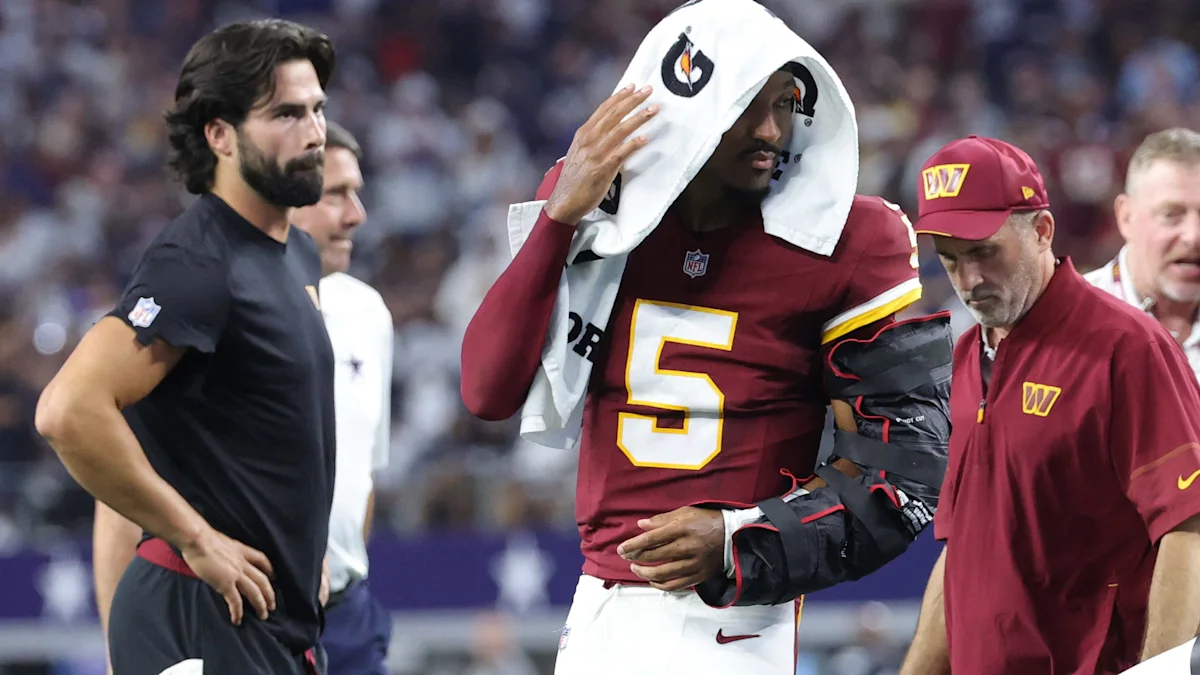
So how about Washington Commanders quarterback Jayden Daniels' dislocated elbow ? What is the diagnosis? What is the prognosis? What are the options? And what is the timetable?
Dr. Michael Alaia is a Sports Orthopedic Surgeon at NYU and was a guest on Grant & Danny on 106.7 The Fan Tuesday. Dr. Alaia shared his professional experience and insights on the Commanders quarterback's options and recovery. Daniels extended his left arm to regain his balance as he fell Sunday, and unexpectedly, his elbow moved/dislocated.
Here are some selected quotes from Dr. Alaia's discussion with Grant and Danny.
Keep in mind this is the second dislocation of Daniels' left elbow within the last nine months, and that he was treated without surgery.
"The first thing that runs through my head is that when someone has the same injury on a joint that has been treated without surgery, my worry is that if this doesn't get stabilized, perhaps it might continue to happen...so my biggest fear is that this might be more of a recurring type of injury, at this point, if it is not addressed in a different way, shape, or form."
"I think that many elbow dislocations without significant injuries to the ligaments, bone, or cartilage are treated non-surgically. There have been many athletes that have had elbow dislocations, and they are out for a few weeks. They have a full, uneventful recovery, and they never have a dislocation again. That usually is the norm."
"It would be very rare to subject an athlete to a season-ending surgical procedure to reconstruct ligaments when the great majority of the time the athlete is going to be fine without anything done...But when they start happening more than once, that's when the worries start getting in your head. Okay, maybe we need to start doing something."
"They have to look at the MRI. They have to see if there are any structural damages. See what the ligaments look like, are there any significant tears? Are there any loose bodies or cartilage damage floating around the joint? Are there any fractures etc.?"
"The conversations between the player, the physicians, the training staff, and agents are detailed conversations. They are going to run through every possible outcome here. They are going to go through the gamut of treatment options. At the end of the day, the player makes the decision as to what they would like to do."
"As long as the player is educated about risks and benefits of proceeding either non-surgically or surgically, that's when good medical care is delivered."
"Bracing definitely has been shown to help particularly unstable elbows. There have been players that play in braces if they have evidence of elbow instability. Sometimes surgery is indicated on athletes...it all depends on the symptoms, quality of life, and expectations about the stress through the joint that are going to be (occur)."
Topics in this story
Gathered from external sources. Rights to this text belong to whoever originally published it.