2026 Fantasy Football All-Bust Team: Second-year players, 1 trendy sleeper among those to be cautious when drafting
These players comprise a team that we are avoiding in drafts for 2026 fantasy football.
You can't beat a good thriller movie. Seven, Zodiac, The Shining … the list keeps going. They're all classics. And keep the viewer (me) locked into the plot, not just by the actors giving standout performances. But the clues sprinkled throughout the sequences. Tidbits of info that come together like pieces of a puzzle all at once when the time is right.
For us, that time is now. We've walked through every phase of the draft. Isolated profiles of what busts look like. You've even got a list of players to avoid based on their ADP. Now, let's put it all together. We're going to assemble the All-Bust Team of the 2026 season.
We never talked about identifying busts at the QB position. Partly because their ADPs are sparse and the same mechanisms (e.g., change in scheme, added competition) for our core positions don't apply. But I did find a way to hone in on when we should be the most cautious when drafting our starting passer.
I used the same scaled-threshold approach as in our early-round discussion . Failing to meet expectations relative to draft price highlights where waiting on QB has its merits. In either case, the QB1-4 and QB5-8 buckets hold the most risk.
So, I'll be honest. Looking at Yahoo's ADP , Joe Burrow (QB4) sticks out with the highest bust potential relative to his peers. All the rest have mobility in their game. But I'm a (long-suffering) Bengals fan. As a result, I shifted to the next cluster and found a suitable replacement.
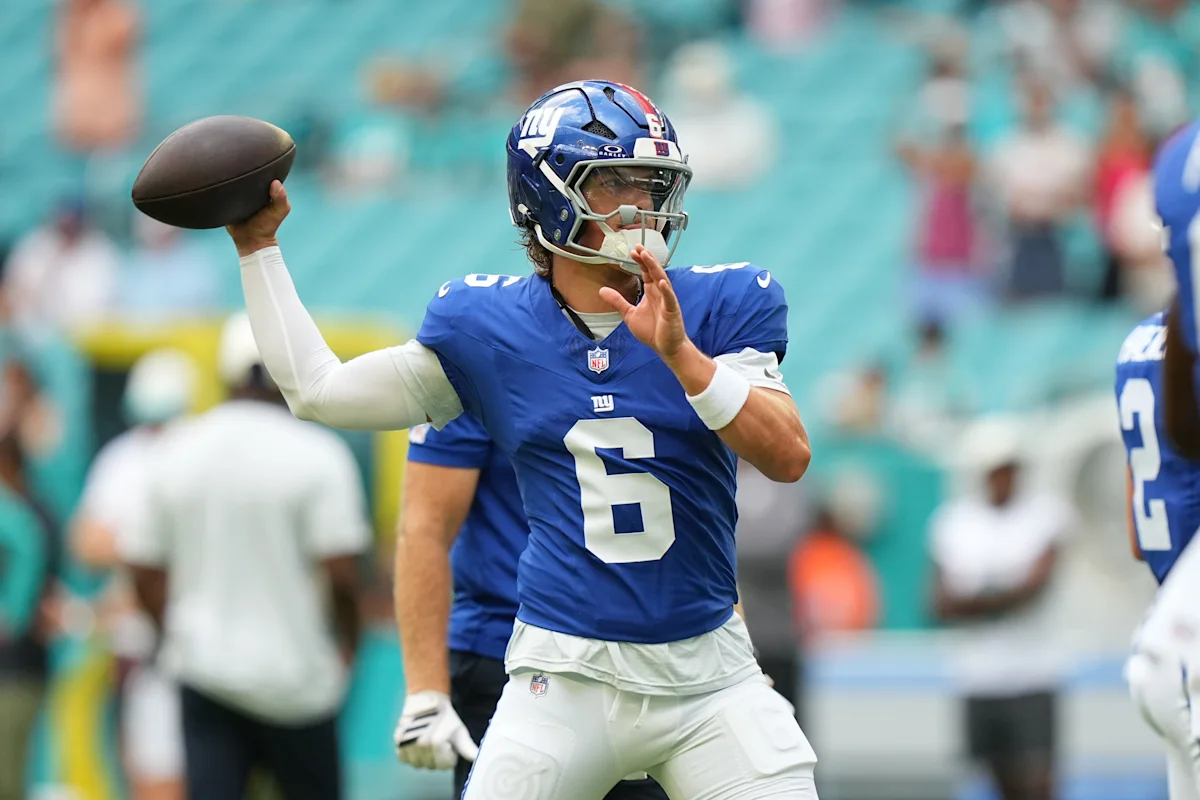
Jaxson Dart's mobility and off-script throwing talent were instant attention-grabbers. He finished the season with top-five marks in rushing yards and TDs. After seeing his college tape, that's exactly what drafters wanted. But without the Konami Code, Dart's throwing ability would've left us with more questions than answers.
Completion Percentage Over Expected: -0.2%, 20th
Dart fell below the league average across every efficiency metric. Even his pressure-to-sack ratio was seventh-worst. His trips to the blue tent should also be a concern to drafters. But let's assume he stays healthy. We still have the health of his WR1 to consider.
Malik Nabers' slow ramp-up has been positive throughout the course of the offseason. But there are still question marks about his Week 1 availability. And a cast of role players, along with 33-year-old Odell Beckham Jr., are backing up Nabers. Between Dart's own health and the availability of his pass-catchers, Dart is the first to make the All-Bust Team.
New Orleans handed Etienne real money this offseason. What the Saints didn't hand him was a role that actually uses him.
Now, I'll walk this call back if offensive coordinator Doug Nussmeier's assessment of his new RB (as a receiver/running back) turns into a reliable target share. But this is HC Kellen Moore's offense. And it hasn't prioritized rushers as pass-game options in the past.
Over the past five seasons, Moore's playcalling has left rushers in the bottom half of the league in target rate. And that's across all players at the position. Not just the starter. Which brings us to the other issue for Etienne.
The backfield split didn't resolve as most expected. After what appeared to be a farewell tour, Alvin Kamara is back for another year. Sure, he's already nursing an injury. But it's hard to see Etienne picking up the third-down, two-minute role with a savvy vet like Kamara on the sideline. Accordingly, the former Jaguar profiles as the type of RB with a fragile workload we should avoid.
Judkins looks like a workhorse on paper. On tape and in the numbers, the details get murkier.
Now, I get it. I'm highlighting a single game against a divisional rival. Fans would argue that I'm stacking the deck against him. OK, fine. I'll expand the scope of the argument to the entire season.
Rushing Success Rate: 31.6%, 19th (out of 19 qualifiers – min. 50% of team rush atts.)
Well, to be fair, I zoomed in on Weeks 3-15. Essentially, a game after he got up to speed (started in Week 2) and before he got injured in Week 16. And during that time, only Jonathan Taylor had a higher share of his team's totes. But more volume didn't equate to more productive touches.
The Browns' rookie had the fourth-most carries but the 13th-most yards. Rico Dowdle generated 213 more than Judkins, while splitting time with Chuba Hubbard. And if the Browns' QB situation has you concerned (and it should), Judkins' outlook for '26 is one we should let our leaguemates acquire.
Drafters at the 1-2 turn will have a hard time passing up Nico Collins.
And honestly, there's no obvious reason to consider anyone else. Over the past two seasons, Collins is one of eight receivers with back-to-back seasons over 2.0 YPRR. And just one of four to do it with a receiving aDOT over 10 air yards. However, he's not the one I'm worried about.
EPA per Dropback: 7th (2023 – among all starters), 27th (2024), 13th
We haven't seen C.J. Stroud get back to the heights he achieved in his rookie season. Houston's playoff game against New England officially put us on "Stroud Watch." On the one hand, we should be interested after the Texans acquired veteran offensive linemen and used Day 1 draft capital to bolster Stroud's protection. But the loss of WR Jayden Higgins, while boosting Collins' projected target share, lessens the versatility of the passing game. So, while betting on talent is the right approach in the early rounds, the ability of the receiver and their QB should be on our minds.
I'm not sure what a bell-cow receiver is. But I'm into it.
If any WR is deserving of the title, it's Garrett Wilson. Since entering the league in '22, if Wilson's been on the field for more than 10 games, his target shares have been no less than 25.0%. The former Buckeye has averaged 8.7, 9.9, and 9.1 looks per game. And 2025 didn't start any different (9.3), but a hyperextended knee sidelined him for the remainder of the season.
However, there's a problem. That high-end workload didn't matter.
2022: 12.7 (PPR PPG), 28th (min. 10 games)
For reference, Wilson's 2026 ADP sits at WR20. He's finished ahead of that just once. The rest of the time, he's been in the high-end WR3 discussion. The excuse has always been quarterback play, and it's not an unfair one — but the new answer isn't obviously better. Geno Smith has never led a wide receiver to a 15+ PPG season across six years as a starter.
The Jets also added two first-round rookies (Omar Cooper Jr., Kenyon Sadiq) to a receiving corps that didn't need more mouths to feed. Wilson's talent has never been the question. The problem is that gaudy target shares keep not showing up on the scoreboard, and there's no clear reason 2026 breaks that pattern.
Oh, wait. We've got the other onesie position. Just like in the QB conversation, I used the same approach to find where bust rates are likely to occur based on draft cost.
Again, we're looking for guys that can pay off their pre-season ADP. Luckily, the early-round players pay off more often than not. However, it's that middle class of TEs that let us down. And, of course, the guy I took in our expert league immediately stood out.
When healthy, Kraft's per-catch numbers are legitimately special.
However, the Packers are already telling us they're not fully sure he'll be on the field enough to matter. Now, it's fair to question how much of the truth the Packers are telling us. But it's hard to lie with your wallet.
Signing a proven, 10-year veteran receiving tight end this late in camp isn't a depth move for the No. 3 spot. It's insurance for exactly the scenario where Kraft can't handle a full workload. And reports already suggest Green Bay plans to use both in 12-personnel sets, capping Kraft's target monopoly even in games he's fully healthy.
He's still the clear TE1 in Green Bay. But drafting him as a top-five tight end means betting against both his own recent multi-ligament knee injury and a front office that just paid real money to hedge against it.
I've mentioned this before, but I usually root for the underdog. The guy that most folks overlook. And players who earned late-round draft capital but rise in popularity will always have my support.
All the way up until I have to pay extra to draft them.
Parker Washington's second half of 2025 was special. It helped keep Jacksonville in the playoff picture. However, the circumstances behind his ascension are the part getting glossed over.
Target Rate: 11.1% (Weeks 11-14), 24.4% (Weeks 15-18)
First, Washington's climb up the pecking order happened over four weeks. Yes, we saw double-digit target outings from him earlier in the season (Weeks 3 and 7). But the peaks didn't outweigh the valleys. It wasn't until this short window (the most important time of the season) that we saw the breakout. And that same scenario may be hard to replicate in '26.
Washington's target-share explosion happened when the receiver room was missing its top-two guys, Travis Hunter and Brian Thomas Jr. Hunter is healthy again, even if he's leaning more toward defense by design. And Thomas is good to go. Plus, Jakobi Meyers and Brenton Strange, both real target earners in their own right, never left.
The bullish case treats Washington's role as settled. Drafters are acting as if he's the unquestioned WR1. However, when you consider that his breakout occurred against a depleted depth chart, it's a genuinely open question whether it survives contact with a complete one.
Topics in this story
Gathered from external sources. Rights to this text belong to whoever originally published it.