B/R's Favorite 10 NHL Goalie Masks of All Time
While Jason Voorhees made the goalie mask something to fear, goalies across the NHL have made it their palette for creativity and intimidation for opponents for decades. Of the hundreds, if not thousands, of different masks over the years, many of them set themselves apart from the pack by becoming iconic.
While Jason Voorhees made the goalie mask something to fear, goalies across the NHL have made it their palette for creativity and intimidation for opponents for decades. Of the hundreds, if not thousands, of different masks over the years, many of them set themselves apart from the pack by becoming iconic.
Whether it's the beauty of the art, the iconography included, or the grim reality, masks have given goalies a chance to make their personalities seen by everyone. Picking out our favorites from the time Jacques Plante started wearing a mask full-time in 1959 until now has made for a lot of fun remembering guys and thinking back on what they wore during their careers.
We've assembled a gallery of our favorite masks all-time, and although we're not ranking them, we are appreciating the players and their artists who made these classic looks possible all the same.
There's arguably no mask more famous than the "face-hugger" mask worn by Bruins goalie Gerry Cheevers.
Cheevers' mask was painted with stitch marks where he would've been cut by pucks that went off it. While goalies were using masks in the early 70s, Cheevers was one of the first to have his painted up, and what a way to do it. His style set a bar that's been hard for most to reach when it comes to art and intimidation.
Not only were the stitches off-putting, but they also served as a reminder to opponents that, yes, he will stop the puck at any cost, whether it's with the pads, trapper, or even his face if necessary. Cheevers' mask goes real hard and remains the gold standard to this day.
The 80s and 90s helped establish so many classic goalie mask looks that left a legacy, and Mike Richter's "Lady Liberty" mask was one of those.
Richter helping lead the New York Rangers to their first Stanley Cup in 54 years in 1994 helped make all of those players household names to a degree, and Richter being an American and leading New York City's team to a Cup made him a celebrity, and his mask embodied everything about the Rangers, New York, and ultimately the United States as well.
After all, Richter was the goalie for Team USA at the 1996 World Cup of Hockey, which won gold as well, and did so donning the same mask. Richter wore this mask throughout his career, and his big-game legacy became attached to that look. Even Henrik Lundqvist paid homage to Richter and his mask during his own incredible career with the Rangers.
Ken Dryden was one of the great gentlemen of hockey, and he was also a goalie with an iconic mask as well.
Dryden's "bullseye" mask became iconic while he and the Canadiens stomped across the NHL during his career. It would've been wrong for a team as good as the Habs not to have a goalie with a legendary look, and Dryden's bleu, blanc et rouge mask more than accomplished that.
Dryden's legacy in Montréal is so pronounced, and he was so beloved and respected that upon his passing, the Canadiens paid tribute to him in a simple, yet beautiful way by displaying his mask atop the goal with a spotlight on the net during the 2025 home opener on Oct. 14, 2025.
Although Gary Bromley may not be the most famous NHL goalie, the guy they called "Bones" because of his slight build used that nickname to create an incredible look for his mask.
Bromley's skull-face mask is the kind of thing you'd expect in a horror movie or a bank heist. Instead, he wore it to stop pucks during his time with Vancouver in the late 70s-early 80s.
The ultra-realistic looking skull is as hardcore looking as anything we've ever seen on a goalie mask and while modern masks don't lend themselves well to this sort of artwork, masks of those days didn't go hard like this either. The "Bones" mask is as good as it gets for any kind of mask.
One goalie who set the tone immediately upon arriving in the NHL with their play and their mask art was Felix Potvin.
"The Cat" had the kind of play that inspired Leafs teammates and fans alike, and his classic mask art was both ultra cool and ferocious. The animalistic style of the art stood out, and the design he used in Toronto was one he kept throughout his career in Long Island, Los Angeles, Vancouver, and Boston, albeit with those teams' colors instead.
Potvin's style was uniquely his, and when he debuted it in Toronto, it created a look that stayed with him for good.
When you've got a nickname like "CuJo," coming up with a great mask idea isn't all that difficult. After all, when you've got an evil dog from a Stephen King book to set the tone, the rest is gravy, and for Curtis Joseph, adopting that design became his own legacy.
Throughout Joseph's career, from St. Louis to Edmonton to Toronto to Detroit, Phoenix, and Calgary alike, the snarling beast adorned his mask in the various team colors to go with it. We threw it back to his St. Louis mask because that's where it all began, but his Toronto mask is worth noting as well for its ferocity.
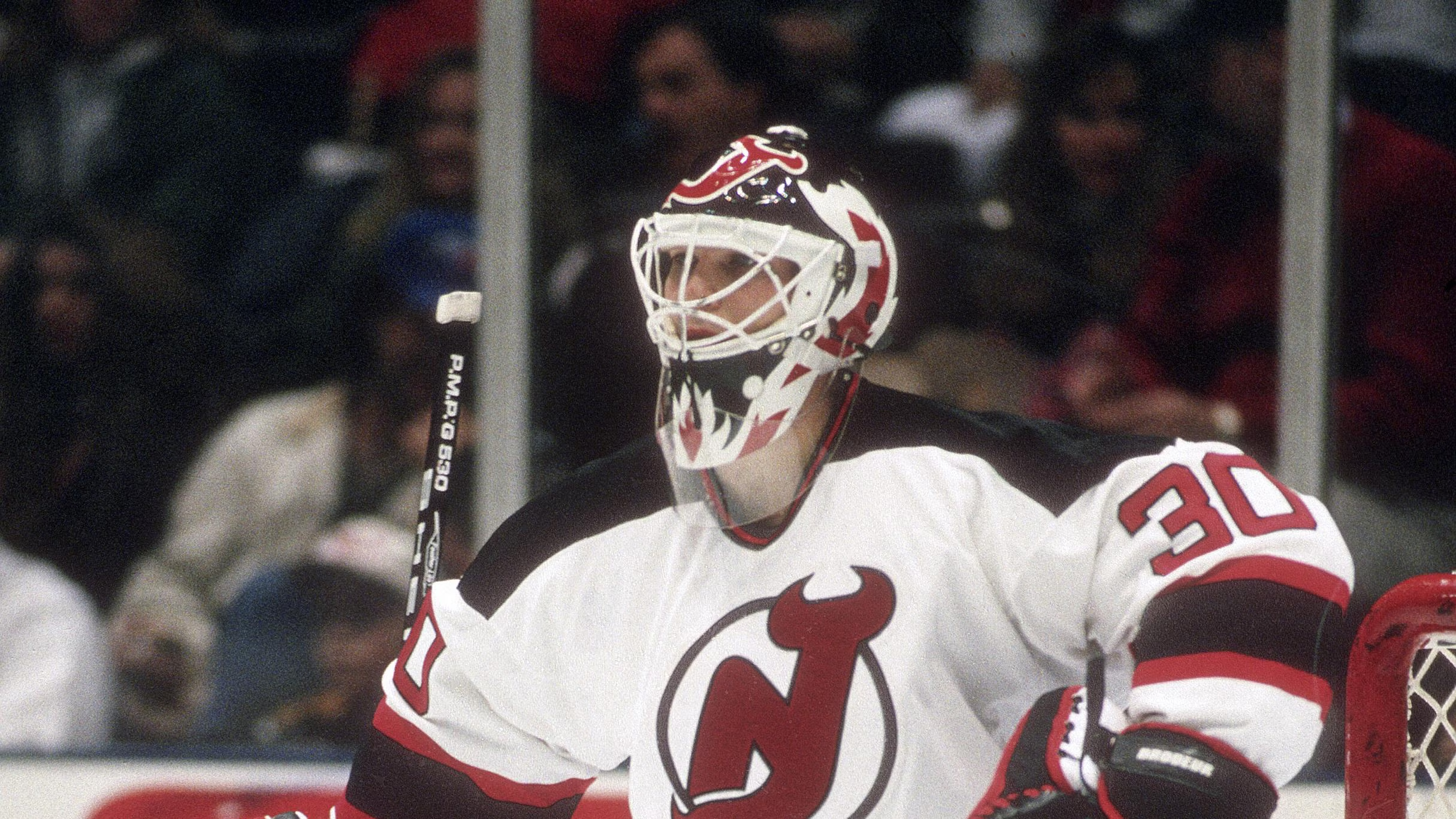
Sometimes a goalie mask is cool because of the greatness attached to the player, and Martin Brodeur helped make his mask iconic by simply being one of the best of a generation.
Brodeur's Devils legacy is untouchable. Three Stanley Cups, four Vezinas, and, of course, a spot in the Hall of Fame — all of it done with his particular style, the Devils mask on his head.
The red, black, and white mask to go with the Devils' colors made it known your team was in for a long night, even if you got through New Jersey's defense to get to the net, all because Brodeur was there waiting to stop you in the end.
In his time with the Edmonton Oilers, Grant Fuhr helped them win multiple Stanley Cups. He also helped set the standard for incredibly cool masks.
Fuhr wore numerous styles of masks in his time with the Oilers, but the one we remember best featured the orange oil drop below the cage and a wild blue, orange, and white flurry of design on the rest of the mask.
When a look helps win Cups, it gets to be popular, but Fuhr's style and cool-under-fire approach to the position helped out, too. We could've picked any number of Fuhr's other masks from his career in St. Louis, Toronto, Buffalo, and Los Angeles, but his Oilers masks set the bar.
What Gary Bromley's skull mask started in the 80s, Miikka Kiprusoff's mask with the Calgary Flames was made into art.
Kiprusoff's screeching skull mask is truly something else, with the skulls on each side of the helmet, as well as the face of a skull with glaring eyes on its chin. Yes, it's got his nickname and number on it, but would you even notice it without having it pointed out? The skulls demand your attention.
Kipper's mask was really one of a kind in that it leaned into such a heavy metal-like style and yet made it so incredibly cool.
You could argue that there's no movie scarier than "Jaws," and you could also argue there's no goalie mask scarier than the one Brian Hayward wore during his time with the San Jose Sharks.
Hayward's shark head mask that featured his face in the open mouth of a great white shark, teeth and all, is truly one of a kind. The mask's art is simply a shark opening wide like you'd see in "Jaws," and its realistic appearance is so incredible it's a wonder we haven't seen more mask art inspired by it.
Hayward was with the Sharks at their inception, and having a mask done up just like "Jaws" made all the sense in the world. You could argue his mask helped give the new team even more attention just by being one of the coolest things anyone's seen in a long time.
Topics in this story
Gathered from external sources. Rights to this text belong to whoever originally published it.