TCU Preview
Kansas finally won a Big 12 game. Will Jayhawk fans get another treat, or is the trick on us?
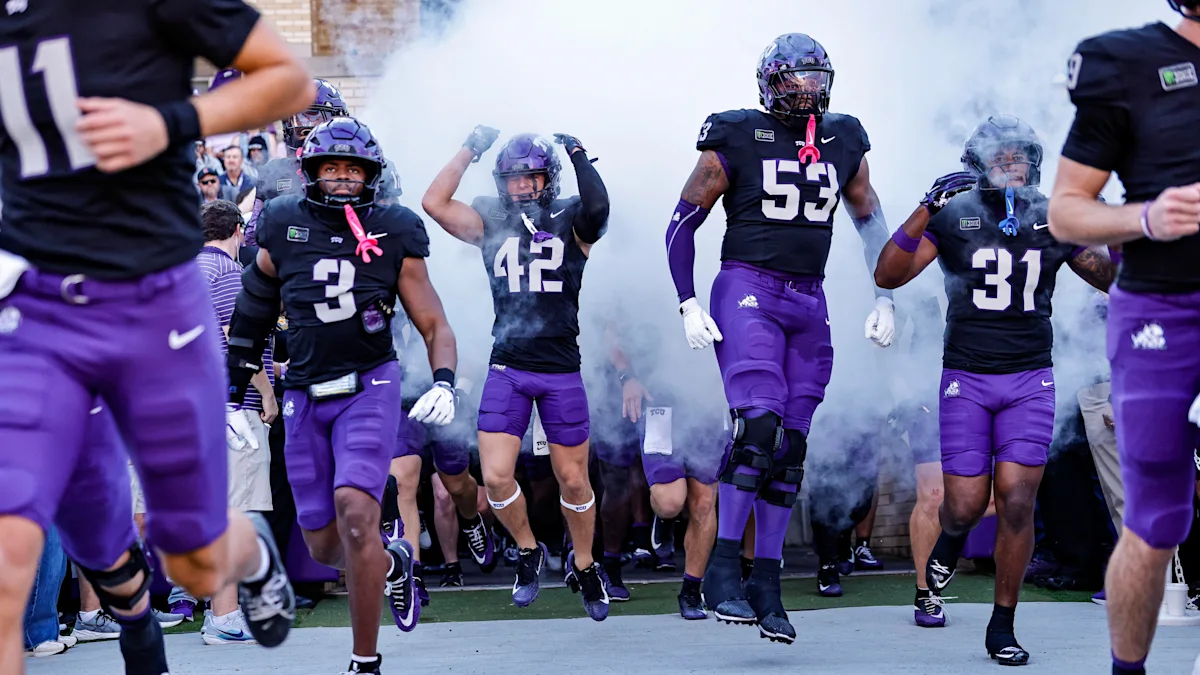
Last time out, surprise surprise, Kansas won a Big 12 football game!
It took a fourth-quarter comeback, a touchdown with 73 seconds remaining, and a blocked field goal with 18 seconds left, but the Jayhawks defeated Baylor 25-24 last Saturday.
Now Kansas travels to Fort Worth to face a TCU team that has one of the best defenses in college football, a surprisingly ineffective offense, and the same 3-4 record as KU.
The Horned Frogs have allowed just 4.1 yards per play against Big 12 opponents, held #9 BYU to 216 yards, and surrendered only three passing touchdowns all season.
Meanwhile, Kansas has demonstrated that it can move the football against legitimate Big 12 competition. The Jayhawks have also demonstrated a remarkable ability to make that considerably less useful than it sounds. Turnovers, sacks, and wasted scoring opportunities have been recurring problems, and last week's victory over Baylor required overcoming all three.
Both teams are 1-3 in conference play. Both need a win to keep their bowl hopes alive.
And on Halloween, one of them is going to walk away with a little more hope for November.
Kansas (3-4, 1-3 Big 12) travels to Fort Worth to face TCU (3-4, 1-3) on Saturday, October 31, at Amon G. Carter Stadium. Kickoff is scheduled for 2:30 p.m. Central on FS1.
TCU leads the all-time series 27-9-4 and has won five consecutive meetings. KU's last victory over the Horned Frogs came in Lawrence in 2018, a 27-26 thriller that ended when TCU fumbled near the goal line while attempting to score the winning touchdown.
Ah, yes. Our very own butt fumble game . Mark Sanchez ain't got nuthin' on us.
Anyway. The Horned Frogs opened their season with a 15-10 loss to North Carolina in Dublin, Ireland. They followed that with victories over Grambling State and Arkansas State before losing to UCF and #9 BYU. TCU then defeated Baylor 17-6 before falling 24-20 to West Virginia last Saturday.
As mentioned above, Kansas defeated Baylor 25-24 last week. The Jayhawks are trying to win consecutive conference games for the first time this season. TCU, meanwhile, is trying to avoid falling to 1-4 in Big 12 play despite having one of the nation's stingiest defenses.
Let's begin with the most obvious problem Kansas faces Saturday. TCU's defense is legitimately excellent. For the K-State fans reading this (and I know you are), that means they're really, really good.
The stats don't lie, and they don't look impressive just because the Horned Frogs have played Grambling State and Arkansas State. Through four Big 12 games, TCU has allowed approximately 4.1 yards per play. The Horned Frogs held #9 BYU to 216 yards and 17 points, and Baylor managed just six points.
For comparison, Kansas gained 421 yards against Baylor last Saturday, but needed 86 plays to do it. That's just 4.9 yards per play, considerably less impressive than the total yardage suggests. The Jayhawks also rushed for 209 yards on 56 attempts, an average of only 3.7 yards per carry. Dylan Edwards accounted for 156 of those yards, but needed 30 carries to get there.
None of that is meant to diminish KU's comeback victory. But it illustrates the difference between gaining yards through efficiency and gaining them by running a whole bunch of plays.
And TCU's defense is designed to make both difficult.
The Horned Frogs are allowing just 3.1 yards per rushing attempt, while opposing quarterbacks have completed only 52.9% of their passes. TCU also allows fewer than one-third of opposing third-down attempts to be converted. Kansas has demonstrated that it can run the football effectively, particularly when Edwards finds some space. But the Jayhawks have also struggled when defenses force Marshall into obvious passing situations.
Against Baylor, Marshall completed 17 of 30 passes for 212 yards, averaging 7.1 yards per attempt. That's respectable, but he also threw two interceptions and was sacked five times. That's a concerning combination against a defense that has been particularly effective at limiting passing opportunities.
The Jayhawks will need to establish something on the ground, but simply handing Edwards the ball 30 times probably isn't going to be sufficient. Marshall will need to contribute both as a passer and a runner, and Kansas will have to avoid putting itself in third-and-long situations. (At least act like you've never heard me say that before.)
The good news is that Kansas has enough offensive talent to challenge this defense.
The bad news is that TCU has demonstrated it can make considerably better offenses than KU look pretty ordinary.
Can Kansas pressure the quarterback? TCU quarterback Jaden Craig has been productive this season, completing 67.5% of his passes for 2,066 yards, 11 touchdowns, and six interceptions.
But perhaps the more interesting number is 20, which is how many sacks TCU has allowed through seven games. For an offense that relies heavily on its passing game, allowing that many sacks is a significant problem. And it's one Kansas should be able to exploit.
Leroy Harris III has 11 tackles for loss through seven games, ranking among the national leaders. He's been KU's most disruptive defensive lineman, and his ability to get into the backfield could be particularly important Saturday. It is notable that TCU's rushing attack hasn't provided much support for Craig, either. The Horned Frogs average just 3.3 yards per carry, including sacks, with Jeremy Payne accounting for much of their production.
That means Kansas should have opportunities to create favorable passing situations by limiting the running game.
But that's where things get interesting.
Craig has several legitimate receiving threats. Ed Small leads TCU with 38 receptions for 514 yards, while Jordan Dwyer and Kari Ashley provide additional options. Tight end Ka'Morreun Pimpton has four touchdown receptions, and TCU's tight ends have accounted for seven receiving touchdowns.
The Horned Frogs can hurt a defense in several different ways through the air. Against West Virginia last week, Craig threw for 372 yards, and TCU finished with 484 yards of total offense on 82 plays, an average of 5.9 yards per play. That's a pretty good offensive performance.
Except TCU only scored 20 points (and lost the game).
Kansas needs to find ways to make Craig uncomfortable without giving up the explosive passing plays that have been a problem in recent weeks. If Harris and the defensive front can generate pressure without requiring additional blitzers, the Jayhawks should have opportunities to force mistakes. But if Craig has time to find Small, Ashley, or Pimpton against a secondary that has occasionally struggled in coverage?
KU's defense has been an interesting study this season. The Jayhawks have occasionally been pretty good at preventing opponents from scoring, even when they haven't been particularly effective at preventing them from moving the football.
For example, last week against Baylor, Kansas allowed 358 yards on 66 plays, an average of 5.4 yards per play. That's not an especially impressive defensive performance, but Baylor's offense scored only 17 points. BU's other seven came on a 42-yard interception return. Kansas also held Baylor to 122 rushing yards on 35 carries, or 3.5 yards per attempt. The Bears converted just five of 15 third downs and one of three fourth downs.
And despite getting into position for a potential game-winning field goal, Baylor couldn't finish the job. Obviously, blocking a field goal in the final seconds isn't something Kansas can count on every Saturday. But limiting touchdowns and forcing opponents to settle for field goals is a perfectly reasonable defensive strategy, particularly against an offense that has struggled to finish drives.
And TCU has certainly struggled in that department.
Against UCF, the Horned Frogs gained 343 yards, averaged 5.1 yards per play, and scored just 13 points. Four turnovers didn't help. Against BYU, TCU actually outgained the Cougars on a per-play basis, 4.7 to 3.5, but managed just 10 points. Even in their victory over Baylor, the Horned Frogs averaged 5.0 yards per play and scored only 17 points.
TCU gained 484 yards on 82 plays (5.9 YPP), collected 29 first downs, controlled possession for nearly 38 minutes, and lost 24-20. That's four consecutive Big 12 games in which the Horned Frogs have failed to score more than 20 points, despite averaging approximately 5.2 yards per play.
Moving the football hasn't always been the problem. Doing something useful with it has been.
The Jayhawks absolutely need to limit explosive plays, tackle effectively, and make TCU execute in the red zone. If the Frogs want to drive 70 yards and kick a field goal, fine. Do that three or four times, and we'll see where things stand.
Of course, this strategy works considerably better when the offense scores touchdowns of its own.
Kansas converted just five of 19 third downs against Baylor. That's 26.3%.
Fortunately, Lance Leipold apparently decided that third downs were optional, because the Jayhawks attempted eight fourth-down conversions and succeeded on five of them. That includes Marshall's 34-yard touchdown pass to Nik McMillan on fourth-and-long early in the fourth quarter.
Kansas also overcame two interceptions, five sacks, a missed field goal, and two failed two-point conversions.
There's something admirable about overcoming that many mistakes. There's also something concerning about making that many mistakes in the first place. Against TCU, those wasted opportunities could be considerably more expensive.
The Horned Frogs have allowed opponents to convert just 30.6% of their third downs. They have also limited opponents to three passing touchdowns all season. This is not a defense that is likely to surrender a whole bunch of scoring opportunities. If KU repeatedly finds itself facing third-and-long, gives away possessions with turnovers, or fails to capitalize after moving into scoring position, the Jayhawks may not get enough opportunities to recover.
Fortunately, TCU has its own problems in that department. The Horned Frogs have committed 12 turnovers this season, including six interceptions and six lost fumbles. Against West Virginia, TCU gained 219 more yards than the Mountaineers and still lost by four points.
Both teams have demonstrated that they can gain yards. Both have also demonstrated a remarkable ability to make those yards less valuable than they should be. So, I don't expect Saturday to be a particularly high-scoring affair. I expect both teams to move the football between the 20s, struggle to finish drives, and spend a fair amount of time deciding whether they should attempt a field goal or go for it on fourth down.
And given what we've seen from both teams, I'm not convinced either decision is going to work particularly well.
This could come down to field position, turnovers, and which team manages to turn a couple of scoring opportunities into touchdowns instead of field goals. Or, knowing Kansas football, which team manages to miss fewer field goals.
Either way, I'm expecting a game in which every point matters.
I can see a path to victory for Kansas. TCU has struggled to score against Big 12 opponents, its running game isn't particularly effective, and the Jayhawks have demonstrated that they can move the football against good defenses. But TCU's defense is legitimately excellent, and KU has had enough problems with turnovers, negative plays, and inconsistent execution that expecting offensive fireworks seems foolish.
On the other side, I wouldn't be surprised to see Craig move the football between the 20s, particularly through the air, only to have drives stall in or near the red zone.
I'm expecting a relatively low-scoring game with plenty of field goals. Or field goal attempts. (The total is 46.5 points as of Thursday night — do with that what you will.)
Kansas finally gave us a treat against Baylor last Saturday. But after everything we've watched this season, I'm not convinced the Jayhawks don't have another trick waiting for us in Fort Worth.
I said I'd believe it when I see it. Well, I've seen it once. I've gotta see it again. One victory doesn't erase everything we've watched over the first seven games. Kansas has demonstrated that it can compete with Big 12 opponents, but it hasn't demonstrated that it can consistently beat them. Until that changes, I'm having a difficult time picking the Jayhawks to win on the road against a team with this kind of defense.
I expect Kansas to be competitive. I expect the Jayhawks to have opportunities to win. But I also expect TCU to survive.
The last time Kansas beat TCU in Fort Worth was in 1996, when Glen Mason's Jayhawks defeated the Horned Frogs 52-17. Perhaps the most memorable meeting came in 2017, when #4 TCU embarrassed David Beaty's Jayhawks 43-0. KU finished with 21 yards of total offense, never crossed midfield, and tied the NCAA record with its 44th consecutive road loss.
You read that right. Twenty-one yards. On national television, over the air, on FOX. You didn't even need cable to watch this embarrassment. And, of course, there was the running clock. With severe weather (allegedly) approaching, the coaches agreed to let the clock run continuously for the final 12:49 of the fourth quarter. Beaty went on Hawk Talk a few days later and denied agreeing to the running clock, or that there had even been one.
And then, of course, as mentioned earlier, Beaty nearly blew the game the following year in Lawrence because he didn't know the free kick rule .
Just Kansas football doing Kansas football things.
Although, if TCU wants to give us a running clock with Kansas leading 43-0? I suppose we could discuss it.
Topics in this story
Gathered from external sources. Rights to this text belong to whoever originally published it.