Valkyries and Dream focus on defense, but why can’t WNBA Finals produce more scoring?
SAN FRANCISCO — Two games into the WNBA Finals, the main question on everyone’s mind has to be: Why is it so hard for these two teams to score? Game 2 ended...
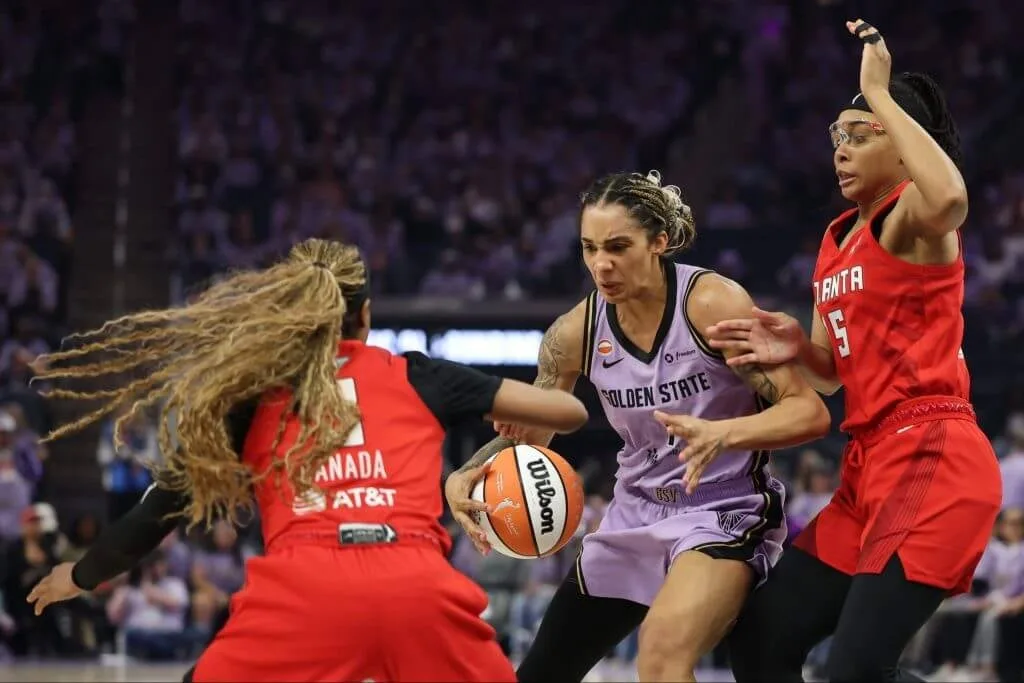
SAN FRANCISCO — Two games into the WNBA Finals, the main question on everyone's mind has to be: Why is it so hard for these two teams to score?
Game 2 ended with the Atlanta Dream and Golden State Valkyries making 33.9 and 34.4 percent of their field goals, respectively. The teams both shot below 33 percent from the field in Game 1. The Valkyries scraped out a win in the opener with 68 points while Dream won Game 2 with 79, which was the average points per game for the lowest-scoring team (Connecticut) in 2026. Per data from Her Hoop Stats, only two teams had won a WNBA Finals game prior to 2026 shooting under 34 percent from the field. Now, four teams have.
The basketball gods seemed to be toying with the two teams on multiple occasions, like when Rhyne Howard had a 3-pointer bounce on the rim multiple times before spilling out or when Gabby Williams threw up a wedgie. This was karmically bad.
There's no denying that these are two excellent defenses. Golden State entered with the WNBA's best defensive rating during the regular season — and the best relative to league average in WNBA history — while Atlanta was third in defensive rating. But that doesn't come close to explaining why it has been such a struggle for both teams to shoot the ball. This was a regular season that set the league record for highest field-goal percentage.
Long-distance shooters can't find their touch from 3-point range. Some of the league's best drivers are blowing their finishes inside. Everyone is missing from everywhere.
"Oh, I mean, I don't have the answer to that," Dream coach Karl Smesko said after his team's 79-65 victory.
To be clear, neither team is sweating its shooting percentages. The Valkyries pride themselves on defense; it's their identity. Before Monday's game, coach Natalie Nakase didn't know what Golden State shot from 3-point range in its previous contest, only that its defensive effort was what it needed to be in the second half.
And that defense takes a lot out of the Valkyries. They play hard all the time. The physical toll of getting into the bodies of opposing players, shifting into passing lanes, walling off drives and boxing out naturally leaves a little less in the tank for the offensive end.
Golden State also denies itself the easiest scoring opportunities because it doesn't play with much pace. The best time to score is before the defense sets, yet the Valkyries don't run the floor, preferring instead to suck the life out of the shot clock and slow the opposition. It's a winning strategy, but it did result in the Valkyries having the lowest field-goal percentage (42.2) in the WNBA in 2026 (along with the fact that they take such a high volume of their shots from 3-point range).
When Golden State tried to run in Game 2, it went disastrously. The Valkyries committed five turnovers in transition, spoiling excellent defensive possessions by being careless with the ball. The only part of the offense that Nakase was concerned with in defeat was ball control.
"(The Dream) really started to shift into those driving lanes," Nakase said. "They're there early, right, trying to create more passes for us. And so, when we're not in the right spots in terms of being able to receive those passes and see the next layer of driving lanes, then that's where it got a little bit sticky."
Scoring is also a little bit harder when your best player isn't at her best. Despite a heroic 26 points in the Game 1 win, Williams appeared to be limping down the stretch after a collision with Jordin Canada at the foul line. She had a harder time finding the bottom of the net Monday, finishing 3 of 15 from the field, though she and Nakase both denied that there was anything wrong with the Valkyries' highest-usage player.
Atlanta's struggles from the floor are a little more predictable. During the regular season, the Dream's shooting percentages against the Valkyries were: 39.4, 34.3 and 39.1 (while Golden State shot at least 43.5 percent in all three matchups). The Valkyries' defense has been difficult for Atlanta to pierce for five games now.
It starts on the interior, where the Dream led the WNBA in points in the paint. Kiah Stokes has been phenomenal at protecting the rim; on Monday, she joined Brittney Griner as the only players in league history to record at least four blocks in back-to-back finals games. That forces Atlanta out into floater range, which is a less efficient part of the floor, and the road team shot 3 of 14 on short mid-rangers.
If it weren't for their ability to get to the line and to force turnovers, the Dream would hardly be able to score in this series. They shot 7 of 11 in transition and 14 of 51 in the half court.
Perhaps some of this is mental. Smesko suggested that some players might be rushing their shots because of the defensive intensity. Hard close outs make jumpers more difficult. The stage of the finals causes some extra jitters, particularly for two franchises seeking their first title. This has been the longest season in WNBA history, and the wear could finally be setting in.
Smesko was mostly happy with Atlanta's shot quality for the second straight game, banking on his shooters to progress to the mean as the series continues. The Dream also enjoyed a dominant performance from Angel Reese, who seemed to be playing in a different offensive environment entirely with her 30 points on 10 of 16 shooting. Nakase had a similar sentiment, provided Golden State holds on to the ball long enough to take more field goals. Assuming full health for Williams and Tiffany Hayes, both of whom appear to have been banged up in the first two games, Nakase likes the shots her team is taking.
"I actually thought (Williams') looks were the same as usual, she just missed," Nakase said. "I wish I could say she's going to shoot 100 percent every night. That just isn't the case, and that's why, again for us, we do rely on our defense."
Both teams would settle for a lot less than 100 percent based on the tenor of this series so far. Even if it's by design, these games have been slugfests and more challenging on offense than any of the previous data would suggest.
With only one day off, which will be a travel day, before Game 3 in Atlanta, it's hard to imagine this getting too much better unless the sight lines in State Farm Arena are dramatically different. Never has the adage "defense wins championships" been tested to this extent.
Atlanta Dream, Golden State Valkyries, WNBA, WNBA Finals, WNBA Highlights
Topics in this story
Gathered from external sources. Rights to this text belong to whoever originally published it.