Ranking 5 NBA Teams With the Worst Salary-Cap Situations
NBA general managers often use the buzzword "optionality" to describe moves that preserve cap flexibility. Some teams, like the Brooklyn Nets, keep it for years as they navigate a difficult rebuild.
NBA general managers often use the buzzword "optionality" to describe moves that preserve cap flexibility. Some teams, like the Brooklyn Nets, keep it for years as they navigate a difficult rebuild.
Others, like the New York Knicks and Oklahoma City Thunder, build championship squads that get increasingly hard to keep together. Their current elite status gives them a pass, since flexibility matters less than going for it—not to mention the Thunder still have plenty of draft compensation to replenish their expensive roster with younger, cheaper players.
The teams that lock themselves in as second-tier contenders are more problematic. The obvious answer to their placement on this list is to win it all, but can the following four semi-contenders—plus the LA Clippers, who have their own issues—prove their difficult cap positions are justified?
The Cleveland Cavaliers will pay Donovan Mitchell and Evan Mobley a combined $133 million in 2029-30. The franchise is committed to its roster, with James Harden, Jarrett Allen, and Peyton Watson. Depth is marginal; Cleveland is just under its first apron hard cap, and flexibility won't open for several years.
Still, the Cavaliers were the second-best team in the East last year, falling to the Knicks in the Conference Finals. They're good enough to boast fifth on the list, but don't get it twisted; the margins are razor-thin.
Cleveland sent out most of its draft capital to build this roster. With its 2033 first-round pick frozen for climbing over last year's second apron, the Cavaliers can offer swaps in 2028 (the lower of an already swapped pick), 2030, and 2032. The only second-rounder available is in 2033.
If the team falls short, its path to improvement may come only through trading away its top-five players.
The Los Angeles Lakers need the trio of Luka Dončić, Austin Reaves, and Walker Kessler to work, after going all-in this summer by paying Reaves a near-max four-year deal and sending their remaining draft capital to acquire Walker Kessler in a trade with the Utah Jazz.
The clock is running on Dončić, who is locked in for only two more seasons, with a player option before the 2028-29 campaign. As long as he's bought in, the Lakers have one of the league's top offensive creators. But if the team struggles, will Dončić start thinking about a new home?
On paper, the Lakers' current ceiling is third in the Western Conference behind the San Antonio Spurs and Oklahoma City Thunder. That's best-case, given the gauntlet of talent L.A. will need to fight through to win at the highest level. For the foreseeable future, the Lakers are spent.
The team has just one first-round swap available to offer—outside of trading low-value additional swaps on previously swapped picks. The team has only three second-round selections available—two from the Washington Wizards, both starting in 2031—which may help smaller deals get done, but may not help land a needle-mover.
Improvements will need to come via small free-agent signings or trades where the Lakers' outgoing talent or willingness to take on other unwanted salaries will drive deals more than the squad's meager draft capital.
If the LA Clippers have greater flexibility than the Lakers, they don't have a talent like Dončić to build around.
Overall, the Clippers are in a tough spot, self-imposed after the NBA's investigation into improper sponsorship agreements involving Kawhi Leonard cost them five first-round picks. The team needs a franchise player to build around; acquiring that piece will be the real challenge.
The Clippers recouped a pair of firsts and seconds (plus a first-round swap) by trading Leonard to the Toronto Raptors. But LA is bound by the Stepien rule, making Toronto's 2031 and 2033 firsts untradeable—though they can offer them as swaps. Still, the team has five first-round picks over the next seven years, though none can be dealt outright and the next three are subject to swaps from prior deals. LA also has 4-5 second-rounders available.
Conversely, the Clippers have a relatively clean set of salaries on the books. Darius Garland and Brandon Ingram will earn $86.8 million combined for 2027-28 on expiring contracts, though Ingram can opt out in June. With Rui Hachimura's $14 million team option, Keaton Wagler is the next highest-paid player locked in at $10.2 million for 2027-28.
The team can try to cash out veterans in trades before the February deadline to add more draft compensation, while increasing flexibility to chase top free agents in 2027 and/or 2028. That said, will the recent punishment deter stars from joining the Clippers?
Compared to others on the list, the Orlando Magic are in a better spot. Still, their heavy commitment to a good but not great roster puts them at No. 2. The Magic are in a similar position to the Cavaliers, invested in their core, except the Magic haven't gotten out of the first round since 2010.
The team spent heavily on Paolo Banchero, Franz Wagner, Desmond Bane (via trade), Jalen Suggs, and Wendell Carter Jr. Next, Anthony Black is eligible for an extension; otherwise, he'll hit restricted free agency in July 2027. For a franchise that doesn't pay luxury taxes, the team is looking at a $33 million bill for 2026-27. Keeping Black past this year, barring cost-cutting trades, will lock the Magic into apron territory.
A healthy roster would go a long way, the team's greatest obstacle in recent seasons. Perhaps new head coach Sean Sweeney can get more out of the group than Jamahl Mosley, who was let go in May. The New Orleans Pelicans quickly hired Mosley, but Sweeney will face the same obstacles with a pair of talented forwards who occupy similar space on the court. Still, neither is a reliable floor-spacing shooter from three-point range.
While salaries are high, the Magic have some available draft capital to trade for either their 2032 or 2033 first-round pick; otherwise, the team is limited to swaps in 2027, 2031, and one of 2032/33. Orlando also has 6-7 second-rounders.
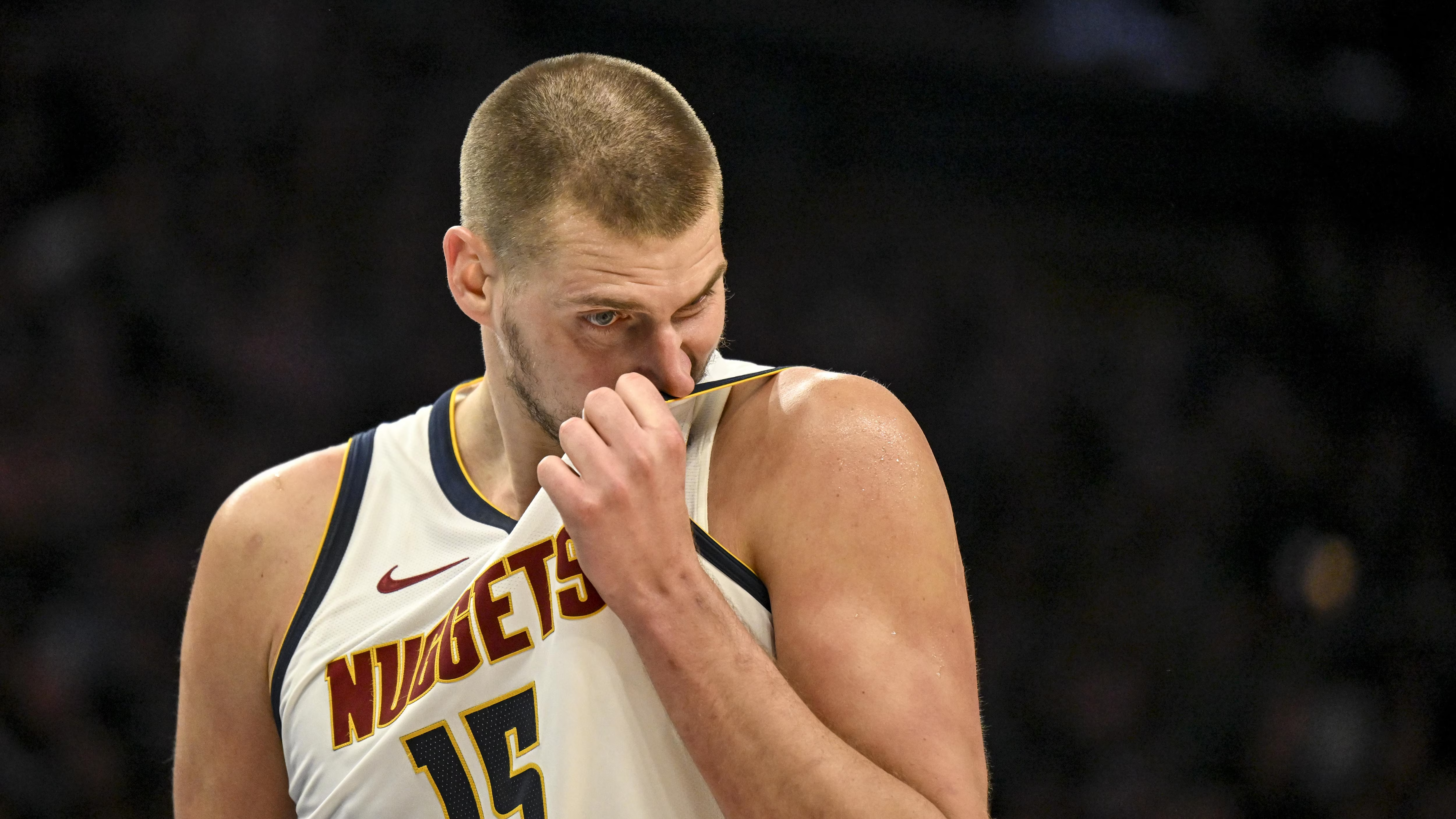
The Denver Nuggets, with Nikola Jokić, feel like the Milwaukee Bucks before trading Giannis Antetokounmpo. After winning a title, both franchises have failed to stay on top with their elite star, seemingly getting worse each season.
Will Jokić follow the same path, pushing the Nuggets to trade him or walk as a free agent next July, when he can opt out of his final year at $62.8 million? Or if he re-signs with Denver on a long-term contract, can the franchise rejuvenate around him?
Letting Peyton Watson go to the Cavaliers may have made financial sense, but the Nuggets didn't have to sign and trade him to Cleveland. Denver couldn't justify paying out an additional $200 million in salary and repeater taxes for the young forward. That may make sense, but the future first-round pick from the Cavs won't help Jamal Murray, Jokić, and the rest of the roster anytime soon.
Denver may find a trade with that selection, but the franchise still owes three firsts to the Oklahoma City Thunder (two) and the Brooklyn Nets. Outside of swaps and the Cavaliers' selection in 2031, the Nuggets have 4-5 seconds to offer.
Meanwhile, Denver has hefty obligations to Aaron Gordon, Christian Braun, Murray, and, if Jokić re-signs, that flexibility won't improve anytime soon.
Email Eric Pincus at eric.pincus@gmail.com and follow him on X/Twitter @EricPincus .
Topics in this story
Gathered from external sources. Rights to this text belong to whoever originally published it.