In 2012, a 67-year-old Chinese duck farmer refused to leave his five-storey home; officials built a highway around it before paying him 260,000 yuan to move
Rest of World News: Explore the remarkable story of Luo Baogen, a 67-year-old duck farmer in China whose five-storey house resisted demolition as authorities built a highway around it, sparking international attention and discussions on property rights.
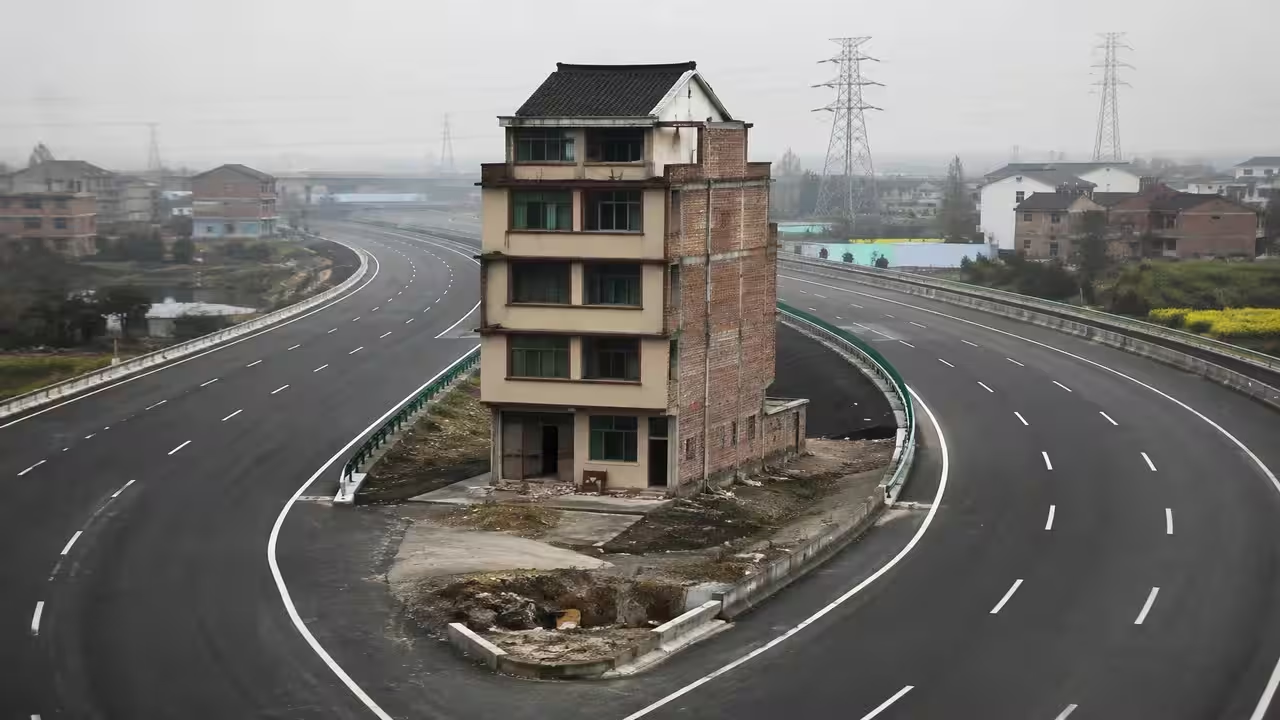
In Wenling, an eastern Chinese city in Zhejiang Province, a five-story house once stood alone in the middle of a newly paved road, surrounded by a makeshift traffic circle. The house belonged to Luo Baogen, a 67-year-old duck farmer who had built it with his wife for more than 600,000 yuan around 2001. When local authorities cleared the neighborhood for a new access road, Luo and his wife resisted relocation for several years, even as workers built the road around their home.While 459 households accepted relocation, Luo did notIn 2008, the Wenling government planned to relocate about 459 households in Xiayangzhang to make way for a main road in front of the cityâs new railway station. The project required relocating 459 households in the village of Xiayangzhang, and by the time construction started, Luo and his wife were the only holdouts. The first offer was estimated at 220,000 yuan and then increased to 260,000 yuan. However, Luo contended that even the second offer was still far too low in comparison with what it would cost him to reconstruct another house, as he had already invested more than 600,000 yuan in building the previous one.Rather than wait for the dispute to end, workers paved a road around Luo's house, leaving the five-story building in the middle of a large roundabout. Photos of that scene started circulating online in late 2012 and made Luo's house one of the most recognizable Chinese "nail houses" (the term is used for buildings resisting demolition).Luo kept electricity, water and cable through the standoff Unlike many nail house holdouts, who are often cut off from basic utilities as pressure to leave mounts, Luo and his wife still had mains electricity, running water and cable television at the time of the report, based on the South China Morning Post. That made his case unusual among nail houses, where utilities are sometimes cut off to pressure occupants. As time went on, he continued to refuse the 260,000 yuan offer, saying it was far less than the 800,000 yuan he would need to build the same house elsewhere, while construction was completed and the road had not yet been opened to traffic.Luo accepted 260,000 yuan and a new plot of land Luo eventually signed a demolition agreement on November 30, 2012, after further talks with local officials and his family. Under the terms, the Wenling government paid him 260,000 yuan and provided a separate parcel of land for a new house, according to China's state Xinhua news agency, cited in a report from the Bangkok Post. âIt was never a final solution for us to live in a lone house in the middle of the road,â Luo Baogen told Xinhua. âAfter the governmentâs explanations, I finally decided to move.The excavators pulled down the house on the very next day, December 1, 2012, after pictures of the property garnered international media attention. According to Chen Xuecai, the head of Xiayangzhang village, Luo had grown tired of the attention, with reporters visiting the house daily during the final stage of the dispute. Luo's case became the most famous example of a dispute that has repeatedly occurred in China during large-scale development projects. Such disputes were common even in big cities like Chongqing, Shanghai and Guangzhou, where local governments or private companies sometimes built roads around a property whose owner refused to move.Catch the latest World News and Live updates. Download the TOI app.
Topics in this story
Gathered from external sources. Rights to this text belong to whoever originally published it.