In 2011, Iowa built US 6’s Keg Creek bridge off-site and installed it in 16 days; the project cut total costs by $440,000
In 2011, Iowa's Keg Creek Bridge project revolutionized bridge construction by significantly reducing road closure time from six months to just 16 days, resulting in a $440,000 overall cost saving. Discover how prefabricated bridge systems are the future of infrastructure in this detailed analysis.
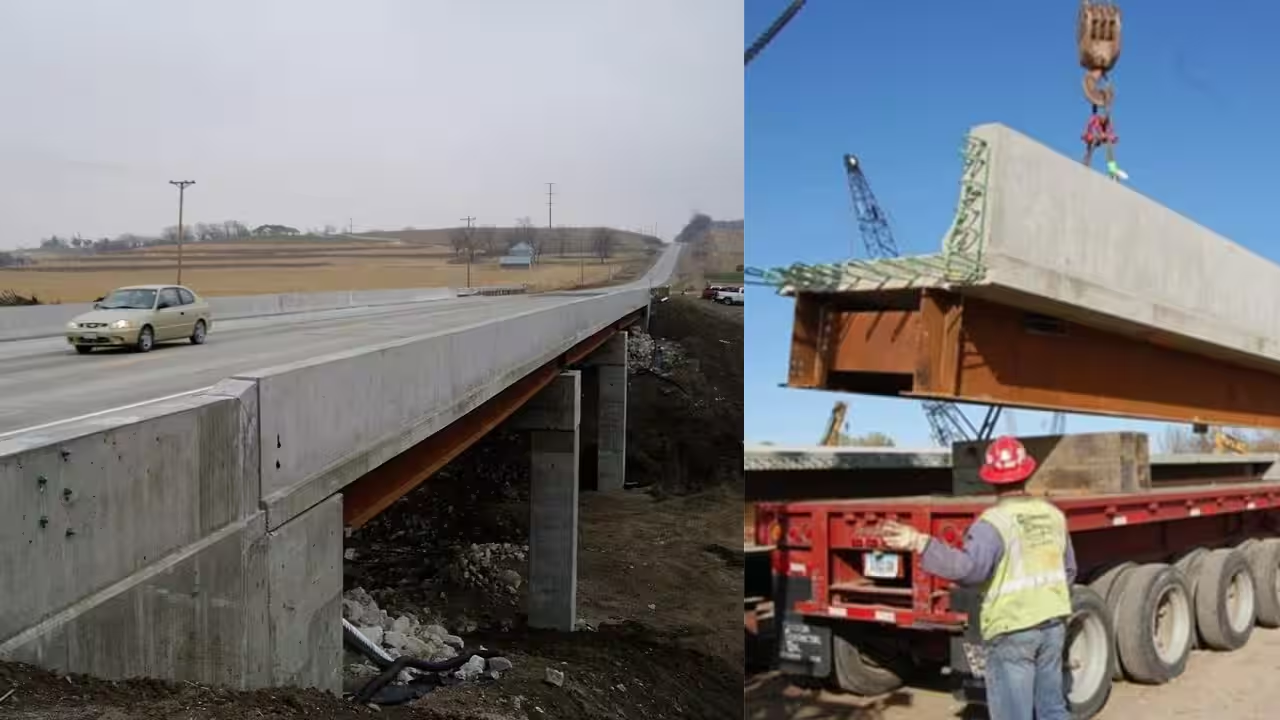
The accelerated bridge construction project that replaced the U.S. 6 bridge over Keg Creek in Pottawattamie County in 2011 closed the road for 16 days instead of the roughly six months that were estimated by Iowa DOT, which would have been required with conventional construction. The bridge was completely prefabricated off-site, which made the project a demonstration of accelerated bridge construction techniques that were developed through the federal Strategic Highway Research Program. It was the first project of its kind in Iowa and was described by the Federal Highway Administration as a first in the United States for completely prefabricating the new bridge system off-site and installing it at the crossing.Most of the bridge was prepared away from trafficThe Keg Creek replacement was designed around prefabricated bridge elements rather than building the entire structure piece by piece over the existing roadway. The project used prefabricated substructure and superstructure systems, along with several other construction technologies. The bridge used high-performance and ultra-high-performance concrete, and self-consolidating concrete for parts of the foundation work. A fully contained flooded granular backfill system was installed behind the abutments.The approach meant that a lot of the work could be completed before the main road closure began, and Iowa DOT selected the Keg Creek site as part of a national research effort that examined ways to replace bridges faster while maintaining structural performance. The bridge itself was a three-span steel and precast modular structure that measured about 210 feet long and 47 feet wide. The Iowa DOT says that the bridge was chosen because its three-span configuration was common in Iowa and other states, and engineers wanted the demonstration to help figure out certain construction methods that could be applied to similar bridges elsewhere.The road closed for 16 daysIowa DOT estimated that the bridge replacement would have required a road closure and detour lasting about six months with conventional cast-in-place construction. The accelerated approach reduced the critical closure period to 14 days, although the completed replacement took 16 days from the time traffic was diverted until it returned to the road. Iowa DOT later described the bridge as a national demonstration of prefabricated bridge elements and systems, and during the project, large bridge components were prepared and assembled away from the final crossing, then brought to the site for installation. That compressed the work that had to take place directly on U.S. 6, with the shorter closure also reducing the time that commercial traffic spent on the detour.The prefabricated approach nearly doubled the initial bridge construction cost when compared with the conventional alternative. The as-built project cost about $2.66 million, in comparison with an estimated $1.51 million for the baseline construction scenario. The difference came when the analysis included costs imposed on road users.The economics changed when driver costs were includedAn FHWA economic analysis calculated vehicle operating and delay costs that were associated with the two construction approaches, and under the conventional scenario, the longer closure would have generated much higher user costs. The analysis estimated about $1.6 million in user-cost savings from the shorter construction period, and after those savings were included alongside the higher agency construction cost, the accelerated project came out about $440,000, or 29%, below the conventional alternative. The $440,000 figure was not just money that was saved on construction materials or the bridge contract, since the project cost more to build directly. The overall saving appeared after the analysis counted the economic cost of keeping motorists and commercial vehicles on a longer detour.According to FHWA's 2013 account of the project, the prefabricated bridge cost more to construct, but the shorter closure reduced vehicle operating and delay costs to a level that was enough to produce an overall advantage of about $440,000. Researchers studied the prefabricated components and the ultra-high-performance concrete connections that were used in the bridge, and testing examined the performance of the joints under laboratory and field conditions.The project became one of Iowa DOT's early examples of accelerated bridge construction and was later followed by additional bridge projects that used prefabricated elements and related techniques. The bridge itself cost more than a conventional structure, but the road was closed for only 16 days instead of months, and once the cost of traffic disruption was included, the faster construction method produced the $440,000 overall advantage.You use AI every day. Now get your AI Quotient. Take the AIQ test.
Topics in this story
Gathered from external sources. Rights to this text belong to whoever originally published it.