King Charles visited a project testing contraceptives on grey squirrels; the unusual plan aims to save Britain's rare red squirrels
King Charles visited a research project in North Yorkshire exploring a new way to control Britain's grey squirrel population and help protect its native
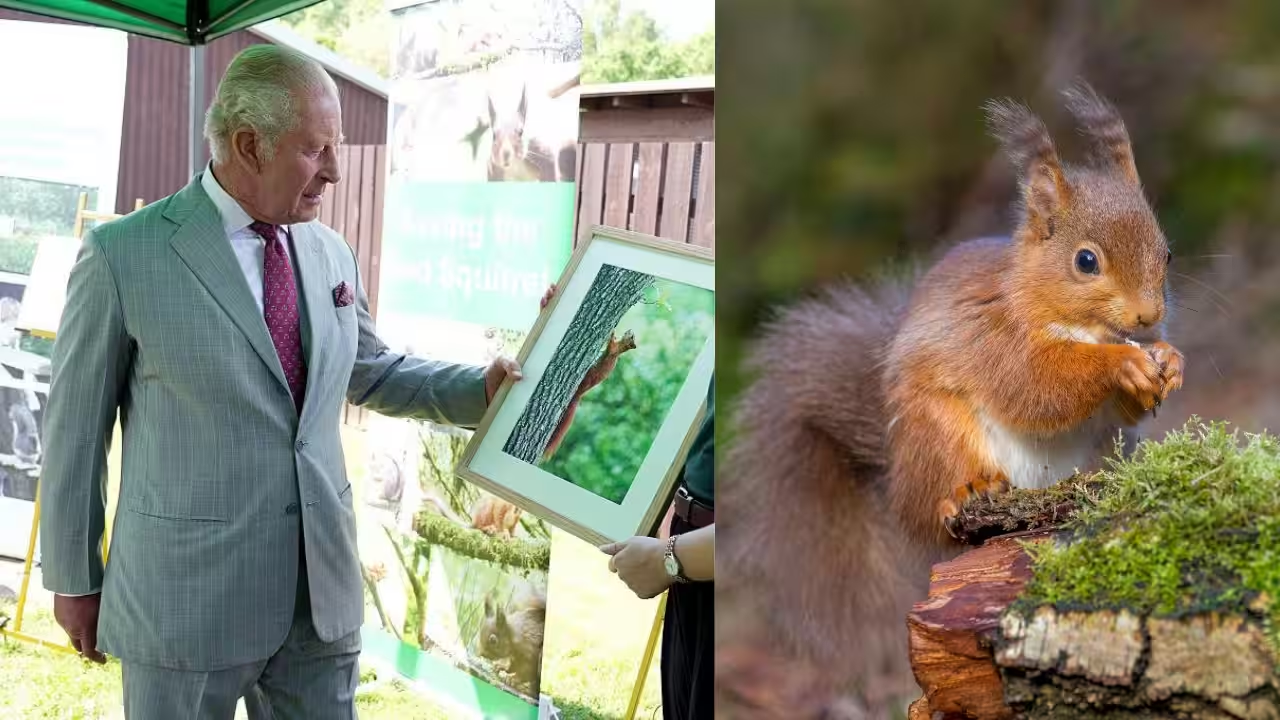
King Charles visited a research project in North Yorkshire exploring a new way to control Britain's grey squirrel population and help protect its native red squirrels. During his visit on May 26, 2026, the King met scientists at the Animal and Plant Health Agency's York Biotech Campus in Sand Hutton and learned about research into an oral contraceptive for grey squirrels. The approach is designed to reduce reproduction rather than rely only on conventional population control. Grey squirrels are an introduced species that competes with red squirrels for food and living space. They also carry squirrelpox, a virus that is usually fatal to reds. Researchers are developing a targeted feeding system to deliver the contraceptive to greys while keeping red squirrels and other wildlife out.King Charles sees unusual squirrel projectDuring the visit, Charles met the Animal and Plant Health Agency's wildlife scientists and saw how the contraceptive, which is delivered in a hazelnut paste, is developed. Dr Julie Lane, head of the agency's National Wildlife Management Centre, told him: "Without you, this work would not be happening at all." She later said the King was very interested in the work, particularly because of his love for red squirrels. The project is part of wider research into non-lethal ways of managing grey squirrel populations. Charles, patron of the Red Squirrel Survival Trust, has championed red squirrel conservation for decades.Why grey squirrels are being targetedGrey squirrels were introduced to Britain from North America in the 19th century and have since spread across much of the country. The UK government estimates that Great Britain now has around 2.7 million of them. Greys are generally unaffected by squirrelpox, but the virus is usually fatal to red squirrels. They also strip bark from trees, damaging woodland.Britain's red squirrels are now rareRed squirrels are Britain's only native squirrel species, yet only an estimated 120,000 to 160,000 remain, most of them in Scotland. They have disappeared from much of mainland England and Wales, with important populations surviving in parts of northern England, Scotland, Wales and on several islands. Their decline has been linked to competition from greys, squirrelpox and habitat loss. The Eurasian red squirrel is classified as Least Concern globally by the IUCN, but its range in Britain has contracted so sharply that local conservation measures matter greatly.Scientists are developing an oral contraceptiveThe research programme, led by the Animal and Plant Health Agency and funded by the UK Squirrel Accord, is developing an oral immunocontraceptive vaccine. Rather than capturing animals individually, scientists hope to incorporate the treatment into bait distributed through specialised feeders, gradually lowering grey squirrel numbers. The vaccine works by preventing an animal's immune system from producing sex hormones. Agency researchers have achieved infertility in rats fed the oral formulation, a world first for wildlife fertility control. In grey squirrels the formulation has so far produced an immune response but not infertility, and work continues to refine its potency and duration.A special feeder could protect red squirrelsDelivering the contraceptive only to grey squirrels is one of the project's biggest challenges. Researchers are developing a species-selective hopper that opens only for animals above a set body weight. Weight data gathered by the Animal and Plant Health Agency showed that a 450g threshold would exclude every red squirrel measured while admitting more than 90% of grey squirrels. Trials of feeders with a weighted plate are being carried out in areas where both species live.The treatment is still being testedThe contraceptive is not yet a routine method of controlling grey squirrels in Britain. The project remains in research and development, with scientists still assessing how reliably it reduces fertility and whether it can be delivered without affecting other wildlife. Researchers are therefore developing the contraceptive and its delivery system side by side.The plan could complement existing control methodsFertility control is being explored as an additional tool rather than an immediate replacement for existing management. Traditional control removes animals from specific areas, while contraception would reduce the number of new animals being born. Lane said that combining a contraceptive with standard control methods is much more effective at bringing grey squirrel numbers down. For red squirrel conservationists, fewer greys in key habitats would mean less competition and a lower risk of squirrelpox transmission, giving isolated red populations a better chance of survival.You use AI every day. Now get your AI Quotient. Take the AIQ test.
Topics in this story
Gathered from external sources. Rights to this text belong to whoever originally published it.