Pacific island’s coconut plantations became an “avian desert”; scientists say native vegetation must return after rats are removed
Rest of World News: Across tropical islands in the Pacific and Indian Ocean, the arrival of people brought more than permanent settlements. Forests were cleared, invasive.
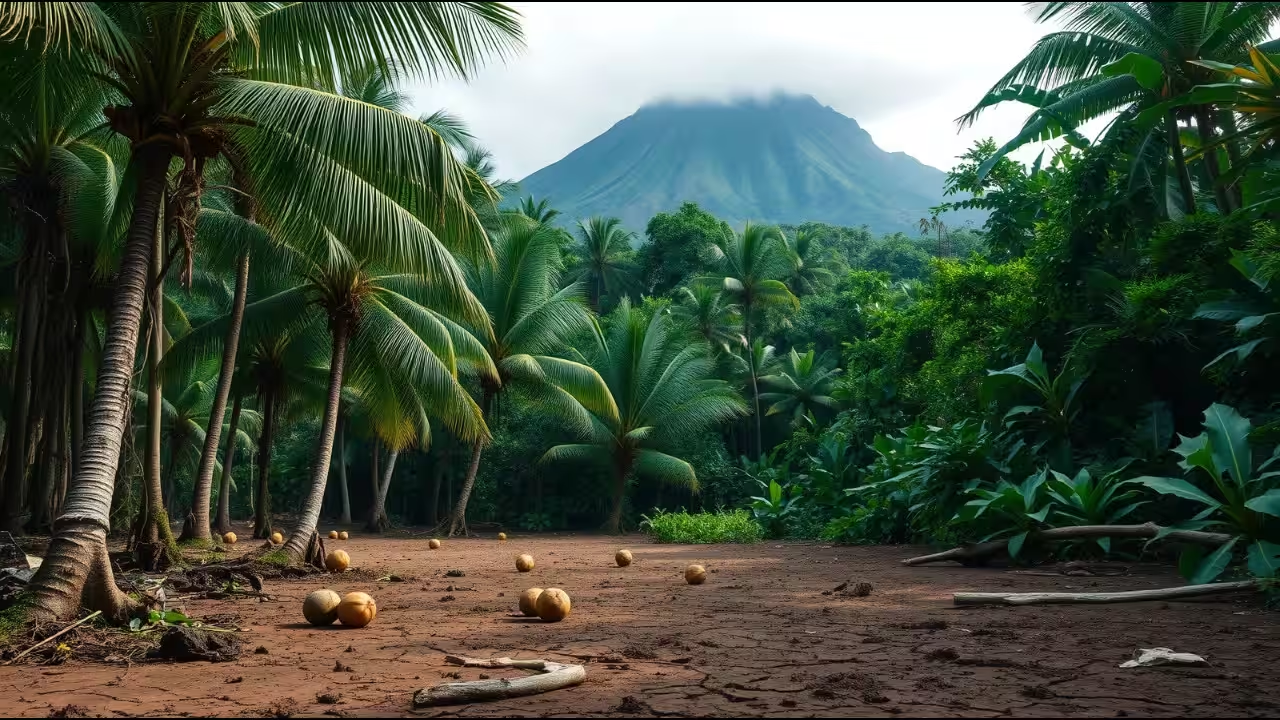
Across tropical islands in the Pacific and Indian Ocean, the arrival of people brought more than permanent settlements. Forests were cleared, invasive predators were introduced, and large areas were converted into coconut plantations for commercial production. On some islands, the coconut industry eventually declined, but the plantations remained, leaving behind dense stands of a single introduced crop where native forests and grasslands once grew. For seabirds, that legacy can be particularly damaging. On islands where abandoned coconut plantations coexist with invasive rats, the landscape can become what researchers describe as an "avian desert", an area offering little suitable habitat for breeding birds even when food may still be available offshore. A new study titled Potential benefits to breeding seabirds of converting abandoned coconut plantations to native habitats after invasive predator eradication, led by scientists from the Zoological Society of London's Institute of Zoology, together with researchers from the Royal Botanic Gardens, Kew, the University of Exeter and Heriot-Watt University, examined whether removing rats is enough to reverse that damage. Their results suggest that it is not. If conservationists want heavily degraded tropical islands to support large seabird colonies again, removing invasive predators may need to be accompanied by a much more ambitious step: replacing abandoned coconut plantations with native vegetation.How scientists spent more than a decade studying seabirds across the Chagos ArchipelagoThe research was based on an unusually extensive dataset from the Chagos Archipelago in the central Indian Ocean. Over more than a decade, researchers surveyed the islands and recorded breeding seabirds alongside the habitats in which they nested. The work covered all 55 islands in the archipelago, allowing the researchers to compare islands with different combinations of vegetation and rat presence. That comparison was important because rats are among the most damaging invasive species on oceanic islands. They can eat seabird eggs and chicks and, in some cases, attack adult birds. Removing them can therefore produce an immediate improvement in breeding conditions. But the researchers wanted to know whether the absence of rats automatically meant an island could return to being a major seabird breeding site. The answer depended heavily on vegetation. The team used the field data to model what could happen under several restoration scenarios. The first involved removing rats while leaving the island's existing vegetation largely unchanged. A second model combined rat eradication with restoring the island's vegetation so that it resembled nearby rat-free reference islands. A third went further, assuming that one square kilometre of former coconut plantation would be converted into an equal mixture of native forest and savannah. The three scenarios produced dramatically different estimates, showing that the number of seabirds an island could eventually support depends not just on whether invasive predators are removed, but on what kind of habitat is left behind.Why restoring one Chagos island could produce hundreds of thousands of breeding pairsThe researchers used Ile du Coin, in the Peros Banhos atoll, as an example of what a restored island could look like. At 1.26 square kilometres, it is the fourth-largest island in the Chagos Archipelago. Today, Ile du Coin has rats and is overwhelmingly dominated by former coconut plantations. Around 92% of its vegetation consists of this plantation habitat. Only 51 breeding seabird pairs were recorded on the island, representing three relatively generalist species: Brown Noddies, Lesser Noddies and Common White Terns. The modelling showed what a difference restoration could make. Under a scenario involving rat eradication alongside the existing habitat conditions, the island's projected seabird population rose to roughly 4,306 breeding pairs across 14 species.The researchers then modelled what would happen if rats were eradicated and the island's vegetation was restored to resemble nearby rat-free reference islands. Under that scenario, the model estimated 138,878 breeding pairs within the study's modelling framework. The largest projection came from the most intensive habitat-conversion scenario. Researchers assumed that one square kilometre of the island's abandoned coconut plantation would be replaced by 0.5 square kilometres of native forest and 0.5 square kilometres of native savannah, alongside rat eradication. Under those conditions, the model projected approximately 319,762 breeding pairs across 16 species. The figure is striking because it would make a single restored island capable of supporting an enormous seabird population. It also shows why there is a substantial difference between removing an invasive predator and rebuilding an island's underlying habitat.Why getting rid of rats does not automatically bring back seabirdsRats are an obvious problem because their presence can directly prevent seabirds from successfully raising young. But removing them addresses only one part of the ecological damage. Abandoned coconut plantations can remain difficult environments for native wildlife long after commercial farming has ended. They are often structurally and botanically very different from the native vegetation they replaced. For seabirds, that can mean fewer suitable places to nest and less of the habitat diversity associated with a functioning island ecosystem. That helps explain the large differences between the restoration scenarios. Rat eradication alone produced a major projected increase from the island's current population, but restoring vegetation produced a much larger potential recovery. The model that brought the island's vegetation closer to that of nearby rat-free islands produced 138,878 breeding pairs, while the more specific one-square-kilometre conversion scenario produced 319,762. The distinction matters for conservation planners. Predator eradication can be expensive and logistically difficult, particularly on remote islands. If conservationists are going to invest that effort, the study suggests they also need to consider what happens to the landscape once the rats are gone. Otherwise, they may successfully remove the immediate threat while leaving behind a habitat that still does not provide the conditions needed for the full range of seabirds to return.What the findings could mean for other tropical islandsThe Chagos Archipelago provides a useful natural laboratory for studying this problem because many of its islands share a history of human disturbance, invasive species and coconut cultivation. But the underlying issue extends well beyond the Indian Ocean. Across tropical islands, abandoned plantations can remain long after the industries that created them have disappeared. At the same time, invasive rats and other introduced predators can continue to affect native wildlife. The combination can leave islands in a state where removing one pressure produces only part of the expected ecological recovery. The researchers' modelling suggests that island restoration should therefore be approached as an ecosystem-wide process rather than a single intervention. Rat eradication can remove one of the biggest barriers to seabird recovery, but restoring native vegetation can determine how much further that recovery goes. Ile du Coin makes the difference particularly clear. The island currently supports only 51 breeding pairs. Removing rats while leaving its existing vegetation in place could increase that figure substantially. Restoring the vegetation to resemble nearby rat-free islands raises the modelled potential dramatically further, while the more intensive conversion of one square kilometre into native forest and savannah produces the largest projection of all.Catch the latest World News and Live updates. Download the TOI app.
Topics in this story
Gathered from external sources. Rights to this text belong to whoever originally published it.