Fragment of Roman mosaic 'thought lost forever' to go on show
The piece of long-lost 2nd Century Roman mosaic will go on show in Cirencester.
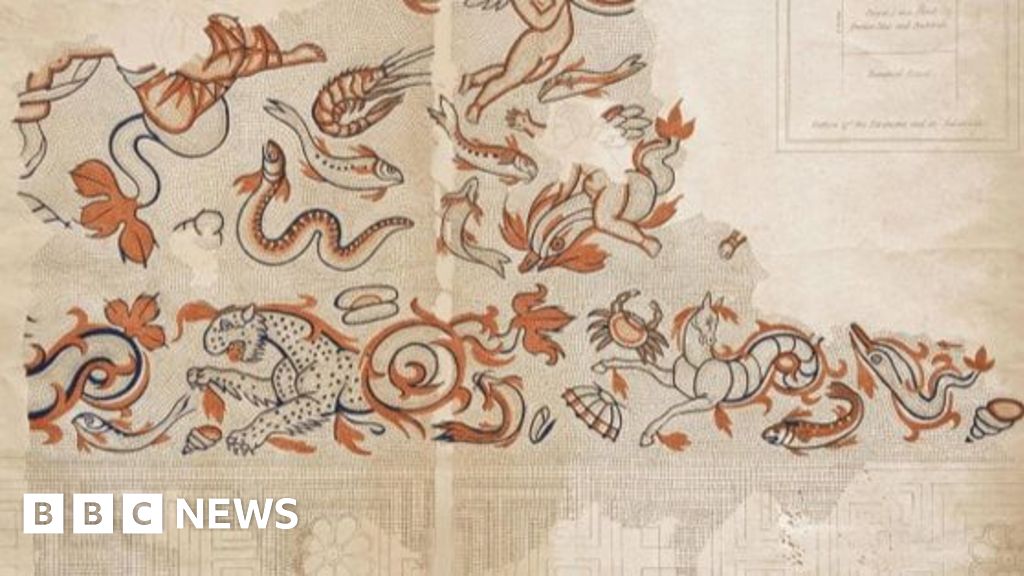
Staff at a museum say they are "delighted" a fragment from a long-lost 2nd Century Roman mosaic of sea creatures that was unearthed 243 years ago has been loaned to them.
The mosaic, which will be on display at Coronium Museum, in Cirencester, Gloucestershire, was discovered under the foundations of nearby Gloucester House, on Dyer Street in 1783.
The original mosaic depicted sea creatures including fish, an eel and a crab, alongside mythological figures including swimming cupids and a sea-leopard.
It was reburied in the 19th Century but years of building construction meant it suffered damage. A surviving section was lifted by specialists and looked after by the Lamplough's of Gloucester House.
Farmers call for food rules update after heatwaves
The eye-catching sculptures found across the West
Pilgrims' 80-day trek to celebrate special anniversary
Piers Lamplough, son of the owner, contacted the museum earlier in the year to arrange the loan the piece.
He said: "This fragment has travelled an incredible path through nearly two thousand years... [and] quietly connected generations of people.
"We never truly own history. We simply become its custodians for a time, preserving it until it finds its way to the next generation."
The original mosaic was recorded through a detailed drawing by antiquarians Samuel Lysons and Richard Smirke, and the surviving corner fragment was lifted and saved by then assistant curator of the Corinium Museum Stephen Clews, alongside conservator Marilee Parrott.
It was then conserved by Nerina de Silva before remaining with the Lamplough family.
Emma Stuart, director of Corinium Museum, said: "When the mosaic arrived at the museum, we all gathered round in anticipation.
She said: "The museum already displays two mosaics – the Seasons and Hunting Dogs – presumed to be from the same Roman town house that also commissioned the sea life mosaic floor.
"We all thought the mosaic lost forever, so to have a fragment find its way back to us after all this time is incredibly exciting."
Stuart said the piece was "tangible evidence" of the early illustrations and 1980s photographs of yet "another incredible mosaic from Roman Corinium".
"You get a wonderful impression of the colours and materials used when you see it up close," she said.
Dr Pat Witts, from the Association for the Study and Preservation of Roman Mosaics (ASPROM), said the "lost mosaic has been described as one of the best drawn and most classical in style of all the Romano-British mosaics".
"So it is thrilling that part survives and has returned to the museum on loan," she said.
The mosaic is due to be on display at the Corinium Museum by the end of the year.
Follow BBC Gloucestershire on Facebook , X and Instagram . Send your story ideas to us on email or via WhatsApp on 0800 313 4630 .
Museum buys Iron Age hoard found by detectorist
Early Bronze Age artefacts go on display at museum
Roman mosaic returns home after 200 years
Topics in this story
Gathered from external sources. Rights to this text belong to whoever originally published it.