Breaking the monolith: Colonial legacy, combat reality, and the future of strategic military leadership in the Indian Army
The Indian Army stands between two military eras: one shaped by mass infantry formations, physical occupation of terrain and attrition, and another driven
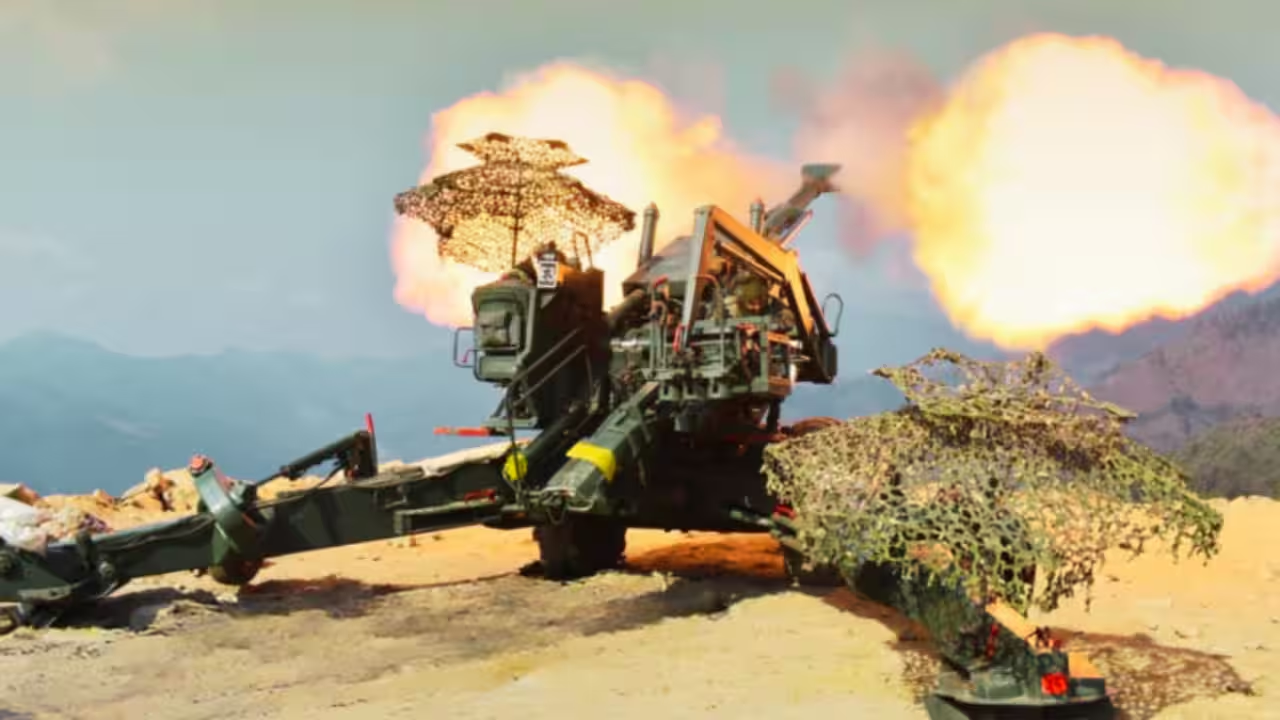
The Indian Army stands between two military eras: one shaped by mass infantry formations, physical occupation of terrain and attrition, and another driven by precision fires, artificial intelligence, cyber and electronic warfare, autonomous systems, space capabilities, information dominance, and integrated multi-domain operations. Yet higher-command structures remain influenced by a colonial system designed for a different battlespace. The resulting General Cadre Syndrome concentrates operational command opportunities in Infantry and Armour and assumes that these arms possess a superior claim to combat experience and strategic leadership.This is not an argument against Infantry, which remains indispensable, but a question of institutional fitness: should nineteenth-century assumptions continue to govern twenty-first-century leadership? Modern combat legitimacy is the collective product of several arms and services acting together. How the Army answers this question will shape command structures, talent management, strategic thought, and its ability to adapt.Part I: Colonial Legacy and the Evolution of the General CadreOrigins and the General Cadre SyndromeThe General Cadre identifies officers eligible to command brigades, divisions, corps, and theatre commands and to become Chief of the Army Staff. Historically, this pool has been drawn from Infantry, Armoured Corps and Mechanised Infantry, while Artillery, Air Defence, Engineers, Signals and Aviation have had narrower routes to the highest operational appointments.The arrangement arose in the British Indian Army after 1857. Following the uprising, the British reorganised the army around the “Martial Races” concept and placed particular emphasis on Infantry and Cavalry. Fearing the potential of guns, they kept Artillery outside the mainstream, largely under British control. Artillery was treated as a supporting arm. Independent India retained much of this structure to preserve continuity during conflict and nation-building. What began as an operational necessity gradually hardened into orthodoxy.The problem is not that the Army identifies a cadre of future leaders; every military must do so. It arises when one type of experience is valued disproportionately, one group dominates senior appointments, and combat legitimacy becomes linked to branch rather than competence. Such a system affects more than promotion. It shapes strategic culture, professional identity, organisational priorities, force development, and resource allocation. It may also narrow strategic thought by under-recognising officers whose careers provide expertise in firepower, technology, communications, mobility, air defence, and other functions indispensable to modern operations.Part II: Combat Reality and the Myth of Infantry ExclusivityCombat Legitimacy: Effect, Not ArmInfantry’s vital role is beyond dispute, but combat experience does not belong exclusively to one arm. Modern battle is a collective activity in which several arms contribute simultaneously. Physical proximity to the enemy is therefore an inadequate test. Combat should be defined by battlefield effect: if an officer’s actions directly help defeat the enemy, that officer is participating in combat. This principle recognises the different risks, responsibilities and effects carried by commanders and specialists throughout an integrated force.Operational Evidence: Artillery Officers in BattleThe erstwhile 87 Light Regiment’s experience in the 1971 Kargil operations illustrates this reality. 2/Lt S. M. Sabharwal died while serving alongside 18 Punjab. Most other officers served as Battery Commanders, Observation Post Officers, or anchor observation post officers with combat formations and firm bases; only the Quartermaster, Regimental Medical Officer, and Second-in-Command remained at the gun position.Gallantry awards reinforced the point: the CO, Colonel S. P. Kapoor, received the Sena Medal. Elsewhere and earlier, Brigadier K. B. Pande and 2/Lt Goswami were awarded the Maha Vir Chakra. Gallantry awards to Battery Commanders and Observation Post Officers in the 1999 Kargil War, where Artillery played a stellar role, and in Operation Sindoor speak for themselves.Artillery officers serve across operational appointments. Observation Post Officers move with assaulting infantry in the plains and, in the mountains, may occupy exposed peaks, ridgelines, and forward heights to locate targets, adjust fire, and coordinate support under enemy observation and fire. Battery Commanders work with Infantry and Armour units, linking guns to manoeuvring troops and delivering responsive fire in attack and defence. Regimental Commanding Officers, located with formation commanders, shape fire plans, target engagement, force protection, and survivability. In defensive positions, including Siachen, they remain alongside their counterparts.Holding ground is consequently a combined-arms function: Infantry occupies terrain, while artillery suppresses, disrupts, and destroys forces attempting to seize it. From forward observer to regimental commander, artillery officers directly influence whether ground is captured, defended, and retained.Combat Is Measured by Effect, Not DistanceDistance cannot determine combat status. Infantry mortar, anti-tank, and machine-gun detachments may operate behind assaulting or defending companies yet remain integral to battle. The 1999 Kargil War made the same point decisively: Observation Post Officers accompanied assaulting troops, guns were deployed unusually close to objectives, and some were used in direct-fire roles. Commanders and participants repeatedly acknowledged Artillery’s battle-winning contribution.The same logic applies across other services. Fighter pilots do not cease to be in combat because they fight from the air, nor do naval officers because they fight at sea. Combat legitimacy must rest on effect upon the enemy, operational responsibility within a domain, and exposure to risk—not on arm, uniform, or distance from the forward line.Part III: Strategic Leadership for Future WarfareOrganisational Consequences and International LessonsA narrow senior-leadership pool can underuse talented officers from Artillery, Air Defence, Engineers, Signals and Aviation; weaken innovation; encourage arm parochialism; and limit the perspectives applied to future conflict.Other militaries show that broader pathways need not dilute operational standards. Canada has accepted senior leaders from engineering backgrounds; Australia has advanced Signals and technical officers to major responsibilities; the United Kingdom increasingly values strategic competence, joint appointments and professional education; and the United States’ Goldwater-Nichols reforms strengthened joint experience as a qualification for high rank.These examples do not diminish operational experience; they recognise that it takes several forms.Continuity and the Demands of Future WarfareIndia’s active western and northern borders, strong regimental traditions, institutional conservatism, and preference for incremental change explain the survival of the current model. They do not, however, determine the future.Conflict will increasingly combine artificial intelligence, electronic and information warfare, precision fires, cyber operations, autonomous systems, space capabilities, and multi-domain operations. Senior commanders must therefore unite operational experience with strategic vision, technological literacy, joint-service understanding and national-security awareness. The central task is no longer only to lead troops, but to integrate complex combat systems and effects across domains.Pathways to ReformReform can be evolutionary. First, officers from Artillery, Air Defence, Engineers, Signals and Aviation should receive wider access to higher command based on performance and demonstrated ability. Beyond Colonel, selection should give greater weight to strategic competence than branch affiliation.Parallel tracks could recognise operational command, strategic command, and technology and multi-domain command. Professional military education at institutions such as DSSC and NDC should carry greater weight in identifying future leaders, while joint appointments should become an important qualification for senior command rather than being limited by a quota system.The General Cadre system served an earlier era, but its assumptions—especially that combat legitimacy belongs to one arm—require review. Combat is defined by military effect, achieved through the integrated action of Infantry, Artillery, Armour, Engineers, Signals, Air Defence, Aviation, the Air Force, and the Navy. The Army should therefore adopt a proportionate, merit-based leadership model that prevents incumbents from sidelining merit while ensuring that officers from smaller arms, such as Mechanised Infantry and Air Defence, can reach higher command. In multi-domain warfare, strategic leadership must rest on competence, operational experience, intellectual breadth, technological understanding, and the ability to integrate military power.
Topics in this story
Gathered from external sources. Rights to this text belong to whoever originally published it.