In 1999, the Azores protected forest for the endangered Azores bullfinch; two decades of restoration later, surveys estimated about 1,300 birds in suitable habitat
Rest of World News: Discover how dedicated conservation efforts have helped restore the Azores bullfinch population from 100 pairs in 1999 to over 1,300 individuals today by revitalizing their habitat in the Azores.
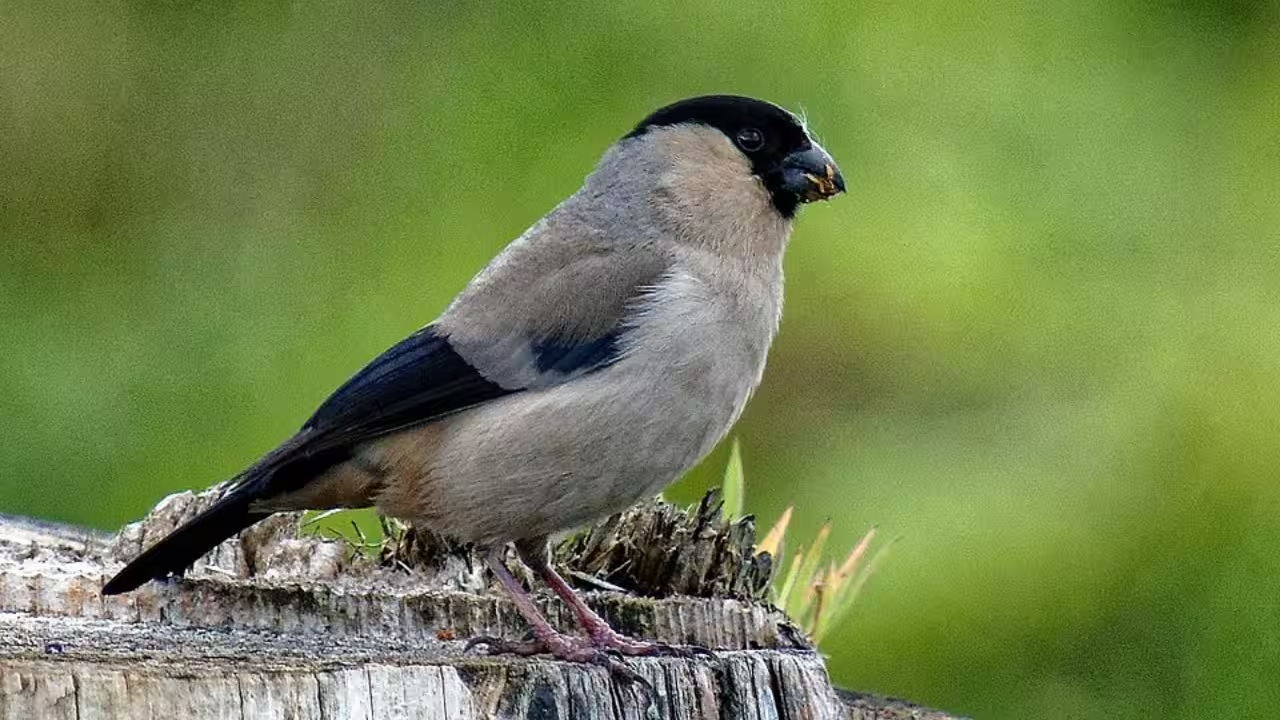
In 1999, the Azores set aside the Pico da Vara/Ribeira do Guilherme region on São Miguel Island for the conservation of the endangered Azores bullfinch, a bird found nowhere else in the world. At the time, the bird species had been reduced to around 100 breeding pairs and survived in a small remnant of native laurel forest. More than two decades later, sustained habitat restoration transformed about 1,000 acres of its core habitat, and surveys estimated the bird population at around 1,300 individuals. The Smithsonian notes that this recovery followed years of removing invasive plants, restoring native forests, and planting more than 500,000 native trees.A species confined to a shrinking forestThe Azores bullfinch, locally known as the Priolo and scientifically as Pyrrhula murina, is endemic to São Miguel, the biggest island in the Azores archipelago, and its decline followed centuries of changes to the islandâs native vegetation. A 2011 study published in Bird Conservation International evaluated annual monitoring data from 1991 to 2008, confirming that the historical population decline had successfully halted and stabilised shortly after the 1999 conservation measures were enacted. Instead of a continuing downward spiral, this tracking window proved that protecting the remaining laurel forest on the eastern side of the island provided an immediate, vital lifeline against habitat degradation.The birdâs dependence on native vegetation made habitat restoration central to its survival. Jamie Ramosâ research, which was later published in Biological Conservation, helped establish the importance of the bullfinchâs diet and habitat preferences. The study showed that the species feeds on a range of native plants and their seeds, buds and other parts, meaning that replacing native forest with invasive vegetation could reduce both available habitat and food. Ramosâ work reportedly helped conservationists conclude that protecting and expanding native forest was more important than simply trying to manage the bird directly.Notably, the conservation situation was serious enough that the International Union for Conservation of Nature listed the Azores bullfinch as Critically Endangered in 2005. However, the formal protection of its core habitat had already begun by then, with the Pico da Vara/Ribeira do Guilherme area designated for bird conservation in 1999. This milestone established the legal framework necessary to secure international funding over the next four years.The process of removing invasive plants and rebuilding native forestFollowing the administrative steps, major restoration work began in 2003, when the Portuguese Society for the Study of Birds (SPEA), working with the Azores government and European Union LIFE funding, began a dedicated conservation programme. Smithsonian reported that the first five-year project concentrated on improving forest quality by planting native trees. Later LIFE projects expanded the work, including establishing a nursery capable of producing a large number of native plants.Conservationists had to remove the invasive vegetation that had displaced the native plants. Managed in sequence, the LIFE Priolo project ran from 2003 to 2008, followed immediately by the LIFE Sustainable Laurel Forest project from 2009 to 2013. These projects restored around 275 hectares of laurel forest, which is roughly 680 acres, while later projects continued the restoration in the protected area.This work restored around 1,000 acres of core laurel forest over approximately two decades, with more than 500,000 native trees planted. Specifically, the European Commissionâs LIFE program notes a broader project footprint of roughly 450 hectares (about 1,112 acres) actively managed. This restored core area ultimately acted as an ecological engine, improving environmental quality across the wider region.In 2010, the IUCN moved the species from Critically Endangered to Endangered when a comprehensive, modernised census estimated the population at 1,000 birds, and then to Vulnerable in 2016. These changes indicate that the Azores bullfinch had successfully moved away from its steep downward trajectory and achieved population stabilisation.By 2023, data published by the European Commission reported that the population had grown to around 1,300 individuals. Benefiting from the core restoration work, these birds successfully expanded out into nearly 5,000 acres of suitable regional habitat now available within the wider protected zone. While different wildlife survey methods can produce varying baseline numbers, such as a parallel annual report estimating 1,061 individuals, both data models confirm that the population has achieved long-term stability.Therefore, the recovery cannot be reduced to a single number or single intervention. Six LIFE projects have supported conservation work over decades, while invasive plants and introduced mammals remain threats. A bird once restricted to a shrinking fragment of native forest now occupies a substantially larger area with improved conservation status.Catch the latest World News and Live updates. Download the TOI app.
Topics in this story
Gathered from external sources. Rights to this text belong to whoever originally published it.