S.F. Mayor Lurie launched an intensive push to improve chaos in the Mission. Did it work?
As with past attempts to transform two of the Mission's most prominent and chaotic public spaces, progress was inconsistent, though San Francisco authorities...
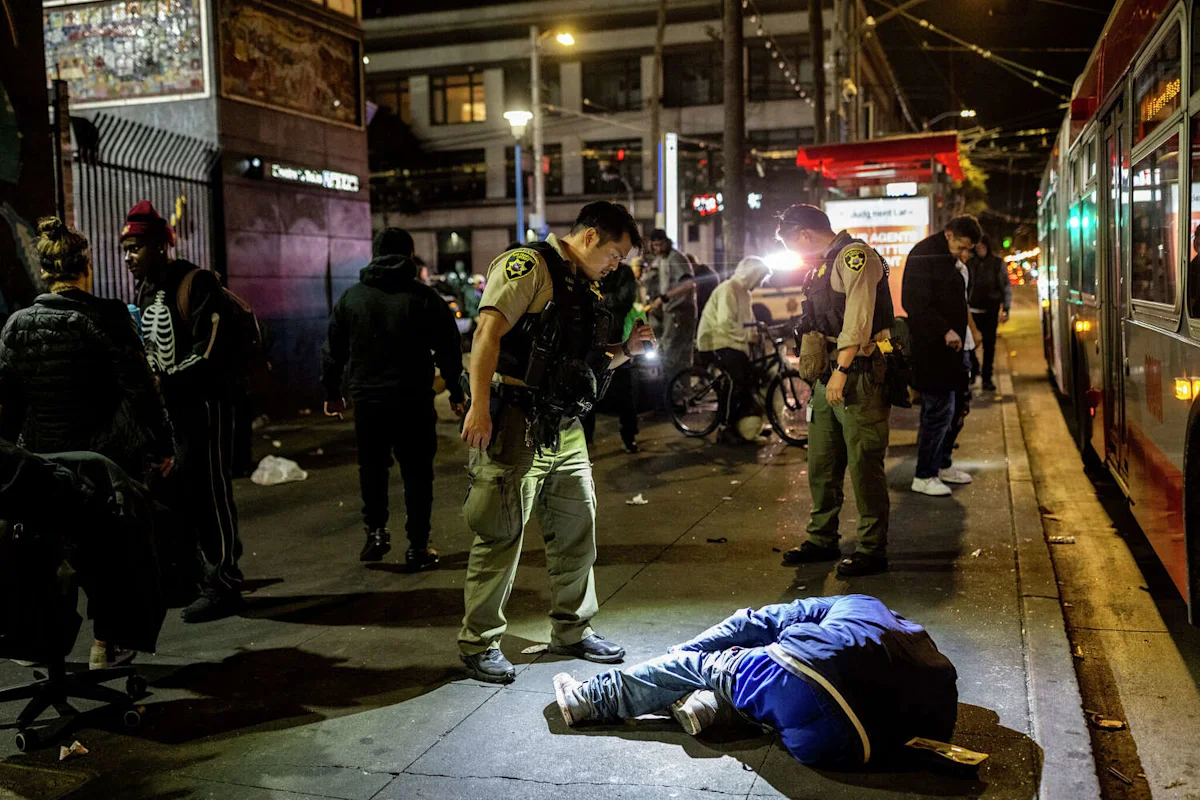
Night had just fallen on San Francisco's 16th Street BART plaza on Wednesday when police pulled up to a frenzied scene they've confronted many times before.
A throng of about 50 people had taken over one of the street corners, huddling around various apparently stolen items displayed for sale: flip phones, e-scooters and mint-condition Air Jordans among them. Riders disembarking Muni buses that stopped by the Mission District plaza had to step around people slumped over on the cement. The smell of smoke hung above.
"If you're going to buy it, I'm going to get it," a police officer barked over his loudspeaker before he drove around the corner.
His warning did not disperse the crowd indefinitely. As the night wore on, people shuffled around the blocks that surround one of the Mission's most troubled intersections. They vacated one spot when city crews came to power wash, only to return when law enforcement circled back to the other.
This cycle has been common over the last three months while Mayor Daniel Lurie's administration embarked on a renewed push to reduce disorder around the Mission's BART plazas .
The plazas have long been an epicenter of the city's most entrenched street problems, and the Mission also struggled with homelessness, drug use and unsanctioned vending under Lurie's predecessor London Breed. But conditions in the neighborhood worsened last year after law enforcement began cracking down on open-air drug markets in the Tenderloin and SoMa during the early months of Lurie's term. The city has tried various approaches, with mixed results.
Amid sustained outcry from Mission residents and business owners eager to see more lasting change, the mayor this summer announced a 90-day initiative that is set to conclude Friday. It brought several local agencies together to better coordinate the city's unfinished campaign to calm the Mission's BART plazas and adjacent neighborhoods.
As with past attempts to transform the Mission's most chaotic public spaces, progress was inconsistent, though authorities say they saw some encouraging results and will continue parts of the initiative indefinitely. The elusiveness of lasting improvements around the Mission BART plazas underscores how street conditions in some neighborhoods remain a top challenge for City Hall, even as residents say they feel better about the direction of the city overall.
During the recent surge, the police department sent more officers to the Mission, where officers - empowered by a new state law - began ticketing people suspected of selling stolen items around 16th and 24th streets.
Police also increased their enforcement of all crime in the area: Officers reported 481 arrests and citations for all infractions around the 16th Street plaza in the last 90 days, more than any other three-month period since 2018, according to a Chronicle analysis. Half were for drug violations. City officials said the initiative also coincided with a drop in homeless- and drug-related complaints in the areas around the plazas.
Public works crews started more frequent power washing at a Mission elementary school and a park. The city continued its push to hold events at the plazas. But the main benefit of the mayor's push, city agencies say, is that it encouraged closer collaboration as officials met three times a week to talk about the Mission.
Local residents and business owners say they've noticed improvements, but people using drugs or selling stolen goods frequently return when street teams leave - and it gets worse at night.
"There's been some changes, and then it goes back to the way it was," said Ryen Motzek, president of the Mission Merchants Association. "It's not really sustainable … It's like this whack-a-mole game."
Supervisor Jackie Fielder, who represents the Mission, told the Chronicle in a statement that her office had been "begging for a year and a half now" for a host of resources, including more police officer foot patrols, more frequent cleanings around the BART plazas, increased city support for street vendors, additional trash cans and expanded ambassador coverage. Yet "it just doesn't seem to be moving upward in a consistent way," Fielder said. "Our inboxes are as flooded with street condition concerns as they were in January 2025 when the Lurie administration began."
Fielder urged the administration to deploy community ambassadors around the BART plazas 24 hours a day. But a Department of Emergency Management official let her down in an Aug. 18 letter, telling the supervisor that expanding the hours of ambassadors would cost too much and put them in harm's way.
On Tuesday afternoon, Lt. Joshua Espinoza surveyed the spread of people lounging around the 16th Street plaza, some with beers in hand. While not yet acceptable, this daytime scene was manageable, said Espinoza, the lieutenant dedicated to the area. Nightfall is when enforcement really gets "overwhelming," he said.
Officers on patrol loop back and forth between the 16th and 24th street plazas in a constant "cat and mouse" chase, Espinoza said. Each arrest requires processing time that pulls an officer off the street, and with department-wide staffing shortages, police say they cannot address every potential infraction.
The Police Department assigned 28 officers to the mayor's 90-day push in the Mission and plans to maintain that staffing level indefinitely. Yet it's not enough to Espinoza, who said that allocating resources is "like robbing Peter to pay Paul."
People living on the streets of the Mission said recent clean-up efforts have frequently pushed them further away from the plazas. Several said they'd abandoned nearby alleyways for "borderzones" under the Central Freeway.
Officials involved in the initiative say it was only the beginning of a longer-term effort.
"We have no intention of just walking away at day 91," said Anne Taupier, the director of Lurie's Office of Economic and Workforce Development, which led the surge alongside other city departments.
The Department of Public Health, another agency involved in the three-month initiative, said the mayor's push allowed it to better coordinate services offered at the plaza. "We've made progress in the Mission District, but there is still work ahead," DPH said in a statement.
City officials recognize that the overnight hours continue to be their biggest challenge at the Mission BART plazas.
While Espinoza declined to give details on their latest plans, he said "operation night time" will attempt to push patrol past 8 a.m. and 8 p.m. to cover late-night and early-morning vending windows.
But not everything can be remedied with law enforcement, Espinoza said. The fire department hopes to station responders at the plazas who can "triage" people with mental health and medical issues until the city finds a longer-term solution, Espinoza added.
San Francisco officials have also identified city and state funding that could be used to help pay for future events, public safety programming, extra cleaning services and other upgrades.
"It really is going to take ongoing, thoughtful strategies about keeping the space," Taupier said. She described the challenge of assisting people struggling with addiction or mental health disorders who often congregate at the plazas.
"I don't think anyone had any delusions that we were going to solve that in 90 days," Taupier said.
This summer, San Francisco police got a new tool to clear the Mission BART plazas and nearby sidewalks of people selling stolen items. In June, the city began enforcing Senate Bill 276, a law from state Sen. Scott Wiener that allowed San Francisco police to step up enforcement against unpermitted vending.
Since then, San Francisco police have issued 534 notices, 93 first-time citations and 14 second-time citations. Three people have been charged with a misdemeanor, officers told the Chronicle.
But Lurie wanted the city to do more than just enforce the new state vending law, which he supported. That's why he tapped Taupier for the 90-day initiative.
"We have a long way to go," Lurie said in a July social media video filmed at the 16th Street BART plaza. "The Mission deserves two plazas that are welcoming to our children, to our seniors and to the community. And we're not going to rest until we get it right."
Some community leaders say the city needs to think bigger. Beyond police enforcement and other temporary measures, they want to see more options for housing, mental health care and addiction treatment.
Right now, "we're not seeing that," said Motzek, the Mission Merchants leader. He added that most parts of the neighborhood "are looking pretty darn good."
Not everyone hanging out at the plazas, which are close to hundreds of single-room occupancy units, is without shelter, local outreach workers said. Nor do they always want what the city has to offer, roving street nurses added.
"I always intended to be a San Francisco street person," said Benjamin Southard, who has spent more than a week in a tent on Valencia and McCoppin streets and over a decade in the Mission. This summer, he said, conditions have gotten "totally worse."
Southard thinks the police's "persecution approach" is "fouling the neighborhood" by forcing unhoused people to constantly pack up and move throughout the day, leaving belongings and garbage behind. He said it's disrupted his sense of community.
"Seedier" transient folks now take over the plazas at night, Southard said. That's when it becomes "impossible to avoid personal contact," and "pick pockets will thieve you out of a handkerchief."
By sunrise, he said, the sidewalks have gone from "dirty-smudgy" to "downright filthy." Danielle Echeverria contributed to this report.
Topics in this story
Gathered from external sources. Rights to this text belong to whoever originally published it.