In 2014, Massachusetts built State Route 7A’s rail overpass with stacked soil-and-fabric walls, cutting the $1.1 million project cost by 49%
In 2014, Massachusetts revolutionized bridge construction by using Geosynthetic Reinforced Soil-Integrated Bridge Systems (GRS-IBS) for the State Route 7A project, resulting in a 49% cost reduction. This innovative approach minimized disruption, accommodated a skewed bridge over an active railroad, and showcased effective monitoring methods post-construction.
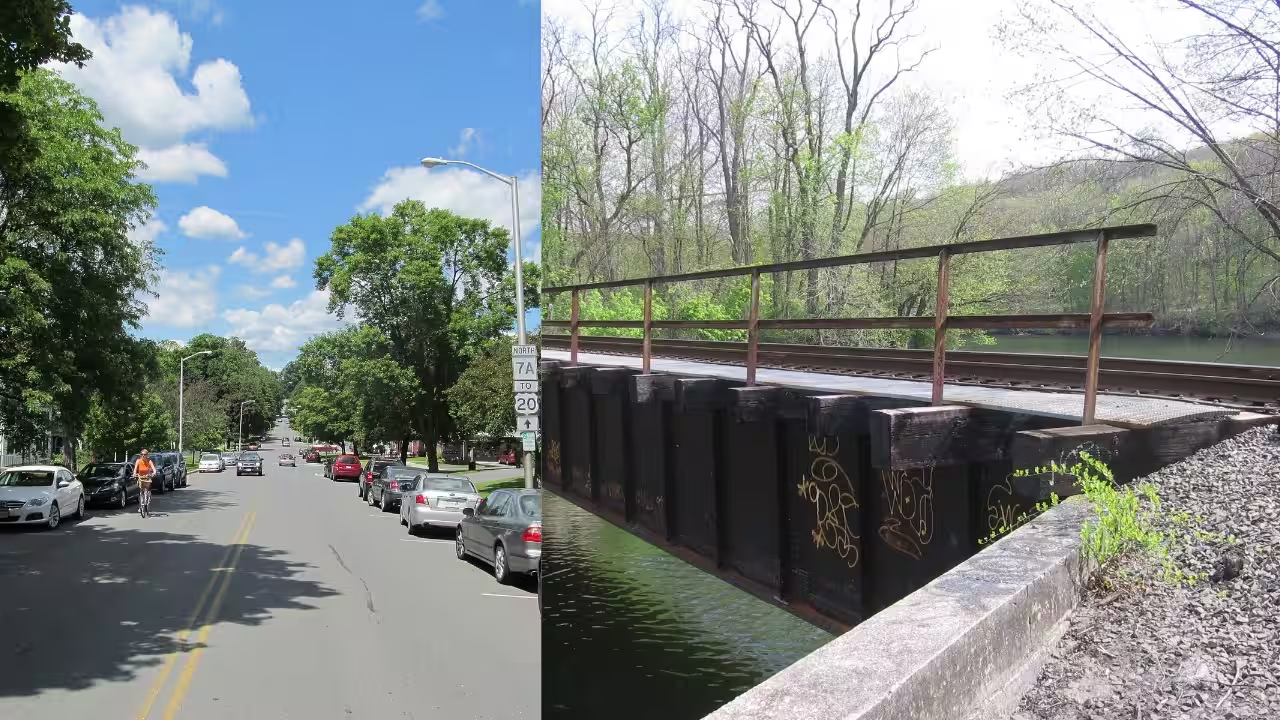
Massachusetts replaced the State Route 7A bridge over the Housatonic Railroad in Sheffield in 2014 by making use of a construction system that replaced conventional bridge abutments. They achieved this with layers of compacted soil and synthetic reinforcement, and called it GRS-IBS, which was the state's first project using the technology.The $1.1 million bridge cost 49% less than the estimated price of the original conventional design, according to the Federal Highway Administration. The project also had to accommodate a railway crossing that required a 105-foot-wide bridge with a 30-degree skew.The bridge used layers instead of a conventional abutmentThe geosynthetic reinforced soil portion uses alternating layers of compacted granular fill and sheets of geosynthetic reinforcement. The integrated bridge system places a bridge superstructure directly on those reinforced soil abutments, which creates a continuous transition between the road and the bridge. FHWA had been promoting GRS-IBS through its Every Day Counts program in order to build smaller bridges more quickly and at lower cost. FHWA says the technology can reduce construction costs because the abutments use readily available fill material and reinforcement instead of some of the heavier conventional concrete construction.The Route 7A project presented a more demanding application, since the bridge had to cross an active railroad and was built with a 30-degree skew. FHWA later identified it as one of the larger GRS-IBS structures that was constructed at the time, with abutments roughly 24 and 28 feet high. FHWA reported that the 2014 project was built with minimal disruption to train traffic, and the completed structure provided the wider roadway and pedestrian facilities that were required for the replacement while using the reinforced-soil system underneath.Engineers watched the walls after constructionA later FHWA synthesis report says that the Route 7A bridge included survey targets on the wall faces, inclinometers to measure lateral movement within the abutments, and earth-pressure cells beneath and behind the bridge girders. The monitoring was done with the intention of tracking how the reinforced soil structure behaved after construction.The report recorded less than 2 inches of settlement in the GRS-IBS structure, and lateral movement remained within a range of about 0.2 inches and appeared to vary with temperature. The data were part of a larger effort to evaluate GRS-IBS structures and determine where the system could be used on future bridge projects.A bridge that crosses a railway at an angle can create different loading and movement conditions from a straightforward perpendicular crossing, and FHWA and the Massachusetts Department of Transportation therefore continued to monitor the structure after it opened. The project was also part of a broader push by transportation agencies to shorten bridge construction and reduce costs, with the GRS-IBS construction using compacted soil and reinforcement for the abutment walls, while the bridge deck itself can use conventional structural components.A large saving on a relatively small bridgeFHWA reported that the $1.1 million GRS-IBS bridge represented a 49% saving in comparison with the estimated cost of the original conventional design. The system changed how the bridge approaches and abutments were constructed, and FHWA describes GRS-IBS as a method that combines reinforced soil with the bridge superstructure rather than treating the roadway and bridge as entirely separate conventional components.In June 2014, MassDOT and FHWA held a workshop in Massachusetts that was focused on GRS-IBS. The Route 7A project in Sheffield was presented as the state's first example, while two additional Massachusetts projects were already being developed. The Route 7A bridge therefore served two purposes: replacing an aging railway crossing and giving Massachusetts engineers a full-scale example of how reinforced soil could be used for a skewed bridge over an active rail line. Its construction changed the structure supporting conventional bridge components, and the cost comparison of a $1.1 million project coming in 49% below the estimated conventional design was the clearest result.You use AI every day. Now get your AI Quotient. Take the AIQ test.
Topics in this story
Gathered from external sources. Rights to this text belong to whoever originally published it.