Newspaper headlines: 'Air traffic out of control' and 'RAF to help Saudis'
A second glitch this month in the national air traffic system and the PM's first major foreign policy move lead the papers.
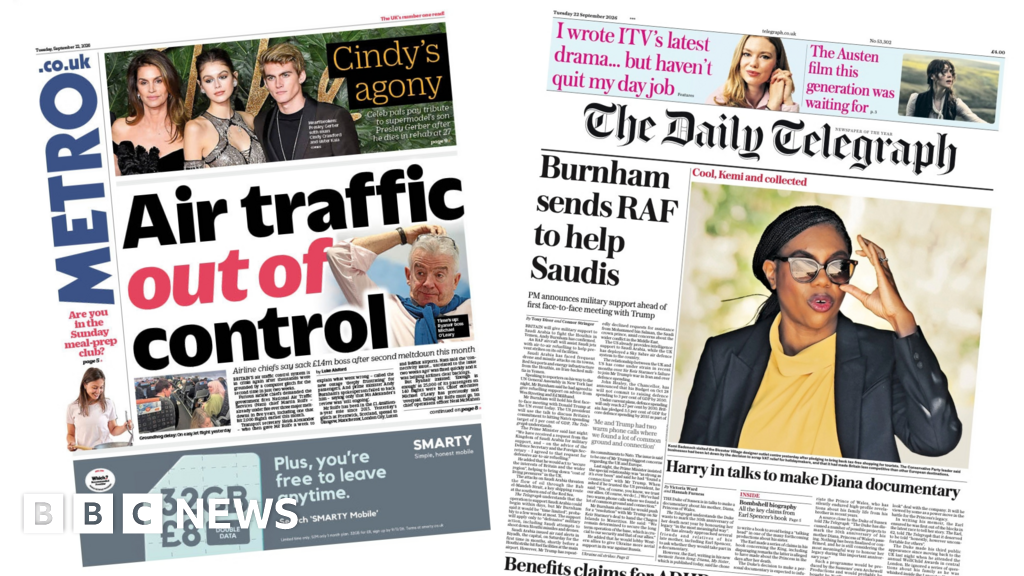
The UK's support for Saudi Arabia in its war against the Iran-backed Houthis in Yemen makes the front pages of the Times , the Daily Telegraph and the Guardian , which calls it a significant military intervention.
The i Paper reports that the UK has fired a torpedo from an uncrewed, underwater drone for the first time. According to the paper, the test was carried out last week in British waters and the weapon is part of the deterrent designed to protect UK ships and seabed pipelines from attacks by hostile powers.
The Financial Times says a financial technology company backed by the Kremlin managed to trick its way into the global financial system to launder nearly $7bn (£5bn) using what it describes as a " vast document forgery operation". The paper says it allowed Russian companies to settle bills abroad, even though its banks were cut off from the system because of the full-scale invasion of Ukraine in 2022.
The majority of prisoners being freed under the government's early release scheme next month will not be fitted with monitoring tags before they leave prison, according to The Times. The paper says 1,350 prisoners will be freed over a two-week period from 1 October, but it understands the Probation Service does not have the capacity to fit tags before release to all but the most dangerous offenders, with the remainder being fitted in the community. A Ministry of Justice spokesperson is quoted as saying that the government's investing £100m in the "biggest expansion of tagging in British history, introducing a presumption to tag offenders before release for the first time".
A University of Cambridge study suggesting that girls and boys exhibit differences depending on their gender within just a few hours of being born is picked up by a number of the papers. The Telegraph says the Cambridge scientists have shown baby girls tend to prefer looking at human faces, while boys choose to gaze at objects. Their conclusion in a nutshell: that both nature and nurture play roles in shaping differences between the sexes, not nature or nurture.
Topics in this story
Gathered from external sources. Rights to this text belong to whoever originally published it.