‘Any one who sleeps over his right is bound to suffer’: Chhattisgarh high court rejects 30-year-old salary arrears claim
RAIPUR: The Chhattisgarh high court has dismissed a writ petition seeking payment of alleged salary arrears dating back to 1989-94, holding that a
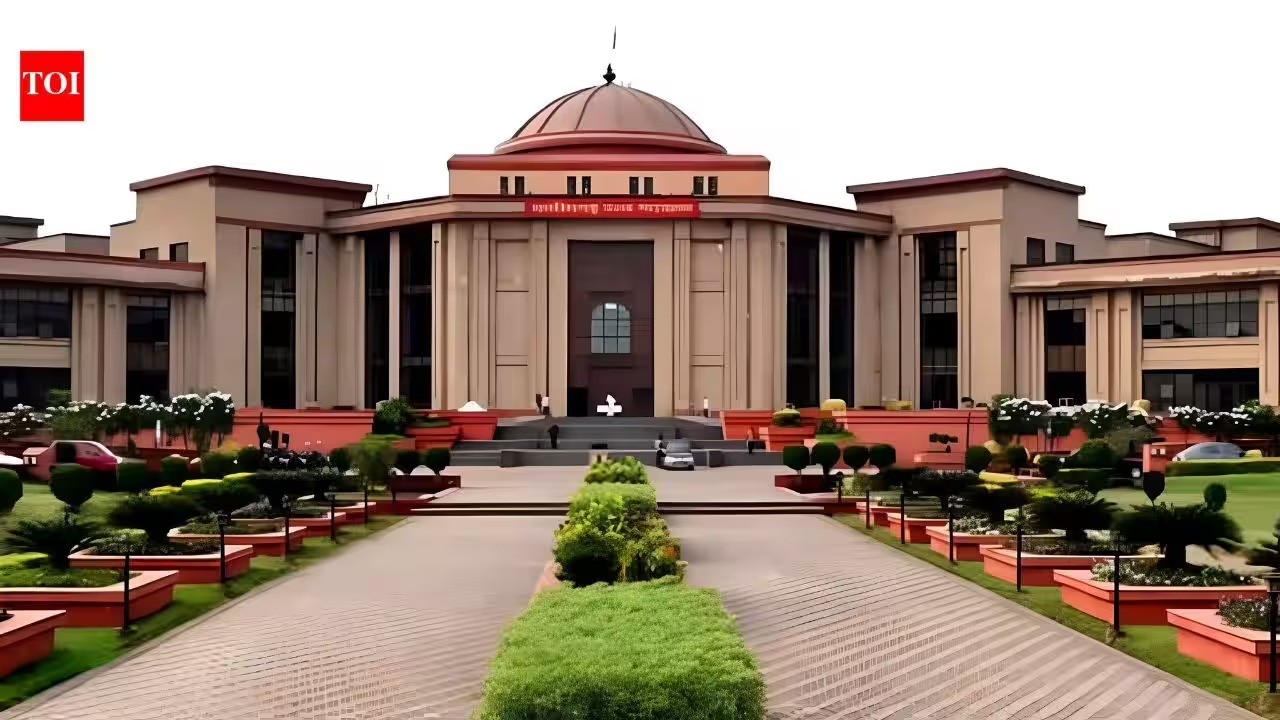
RAIPUR: The Chhattisgarh high court has dismissed a writ petition seeking payment of alleged salary arrears dating back to 1989-94, holding that a litigant must approach the court within a reasonable time, even though no limitation period is prescribed for filing a writ petition under Article 226 of the Constitution.Justice Bibhu Datta Guru dismissed the petition in limine on October 6 on the grounds of delay and laches, noting that the petitioner had failed to explain why he waited more than three decades to pursue the alleged dues of his late father.The court observed that “a person invoking the extraordinary and discretionary jurisdiction of this Court under Article 226 of the Constitution of India must approach the Court with due diligence and within a reasonable period of time”. It added that writ jurisdiction was not intended to revive stale claims after prolonged inaction.The petitioner, claiming to be the son of a deceased South Eastern Coalfields Ltd (SECL) employee, had sought a direction to the authorities to consider an alleged representation submitted by his father in 1996 for payment of arrears for the period from 1989 to 1994.The court noted that the employee retired in 2002 and died in 2015. Neither he during his lifetime nor the petitioner later took effective steps to pursue the alleged pending representation.Justice Guru said the principles underlying the doctrine of delay and laches were based on “repose, certainty and finality”. Overlooking an enormous delay, the court observed, could prejudice the rights and interests of other parties and unsettle matters that had otherwise attained finality.The petitioner claimed that his father had submitted a representation dated January 2, 1996. However, the court noted that “there is neither any acknowledgement nor any receipt on the record” to establish that it had been submitted to the competent authority.It also found no satisfactory explanation for the delay and said no exceptional circumstances had been presented to justify overlooking it.In a strong observation, the court said: “The petitioner (son of the deceased employee) chose to sleep and got up at his own leisure, for some reason which is fathomable to him only. But such fathoming of reasons by oneself is not countenanced in law.”It added: “Any one who sleeps over his right is bound to suffer.”The court also noted inconsistencies in the petitioner's pleadings. While he claimed that his father had been appointed as an assistant teacher, the alleged representation described him as a peon, Category-II.Holding that the claim concerned alleged arrears more than three decades old and that the petitioner had failed to establish submission of the 1996 representation or provide a plausible explanation for the prolonged inaction, the court declined to exercise its extraordinary writ jurisdiction.“Though there is no period of limitation provided for filing a writ petition under Article 226 of the Constitution of India, yet ordinarily a writ petition should be filed within a reasonable time,” the court said before dismissing the petition in limine on the ground of delay and laches.You Can Also Check: Gold Rate in Raipur | Silver Rate in Raipur | Bank Holidays in Raipur | Public Holidays in Raipur | Raipur AQI | Weather in Raipur | Petrol Price in Raipur | Diesel Price in Raipur | CNG Price in Raipur | LPG Price in RaipurStay updated with the latest Raipur news. Download the TOI App.
Topics in this story
Gathered from external sources. Rights to this text belong to whoever originally published it.