Rescuers pump air into hydropower tunnel in search for missing workers after Nepal-China flooding
Around 3,000 people are still missing after this week’s catastrophic flash flooding on the Nepal-China border. Follow live updates.
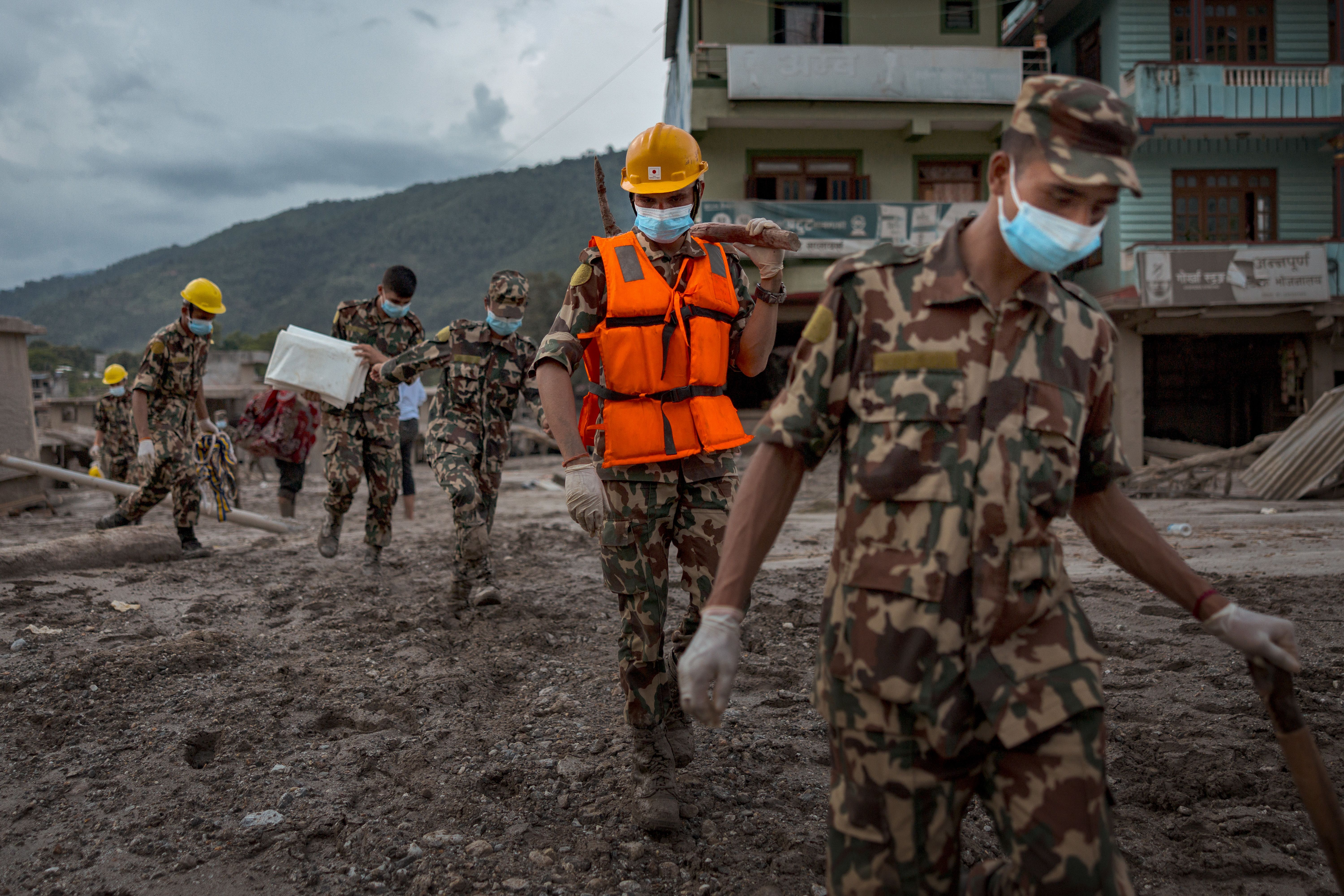
• Rescue effort: A search is underway more than 900 missing workers at various hydropower projects in Nepal after Wednesday’s catastrophic flooding. Emergency workers have pumped air and dropped food into one tunnel but have yet to establish communication with anyone inside.
• Search continues: More than 3,000 people are still missing. The US is providing $3.6 million of humanitarian aid , up from the earlier announced $500,000.
• Grim toll: The disaster has killed at least 750 people . More than 700 people have been confirmed dead in Nepal and at least 16 in China. Nepali authorities are struggling to cope with the mounting number of bodies, and Chinese officials have said their search teams have found no more survivors yet.
• New barrier lake: A landslide detected on Saturday evening created a new barrier lake on a river near the disaster zone, prompting the evacuation of rescuers in China, reported state media.
Family photos, spiritual statues, and reminders of his missing father: These are some of the things Sumit Nepal hoped to find when he returned to his home in Devighat searching for anything salvageable among the mud and debris that engulfed much of the village.
“But there was nothing left,” Nepal told CNN.
His father Navaraj, 42, remains missing. His last known whereabouts was meters from the China-Nepal border crossing that was engulfed in flood water earlier this week.
“Father where are you? Please be safe and contact us,” he said.
For now, all he has to remember his home in happier times is a photo of him and his father standing by the front door on a sunny day and another of him with his mother, inside on the stairs.
People cut off by flood damage in Nepal are in urgent need of clean water to prevent disease spread, according to an aid chief who raised concerns of damaged pipes and contaminated drinking sources.
“The biggest concern is that dirty water can spread disease, so people need clean water for drinking and washing as quickly as possible, alongside urgent help for those still stranded,” Sudarshan Neupane, country director of WaterAid Nepal, told CNN on Sunday.
“Besides, there is a real danger of disease outbreak from the decayed bodies and animals, as we have seen in other disasters.”
The immediate priorities are to rescue those still trapped, get clean water and essential supplies to affected families and restore electricity and water connections, Neupane said.
In the longer term, national and international financing is needed “to repair and strengthen damaged water systems, help communities prepare for future floods and reduce the risk of disease,” he added.
We’ve been continuing to report on search and rescue efforts after Wednesday’s deadly flooding near the Nepal-China border.
Survivors have begun returning to mud-caked homes to search for their belongings as relatives of those missing are still desperately searching for updates on their loved ones.
Death toll climbs: At least 750 people have died in the disaster. In China, 16 people were killed and 546 people are missing, according to authorities on Sunday local time. Chinese officials added that no more survivors have been found yet. Eighteen Americans are among the at least 261 foreigners missing in China. In Nepal, at least 734 died with 2,498 missing.
Rescue efforts: Rescuers have been using heavy equipment to clear debris in tunnels at hydropower projects along the Trishuli river, where about 900 employees are still missing . They have pumped air and sent food through holes bored into the tunnels.
New barrier lake: A landslide on Saturday evening created another barrier lake near the Nepal-China border, prompting the evacuation of rescue personnel near Gyirong Port, Chinese state media reported.
US aid: The State Department said the United States is providing $3.6 million of humanitarian aid to Nepal, up from the $500,000 it announced earlier. It includes emergency food assistance for up to 10,000 flood-affected households, the State Department said.
Victims’ burial: Workers are preparing a mass burial site in Nepal’s Chitwan region. Footage from a CNN team on the ground showed workers in hazmat suits placing body bags into the back of a van.
An American citizen said he feels “super happy and lucky to be alive” after he narrowly avoided the flash floods in Nepal.
47-year-old Roman Shteynshlyuger is now in the US after returning from Nepal, where he was supposed to join a trekking tour to Tibet. He said he dropped out of the tour after his Chinese visa was denied.
Shteynshlyuger went to hike Everest Base Camp instead, then flew to the US. He joined a party for his mother’s 70th birthday in Brooklyn on Saturday, and said he felt “unimaginable joy and happiness to be here.”
“I’m glad I wasn’t there, but I feel sad for the families,” he said. “It was shocking.”
He had been on a list of “missing” American passport holders in the flood, but he has now informed the authorities that he is safe.
In an email seen by CNN, Nepal Tourist Police responded saying “we are so glad to hear this news,” adding “have a great and prosperous life ahead.”
Shteynshlyuger moved to the US from Ukraine in 1991, and has been living in Puerto Rico in 2020. His family lives in Brooklyn.
A 13-year-old Nepali girl told CNN she was nearly washed away by the floods as she rode on her school bus to safety.
“At first, the teachers knew that a big flood was coming,” 13-year-old Rojina Bhatta said. “They instructed us to leave the school and go to a safe location.”
The driver “drove extremely fast” and got them to safety, she said, after picking up some other students on the way.
“The water was chasing us,” Rojina recounted. “Everyone on the bus was scared and crying.”
Her school, Trishuli High School, was completely washed away in the flood. But the driver managed to save around 50 children on the bus.
“When I recall that terrifying moment, I still get scared,” she said.
Bhatta’s father, Rajendra Bhatta, witnessed the flooding from near their home in Bidur, seeing dozens of homes washed away, along with a bridge and a newly-built road.
“The water in the river was roaring as if it were flying,” 38-year-old Bhatta said. “I saw it jumping into the sky.”
“Not just me, but my father and grandfather also never witnessed such a devastating flood in their lifetimes,” he said.
Bhatta has 30 buffalo across the river, which he now can’t access due to the bridges being destroyed. But he’s just grateful his family survived.
For the first time, Chinese authorities on Sunday provided a breakdown of the nationalities of foreigners missing in the Tibet region following the flooding disaster on the Nepal-China border.
261 foreign nationals from 23 countries are missing:
3 each from Russia, Malaysia and Germany
2 each from the Netherlands, New Zealand, Estonia, France and Ireland
1 each from Finland, Lithuania, Portugal, Ukraine, Spain, Hungary and Kazakhstan
Rescue teams are facing challenging conditions as they race to rescue workers in tunnels of hydropower plants, with water levels of the nearby river rising once again early Sunday morning local time.
“The water level of Trishuli River increased by 5 to 10 meters due to floods at the planned site again at around 4 a.m. today,” said the Nepali prime minister’s office on Sunday, referring to the Upper Trishuli 3A hydropower plant.
“The flood has started to cut the river banks off,” it said. “Road access to tunnel has been blocked and preparations are underway to make helicopter landing possible and recover important equipment.”
The office added that crews were using heavy equipment to remove debris, and that a special force is preparing to recover parts of the hydropower facility, its CCTV cameras, and other equipment.
Some viewers may find this footage distressing.
Workers are preparing a burial site in Nepal’s Chitwan region after Wednesday’s catastrophic floods.
Footage from a CNN team on the ground shows workers in hazmat suits placing body bags into the back of a van on Saturday night.
In another scene, diggers broke into the earth to prepare a mass burial site.
More than 700 people have died in Nepal and at least 16 have been killed in China.
Local police previously told CNN Chitwan officials are planning to bury hundreds of unidentified bodies in a mass grave at a sacred Hindu site. Authorities are struggling to cope with the number of already decomposing bodies.
A landslide on Saturday formed a new barrier lake on a river near the China-Nepal border, prompting rescue personnel near the Gyirong Port to evacuate, Chinese state broadcaster CCTV reported.
A monitoring drone detected the landslide Saturday evening on a mountain slope about 2.8 kilometers (1.7 miles) downstream from an existing barrier lake on the Purepu Tsangpo River, according to China’s Ministry of Emergency Management.
The latest landslide created a new blockage in the river and formed another barrier lake, authorities said.
Rescue teams at a hydropower plant in Nepal are sending food into a tunnel through holes bored by machines as they search for possible survivors inside.
More than 930 workers are unaccounted for at various hydropower projects in the flood zone in Nepal.
At the Trishuli–3A project, rescue workers have worked through the night as they try establish contact with anyone who might be inside the projects tunnels –– which stretch more than four kilometers according to documents from the Nepal Electricity Authority.
“Of late, two holes (were) created to send oxygen, light and food,” said Mohan Shakya, spokesperson at the Ministry of Energy, Water Resources and Irrigation, on Sunday morning.
“Efforts are underway to rescue people by breaking the tunnel from other ways. We are sending more drilling equipment and explosive items.”
He added that Chinese and Indian teams, who arrived in the country on Saturday, are helping the rescue effort at the tunnel. “We haven’t stopped the work even in the night,” he said, adding that work continues even with light rain in the area.
The number of people confirmed dead after the Nepal-China flooding has reached 750, with more than 3,000 people still missing, according to official tallies from Nepal and China on Sunday.
Nepal’s disaster agency said the death toll there had climbed to 734, from a previous total of 670. At least 2,498 people remain missing in Nepal, including 589 foreign nationals.
Earlier on Sunday, Chinese authorities confirmed at least 16 people had died on in the Tibet region, with 546 people missing. Among them are at least 261 foreigners including 18 Americans.
Chinese authorities held a press conference on Sunday, sharing updates and details about rescue operations after catastrophic flooding hit Gyirong Port in Tibet.
The death toll rose to 16 while the number of missing fell to at least 546. At least 261 foreigners are among the missing, including 18 US citizens.
No more survivors have been found yet in China.
Chinese state media reported on Saturday that two villagers had been rescued.
Footage from Wednesday’s disaster showed the deluge engulfing a large administrative building at Gyirong Port. A rescue team leader previously told CCTV: “The buildings within the mudslide’s impact zone have largely been flattened, with no discernible outline of any structures.” The rescue team said they had seen no signs of survivors at the border checkpoint.
A barrier lake formed near the flood zone at the Nepal-China border from an initial landslide has overflowed, but the situation is stable.
“The barrier lake has already overflowed and started to discharge water,” officials said.
“Currently, the overall situation is stable and the possibility of a complete breach is relatively low.”
CNN’s Simone McCarthy and Laura Sharman contributed reporting.
Rescuers are urgently pumping air into into a tunnel at a hydropower project along Nepal’s Trishuli river, and plan to drill a manhole in the hopes of sending teams inside to look for survivors.
About 900 workers at various hydropower projects are unaccounted for, according to the country’s Independent Power Producers’ Association. About 361 workers have been rescued so far, their data shows.
“There has been some success in the ongoing rescue efforts at the Trishuli–3 ‘A’ Hydropower Project tunnel, which was buried under mud and sludge following the flood,” wrote Biraj Bhakta Shrestha, Nepal’s Minister of Energy, Water Resources and Irrigation, in an update late Saturday night.
Crews had been working with excavators to clear the mud and sludge, and had drilled a 6-inch hole through the upper section of the tunnel, he wrote. Initial inspections showed no debris inside; they’ve since pumped air into the tunnel, and let in light and sound, but have yet to establish communication with anyone inside.
Earlier on Friday, the Nepali army released dramatic video showing rescuers saving several people from the tunnel of a hydropower plant in Rasuwa district, with survivors crawling through thick mud and being carried out by emergency responders.
The Nepali army has released video showing rescuers saving several people from the tunnel of a hydro power plant in Rasuwa. The footage shows survivors crawling through thick mud to reach rescuers.
The Nepali government has requested experts on tunnel rescues from India and China to help free the trapped workers. Teams from both countries arrived in Nepal on Saturday.
The United States is providing $3.6 million worth of humanitarian aid to Nepal after disastrous flooding, the State Department announced Saturday — up from the $500,000 it announced two days ago.
The department said the US embassies in Nepal and China “are working closely to assist Americans and support disaster relief efforts.”
The State Department announced Thursday that the US was “quickly deploying” $500,000 in assistance to affected communities.
Living in the shadow of the world’s spectacular, ice-capped mountains has always carried dangers , but the devastating flood wave that carved a path of destruction on the Nepal-China border this week shows how life for the millions worldwide who live downstream of these peaks is becoming more unpredictable and more deadly.
Nepal is a country of jagged, towering peaks with sheer slopes sweeping down to narrow valleys, cut through by powerful rivers. Its stunning landscape attracts hordes of tourists; it’s also treacherous.
Nestled in the rapidly warming Himalayas, the country has long been a hotspot for flooding and landslides. But what happened on Wednesday “was of significantly larger scale than what we have seen in the recent past,” said Prashant Baral, a cryosphere analyst at ICIMOD, a Nepali climate organization.
An enormous chunk of glacier around 2,000 feet wide sheared off Langtang Lirung mountain in northern Nepal, accompanied by landslide, according to satellite analysis. It sent a deadly mix of ice, water, rock, sediment and boulders the size of cars crashing 7,000 feet downward, causing such a powerful tremor, it was initially mistaken for an earthquake.
This torrent – described by some as “ liquid concrete ” – surged through narrow gorges, wiping out homes, buildings, power plants, bridges and roads.
Scientists are still unpicking the exact causes of the devastating flooding on the Nepal-China border, but what we know so far is that the disaster began when a vast chunk of glacier sheared off the mountainside on Wednesday .
The glacier chunk plunged around 1 kilometer (0.62 miles) into the valley below, according to a team of international scientists, which has been poring over satellite images and other data.
The US Geological Survey says the event created the equivalent of a 5.2-magnitude earthquake.
A glacier collapse alone would not have been enough to generate such an enormous amount of energy, “so there had to be something else involved,” said Daniel Shugar, a geologist at the University of Calgary in Canada, who is part of the scientific group. They believe a landslide likely happened at the same time.
Scientists say there is still work to be done to establish exactly what happened and what made the flooding so deadly.
“Figuring out where that water came from is is actually probably the hardest thing about all this,” Shugar added.
Two lakes that subsequently formed beside the site of catastrophic landslides sparked fears of fresh flooding and prompted both China and Nepal to briefly pause rescue efforts.
Nepal’s foreign minister told a press conference on Saturday that the country remained on high alert for fresh flooding risks.
“The river systems and downstream flood risk are being continuously monitored,” Foreign Minister Shisir Khanal said.
“Our systems are on high alert for any additional fraud risks, and all required coordination is in place.”
Topics in this story
Gathered from external sources. Rights to this text belong to whoever originally published it.