In 1948, retired Wisconsin lumberjack Fred Smith began shaping a concrete park by hand; by 1964, he had created 237 sculptures beside Highway 13
US News: Explore the fascinating story of Fred Smith, a retired lumberjack who transformed his property into Wisconsin Concrete Park, an iconic outdoor museum filled with over 200 unique sculptures that intertwine local and American history.
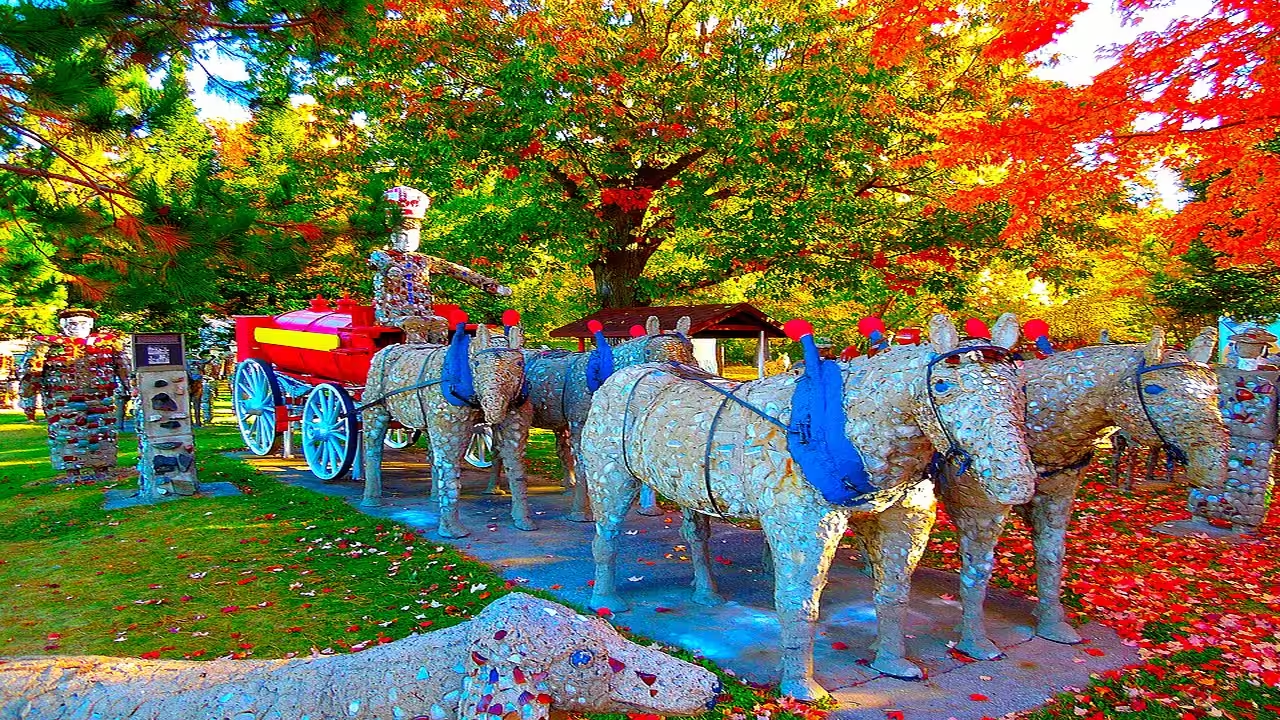
A retired lumberjack in northern Wisconsin once turned his own property into an unlikely outdoor museum, filling it with towering concrete figures, animals, local characters and scenes from American history. What began in 1948, when Fred Smith stopped working in the logging camps, grew over the next 16 years into Wisconsin Concrete Park, a sprawling collection of 237 sculptures beside Highway 13 near Phillips.From lumber camps to concreteAccording to Wisconsin Concrete Park, Smith was born in 1886 to German immigrant parents in Price County and spent much of his working life in the Northwoods lumber camps. He also farmed, grew ginseng and Christmas trees, and in 1936 opened the Rock Garden Tavern on his homestead. The tavern later became an important source of material for his sculptures, particularly the discarded beer bottles whose glass he embedded in the concrete. When Smith left the logging camps in 1948, retirement did not mean slowing down. He began with relatively modest bas-relief plaques and gradually moved towards larger, three-dimensional figures. His early subjects included local people and events, but his imagination soon expanded. There were lumberjacks and Native American figures, pioneers and politicians, animals, biblical subjects and characters drawn from popular legends.Smith's first creations were closely connected to the place where he lived. Rather than making sculptures for galleries or exhibitions, he incorporated them into the landscape around his home, tavern and rock garden. The result was not a conventional sculpture garden with works displayed separately. The figures occupied the same landscape, which Smith called his "Wisconsin Concrete Park". The National Register of Historic Places later described it as a cohesive built environment combining local and national history with Smith's own artistic vision.His materials were as unconventional as his subjects. Smith built wooden frameworks, wrapped them with wire and added layers of hand-mixed cement. Broken bottles, pieces of glass, mirrors, stones and other found objects were pressed into the surfaces. For larger sculptures, he often constructed components separately before assembling them at their final locations. The method was practical and gave the figures their distinctive rough, textured appearance.A roadside panorama of AmericaSmithsonian Magazine notes that Smith's sculptures became a kind of three-dimensional scrapbook. Paul Bunyan, the legendary giant lumberjack associated with the Northwoods, stands among figures representing people and stories from much wider American culture. There are sculptures of Abraham and Mary Todd Lincoln, Sacagawea and the Statue of Liberty, alongside animals and scenes inspired by everyday rural life. One of the park's most unusual works depicts an enormous muskellunge being pulled by horses. Smith deliberately blended local history with national history, folklore and legend. His sculptures placed regional characters alongside famous historical figures, while animals and mythical subjects appeared within the same landscape. The result was a richly varied environment where different parts of Smith’s imagination and the history of the Northwoods existed side by side.According to Conservation Online, Fred Smith’s Wisconsin Concrete Park belongs to a wider tradition of outdoor environments created by self-taught artists, combining materials such as concrete, wood, glass, metal and stone. The scale and subject matter of Smith’s work were closely tied to his life in Wisconsin’s Northwoods and his years as a lumberjack. Even as arthritis made the physical work more difficult, he continued creating and installing sculptures with help from family and neighbours. Smith’s sculpting career came to an end in 1964 after he suffered a stroke.From roadside curiosity to preserved landmarkWisconsin Concrete Park also notes that Smith died in 1976, but his unusual landscape survived him. Shortly afterwards, the Kohler Foundation acquired the property and began restoration work. The timing proved unfortunate: a powerful windstorm struck the area in 1977, damaging many sculptures and uprooting trees across the site. Restoration nevertheless continued, and the property was eventually transferred to Price County. A second major storm in 1987 reinforced the need for long-term stewardship and regular maintenance rather than one-time repairs.That need for continued care remains relevant because Smith's sculptures were designed for outdoor display and contain materials that deteriorate differently. Wooden internal supports can decay, metal armatures can corrode and repeated freezing and thawing can crack concrete. Glass and other decorative pieces can also loosen. Conservators therefore carry out ongoing work to reinforce structures, repair cracks, stabilise foundations and replace damaged internal components while trying to retain Smith's original appearance. According to the Wisconsin Historical Society, the park was added to the National Register of Historic Places in 2005, recognising not just the individual sculptures but the entire environment Smith created. Today, the roadside landscape south of Phillips remains home to his collection, with the sculptures spread across the property among trees and pathways. What began with a retired lumberjack pouring concrete on his homestead has outlasted the man who made it. He kept making sculptures until his property became a record of the people, stories and landscapes that filled his imagination.Catch the latest World News and Live updates. Download the TOI app.
Topics in this story
Gathered from external sources. Rights to this text belong to whoever originally published it.