Michigan’s AQI hit 616 after Ontario wildfire smoke crossed into the US; scientists warn a warming climate could make such pollution more common
US News: Smoke from Canadian wildfires can travel hundreds or even thousands of kilometres, turning a distant fire into a serious air-quality emergency. That d.
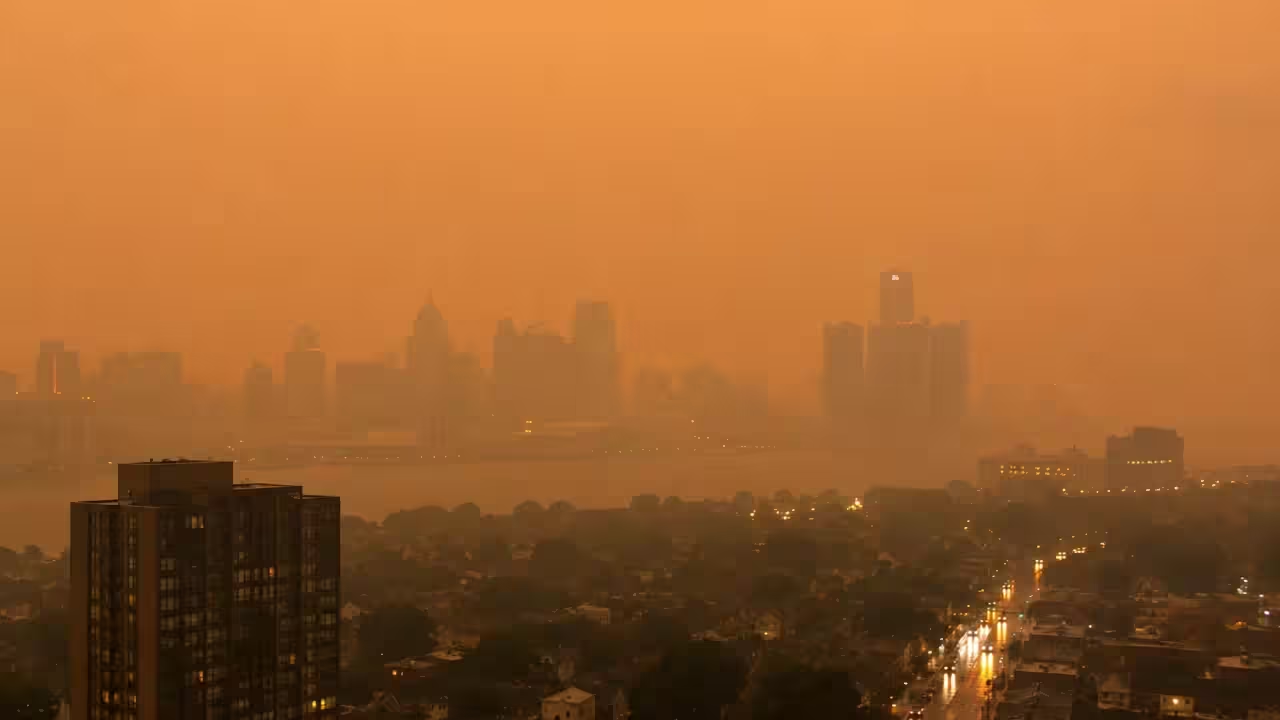
Smoke from Canadian wildfires can travel hundreds or even thousands of kilometres, turning a distant fire into a serious air-quality emergency. That danger was starkly illustrated when wildfire smoke from Ontario moved into the United States and contributed to exceptionally poor air quality across parts of the Midwest. In Michigan, the Air Quality Index reportedly reached an extraordinary 616, a level far beyond the EPA’s hazardous category. But the episode is part of a much larger concern. Scientists have increasingly linked worsening wildfire conditions with a warming climate, while new research shows that smoke-derived fine particulate pollution is already contributing substantially to premature deaths across the United States. A 2026 Science Advances study estimated that wildfire-smoke PM2.5 was responsible for approximately 24,100 deaths each year in the contiguous US between 2006 and 2020.How wildfire smoke from Ontario reached MichiganWildfire smoke does not remain close to the flames that produce it. Once fine particles enter the atmosphere, winds and large-scale weather systems can carry them across state and national borders, exposing communities far from the original fires. Research published in The Lancet Planetary Health has shown that wildfire smoke can affect regions far beyond the areas where fires are burning, including the US Midwest through long-range transport. Michigan’s extreme air-quality episode demonstrates how quickly this distant pollution can become a local problem. Smoke transported from Canadian fires can contain high concentrations of fine particulate matter, or PM2.5, which is small enough to penetrate deep into the lungs. The particles can also enter the bloodstream, making wildfire smoke considerably more dangerous than simply an unpleasant haze. The scale of the pollution is particularly concerning because communities do not need to experience a wildfire directly to face its consequences. A fire burning hundreds of kilometres away can produce an air-quality emergency when atmospheric conditions carry its emissions towards populated areas. Scientists have therefore increasingly treated wildfire smoke as a continent-wide environmental and public-health issue. As fire seasons become more severe in some regions, the areas exposed to smoke can expand well beyond traditional wildfire zones.Why PM2.5 from wildfire smoke is a serious health threatThe most significant pollutant in wildfire smoke is PM2.5, referring to particles with an aerodynamic diameter of 2.5 micrometres or smaller. Their tiny size allows them to travel deep into the respiratory system, where prolonged exposure can contribute to harmful health effects. A 2026 study in Science Advances, examining the contiguous United States between 2006 and 2020, found that wildfire-smoke PM2.5 was associated with increased mortality across the outcomes studied. The researchers estimated that wildfire smoke was responsible for approximately 24,100 all-cause deaths per year. Importantly, their analysis found no evidence of a clear “safe” threshold for the relationship between smoke PM2.5 exposure and mortality. Earlier research has similarly demonstrated that long-term exposure can have consequences beyond the immediate respiratory irritation often associated with smoky conditions. A study examining 2007–2020 data estimated approximately 11,415 non-accidental deaths annually were attributable to long-term wildfire-smoke PM2.5 exposure. These findings make extreme AQI events more than a temporary inconvenience. They represent one visible manifestation of a much broader exposure problem, particularly as wildfire smoke increasingly affects densely populated areas outside traditional fire-prone regions.Climate change is intensifying the wildfire smoke problemHealth impacts have a strong link with the changing dynamics of wildfires and the climate. It has been discovered that human-induced climate change has expanded the forest-fire area in temperate and boreal North America due to increasing warm and dry weather, which helps make a suitable environment for fires. A study conducted in the contiguous United States from 2006 to 2020 indicated that climate change was responsible for around 15,000 deaths from pollution due to wildfires during 15 years. The researchers also estimated an associated economic burden of around $160 billion, warning that the health effects of climate-driven wildfire smoke are expected to increase without major changes in climate trajectories and land management. Another major study, ‘Wildfire smoke exposure and mortality burden in the USA under climate change’ published in Nature modelled how wildfire-smoke exposure could change under future warming. Researchers projected that smoke PM2.5 could cause approximately 71,420 excess deaths per year by 2050 under a high-warming scenario, representing a 73% increase compared with the estimated 2011–2020 annual average. The same research estimated that cumulative excess deaths from wildfire smoke could reach 1.9 million between 2026 and 2055 under that high-warming scenario. The researchers also found evidence that mortality impacts associated with smoke exposure can persist for as long as three years after exposure.Wildfire smoke could become a growing US air pollution threatThe changing wildfire landscape creates a difficult challenge for US air-quality policy. Decades of pollution controls have reduced many conventional sources of particulate pollution, but wildfire emissions can undermine some of those gains. The wildfire smoke contributed to changes in US PM2.5 trends, particularly in wildfire-prone regions. The threat is also becoming increasingly widespread. The Nature study also found that wildfire-smoke PM2.5 exposure could increase substantially under future climate scenarios, with neighbouring and downwind populations facing particularly significant increases. For states such as Michigan, the lesson from severe Canadian smoke episodes is clear, wildfire preparedness is no longer solely a concern for communities living near forests that frequently burn. Air-quality alerts, access to clean indoor air and public awareness can become increasingly important when smoke travels across borders. The Michigan episode therefore offers a glimpse of a wider challenge. As climate change alters wildfire conditions, the smoke generated by those fires could become an increasingly important source of air pollution across the United States, with consequences extending far beyond the flames themselves. The original research suggests that limiting this growing burden will require both better protection against smoke exposure and efforts to address the climatic and land-management conditions that are helping drive increasingly severe fires.Catch the latest World News and Live updates. Download the TOI app.
Topics in this story
- Canadian wildfire smoke
- wildfire smoke air quality
- Michigan Air Quality Index 616
- wildfire smoke PM2.5
- Ontario wildfire smoke United States
- wildfire smoke premature deaths
- Science Advances wildfire study 2026
- climate change wildfire smoke
- hazardous air quality Midwest
- fine particulate pollution wildfires
- World news
- World news today
Gathered from external sources. Rights to this text belong to whoever originally published it.