Japan joins India in military exercises to counter China
The ongoing exercise showcases Japan’s growing military capabilities.
For the first time ever, Japan has sent jet fighters to India for joint exercises. Three F-2 jets from the 8th Air Wing at Tsuiki Air Base are now participating in the Veer Guardian 26 exercise, which began at India’s Jodhpur Air Force Station in Rajasthan on Sept. 9. The exercise is scheduled to conclude on Sept. 21.
Two Japanese C-2 transports and 110 troops accompanied the Japanese F-2s. Japan and India held the first Veer Guardian exercise in January 2023, but it took place in Japan.
The ongoing exercise showcases Japan’s growing military capabilities. Lance Gatling of Tokyo-based Nexial Research told me that “Japan dispatched three F-2A fighters to India for the 2024 Tarang Shakti multilateral air exercise,” but the “mission was aborted when the aircraft reached Singapore, where equipment problems and adverse weather meant their timely arrival in India was impossible.”
“That failure showed that a viable fighter unit deployment 10,000 kilometers to South Asia requires aircraft availability, maintenance, weather, tanker support, transit clearances, logistics and time in the schedule to recover from inevitable disruptions,” Gatling noted. He said the exercises were “deliberately low-key politically,” but the drill “also appears designed to demonstrate that the Japan Air Self-Defense Force has absorbed those 2024 lessons and made corrections.”
Japan and India form half of the Quad , a defense-oriented grouping also including the U.S. and Australia. Beijing is particularly sensitive about the Quad as it is seen, correctly, as a counterforce to China.
China’s regime, which has been engaged in a relentless propaganda campaign against Tokyo since November when Prime Minister Sanae Takaichi made comments relating to Taiwan, does not appear mollified by the low-key nature of Veer Guardian 26.
Chinese researcher Da Zhigang wrote in the Chinese Communist Party-aligned Global Times that “Japan is pursuing a comprehensive transformation toward a more offensive military posture.”
“This long-range overseas exercise lays bare Japan’s efforts to break through the postwar framework and hollow out the principle of ‘exclusively defense-oriented’ policy,” argues Da.
The exercise also shows that Japan has developed strong linkages in the region as its F-2s made at least one stop — thought to be in Thailand — and were constantly refueled by U.S. Air Force tankers along the way.
China should take note: The Veer Guardian exercise focuses on air-to-air combat . They give Japanese pilots experience in confronting what they would face against Chinese aircraft. The F-2 is a Japanese-designed modification of the light-weight U.S. Air Force F-16. Exercises with America do not provide Japan’s pilots with the best know-how when it comes to dogfighting with heavier Chinese planes. Veer Guardian does, however. As Gatling pointed out, India, like China, flies aircraft modified from Russian designs.
Ultimately, Tokyo’s benefit from Veer Guardian is mostly political, not technical. This exercise is part of Tokyo’s determined push to widen regional ties. “Japan is rapidly building a web of defense partnerships spanning the Indo-Pacific and beyond,” writes Gabriel Dominguez of Hong Kong’s South China Morning Post.
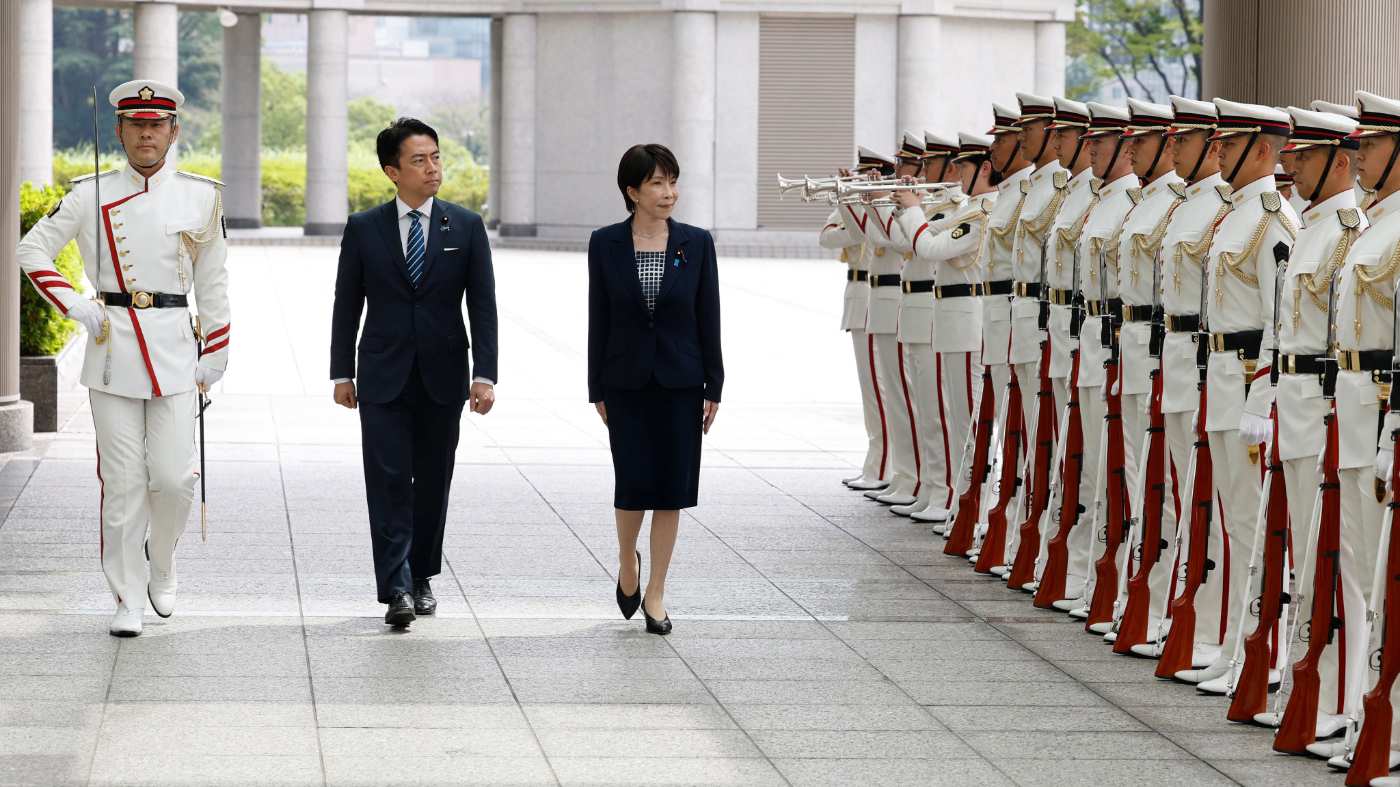
In August, Japan’s Defense Minister Shinjiro Koizumi visited India and held talks with his Indian counterpart, Rajnath Singh, when both agreed to hold joint exercises. Tokyo has only one formal treaty ally — the U.S. — but has in recent years developed relationships with other U.S. allies, most notably Australia and the Philippines, as well as nearby friendly states.
Tokyo is moving fast to develop the capabilities to defend itself. After decades of neglect, Takaichi’s government is trying to ramp up defense spending. Her proposed budget for the 2027 fiscal year, which begins next April, includes only a small increase over the current budget, but she is trying to meet the five-year plan, set in 2022, to double defense spending to 2 percent of gross domestic product.
China’s regime continually raises the specter of Japan’s “new militarism.” The campaign, which is not gaining traction in Asia, is nonetheless affecting the way the Japanese themselves talk about defense.
Gatling said the Japanese government, when speaking about Veer Guardian 26, has emphasized “capacity-building, bilateral trust, and Indo-Pacific stability.” Japan’s newspapers, however, are more plain-speaking. Asahi Shimbun, not known for nationalistic views, dares to mention the word “China” in this context.
Candor in the Japanese capital is needed. China is engaging in belligerent air and naval maneuvers in its campaign to seize from Japan eight uninhabited islands and rocks in the East China Sea and is now laying the groundwork to claim the Ryukyu chain from Tokyo.
Although there is still reluctance in Tokyo’s governing circles to speak clearly, China is the reason Japan is sending jets a long distance to India.
Topics in this story
Gathered from external sources. Rights to this text belong to whoever originally published it.