Tata Sons: India's corporate crown braces for upheaval amid boardroom revolt
The Tata boardroom battle has intensified over a re-appointment of its chairman and a diktat to go public.
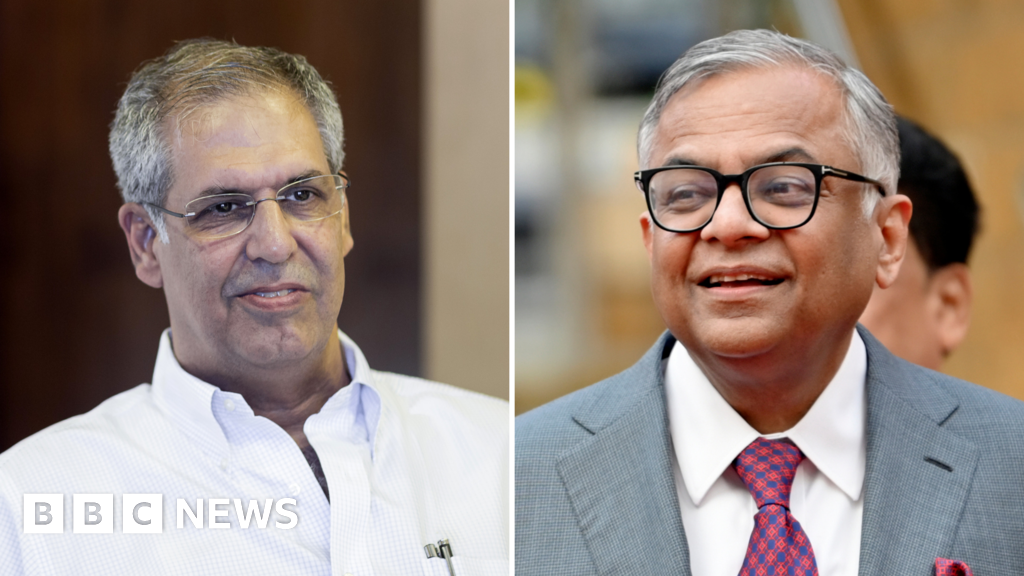
This week, the board of Tata Sons - one of India's oldest conglomerates and owner of iconic British brands such as Jaguar Land Rover and Tetley Tea - defied its largest shareholder, Tata Trusts, by reappointing N Chandrasekaran as chairman and backing a public listing of the holding company.
Tata Trusts, which owns 66% of Tata Sons called the decision "illegal" under its articles of association and also opposed the listing, setting the stage for a period of prolonged upheaval and possibly a protracted legal drama at Bombay House, the headquarters of the 158-year-old company.
For the Tatas, who are no strangers to boardroom battles , a cloud of uncertainty now prevails at multiple levels.
The resolution to reappoint Chandrasekharan, while approved by the board, could be defeated at the company's Annual General Meeting as Tata Trusts is likely to vote against it, putting a question mark over his future.
The meeting has to take place before 31 December as per reports, after the previous one was adjourned for lack of quorum, but no new date has yet been announced.
"The Nomination and Remuneration Committee (NRC) of the Board of Tata Sons which reappointed him has no power to take this decision. They can only make a recommendation. Also, their decision flies against the governance code of the company that requires executives to step down from active roles at 65. These are serious lapses," Nitin Potdar, a prominent Mumbai-based corporate lawyer told the BBC.
Chandrasekharan, who got a five-year extension, will turn 65 in 2028.
Tata Group stocks first soared and then crashed as the tensions mounted, reflecting hope and uncertainty about leadership and business continuity amid several high-stakes but loss-making bets by Chandrasekharan in sectors like semiconductors and airlines.
But beyond the leadership tussle, the bigger question to contend with is the group's public listing, "which now looks increasingly inevitable", Nirmalya Kumar, who previously headed strategy at Tata Sons, told the BBC.
In 2022, India's central bank, the Reserve Bank of India (RBI), classified Tata Sons as an "upper layer non-banking financial company" because of its systemic importance and investment activities. This created a listing obligation on the group.
Tata Sons sought to get out of this classification by repaying their debt and arguing that they do not borrow directly from the public markets.
But after sitting on its application for over two years, the RBI rejected the company's bid to get out of the framework earlier this month, pushing the group closer to a stock market debut.
In a statement, Tata Trusts reiterated its long-held opposition to going public and said "all available options and not a listing alone" are being explored even though its trustees are no longer unanimous in their position on the matter.
Potdar says the regulator has no power to force any company to go public and the issue will almost certainly be legally challenged by Tata Trusts.
The RBI meanwhile has pre-emptively approached the courts seeking to be heard first in any matter related to the listing.
The issue has sharply divided opinion among corporate pundits.
Many in the group, including the late Ratan Tata and veteran director NA Soonawala, have long argued strongly for keeping the group private.
A publicly held Tata Sons could significantly reduce the control and special rights the Tata Trusts wield over the group.
They say the Tatas have a unique operating structure where the majority shareholder is a charity which uses dividends received from commercial arms to fund hospitals, universities and research.
A listing, they say, will destroy its character by making it accountable to outside shareholders whose focus would be financial returns.
"A new group of shareholders might say, 'Don't declare dividends; we need to reinvest this money in the companies.' What happens then? The first casualty will be the hospitals they run," said Potdar.
Opponents of the initial public offering (IPO) also worry that bringing in public investors will weaken the group's internal support function to rescue distressed businesses and expose the company to quarterly performance pressures.
Moreover the timing is another crucial factor.
"The group currently faces large financial commitments from recently formed subsidiary companies, including Air India, investments in long gestation projects, and losses in newer ventures," Soonawala wrote in a piece for Times of India.
"The current situation in the case of Air India would be an acid test. All these would need to be disclosed fully in an IPO prospectus. Consolidated financial statements – reflecting subsidiary losses and borrowings – may not present an especially attractive picture to sophisticated investors, pointing to wrong timing for an IPO at the present time."
Many, including Potdar, also argue that globally , industrial foundations are being protected as sources of patient capital - money that can be committed for years to fund long-gestation projects and social goals. By forcing the Tatas to list, India is going the other way.
But supporters of a listing say it would bring much-needed transparency and accountability to a group that is systemically important to India.
"There should be tougher scrutiny of their capital-allocation decisions being so central to the Indian business ecosystem. Everybody wants complete control over their empire and the freedom to take capricious decisions, but that is not a good thing for the organisation," said Kumar.
Collectively, listed Tata companies including Tata Motors and TCS have a market capitalisation of more than $260bn and influence over 17.7 million retail shareholders, pension funds, insurers and mutual funds, investment advisory firm InGovern said.
"[It] cannot reasonably remain outside the governance and transparency expectations increasingly associated with systemically important financial and industrial conglomerates," the report added.
It also argued that shareholders of listed Tata companies are indirectly affected by Tata Sons' decisions, even though they have no direct voting rights in the holding company.
Moreover, given that the Tatas have recently made several high stakes global bets, making iPhones for Apple, partnering with Nvidia on artificial intelligence and Boeing, Airbus and Singapore Airlines on aerospace and aviation, InGovern says, a "flexible and transparent capital structure increasingly important".
Some experts say a listing may now be the only way to ease increasingly fractious relations between the board and shareholders - tensions that are hurting not just the group, but India more broadly.
Tata Trusts hold controlling economic interest and veto rights over Tata Sons board appointments and capital allocation decisions above a certain threshold.
It's hard to imagine the latter can function effectively on crucial issues of national interest - such as turning around Air India or raising funds to pay off a large minority shareholder like the SP Group which is in urgent need of cash to avert a potentially ruinous default - if it can no longer see eye to eye with its biggest shareholder.
Whatever happens on the listing front, experts say India's biggest trophy asset is entering totally uncharted territory. As Kumar suspects, "a new twist" can be expected every week.
Follow BBC News India on Instagram , YouTube, X and Facebook .
Topics in this story
Gathered from external sources. Rights to this text belong to whoever originally published it.