After 38 years teaching in Massachusetts, Tufts math professor Loring Tu donated more than $10 million to the university in 2024, helping expand student aid
Loring Tu, a mathematics professor at Tufts University, donates over $10 million to enhance student financial aid, commemorating his grandfather Tsungming Tu, a pioneering Taiwanese educator and physician.
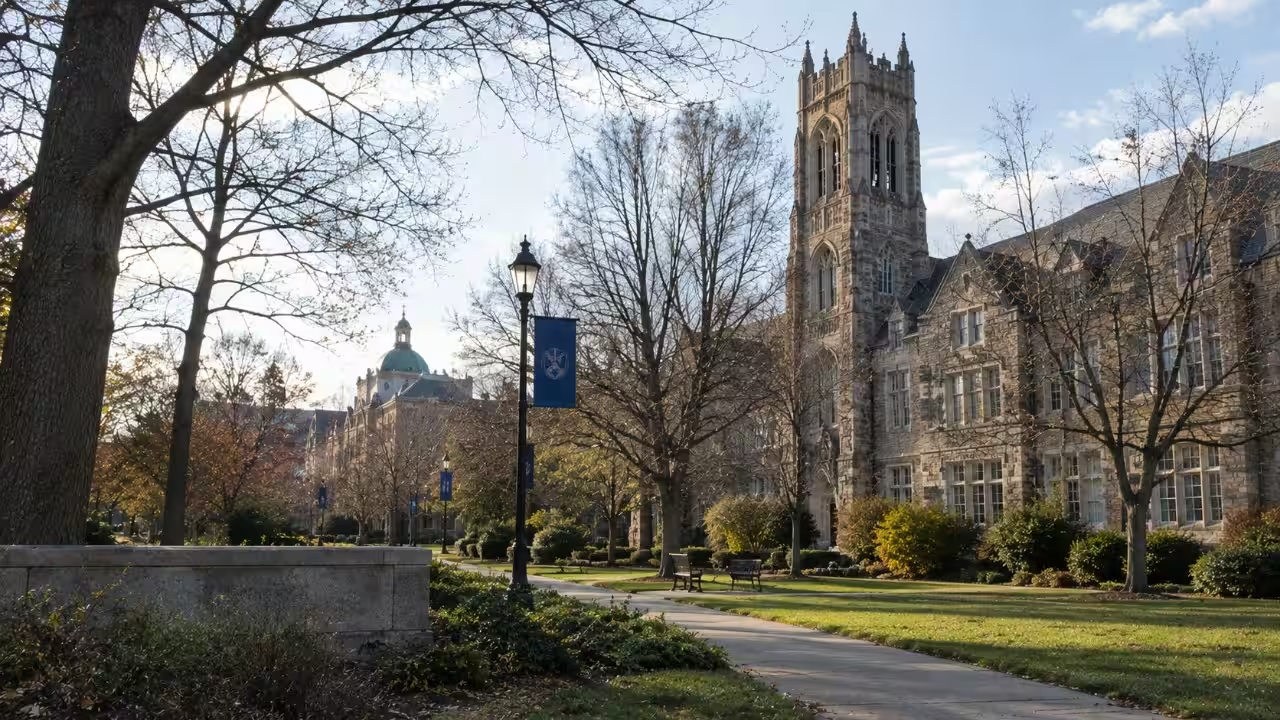
A mathematics professor who spent decades teaching at Tufts University built his fortune through the stock market and later gave much of it back to the institution. According to the Taiwan Embassy, Loring Tu donated an eight-figure sum, worth more than $10 million, in honour of his late grandfather. In response to the gift, the university renamed its Science and Engineering Complex the Tsungming Tu Complex, after his grandfather. Tu had taught at Tufts for 38 years when the donation was announced and planned to retire at the end of 2025, and said he wanted the university to have greater financial resources for student assistance.A gift that is synonymous with family history Completed in 2017, the university’s Science and Engineering Complex brought together renovated older buildings with new construction. With facilities made to support collaboration across disciplines, it served the School of Engineering and the School of Arts and Sciences and saw its name changed in November 2024 following Loring Tu’s donation.According to the university’s record, Loring Tu’s grandfather, Tsungming Tu, was a Taiwanese physician, pharmacologist, and educator who was born in 1893 in Sanzhi, which is now part of New Taipei City. Coming from modest beginnings, he grew up in a family mired in financial hardships and, at the age of 10, saw his father, a tea farmer, pass away from injuries sustained in a field accident.In the year 1914, he graduated at the top of his class from Taiwan Governor Medical College, a forerunner of Taipei Imperial University Medical School. By 1922, he had completed his doctoral dissertation, equivalent to a PhD, at Kyoto Imperial University. In doing so, he achieved the feat of becoming the first Taiwanese professor to obtain a doctorate in medical sciences amid other professors who were mainly Japanese. Following World War II, he was named the first dean of National Taiwan University Medical School.Tsungming Tu would go on to create a lasting legacy for his innovative treatments for opium addiction and earned an appointment from the Japanese colonial government to tackle the problem. The list of his accomplishments continued, and he went on to establish an early opium addiction clinic in Taiwan and help curb the use of that drug. His epidemiological studies of the merits and demerits of snakebite were equally influential and groundbreaking.In 1954, he founded Kaohsiung Medical College, now Kaohsiung Medical University, Taiwan’s first private medical school to bridge the gap for Indigenous communities and people in remote villages who had limited access to doctors.Smart investing and giving back to TuftsBefore he donated to the university, Loring Tu had established two endowed scholarships and supported three on-campus houses that would benefit junior and senior students alike. The initiative came from his own personal experience, as Tu's life as a student was a success story made possible through financial aid. The financial aid had allowed him to study at McGill University and Princeton University and later secure a PhD at Harvard University.Tu joined the university faculty in 1986, and while he worked at Tufts, his academic work involved the study of manifolds, higher-dimensional counterparts of curves and surfaces. In addition, he had also authored or co-authored four books on geometry and topology, the mathematical study of spaces and shapes.According to the Boston Globe, it wasn’t wisdom from financial advisors that brought him financial success but rather a calculated purchasing of shares in company products he was familiar with. Led by his background in mathematics, Tu had invested in several well-known companies, particularly Apple, whose shares he had first bought in 1997. At the time, Apple stock was trading at around 15 cents a share, adjusted for splits, and a $1,000 investment made then would be worth well over $1 million today. Speaking on the experience, he remained modest and said, “I didn’t expect to be wealthy; I would attribute it mostly to dumb luck and frugality.”Although he had studied at Princeton and Harvard, he chose to give to Tufts partly because he believed his money could have a greater effect there. His donation was acknowledged by Tufts President Sunil Kumar, who said the gift would support the university’s teaching, research and learning for future generations. The donation also recognised a family connection that stretched from Tsungming Tu’s medical education work in Taiwan to his grandson’s career in American higher education.You use AI every day. Now get your AI Quotient. Take the AIQ test.
Topics in this story
Gathered from external sources. Rights to this text belong to whoever originally published it.