India vs China: How their nuclear-capable missile arsenals compare
News News: China and India, Asia's two most powerful countries, have spent decades building ballistic missile arsenals. These ballistic missiles are strategic we.
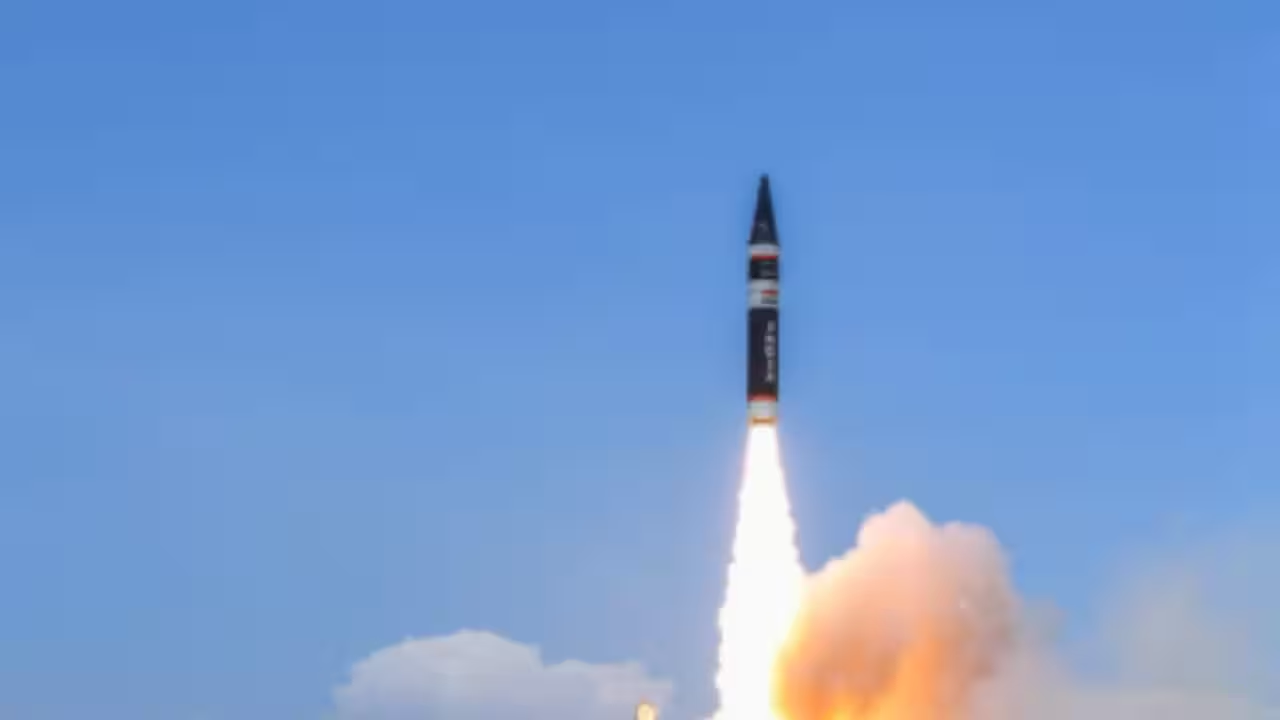
China and India, Asia's two most powerful countries, have spent decades building ballistic missile arsenals. These ballistic missiles are strategic weapons that act as a deterrent, under the concept of Mutually Assured Destruction (MAD). This prohibitive concept states that two nuclear armed powers will not use these weapons on each other, as the use of such a weapon will ensure a retaliatory strike, thereby increasing the cost for the attacker. India and China's strategic missile arsenals now bear resemblance, but also at the same time there are differences in capability. The two countries also are also employing different philosophies for the use of these weapons, as the US Naval Institute states that China is building a significant amount of missile capability to hit US bases in the vast Pacific.While India is building its strategic missile arsenal to act as an insurance against attacks from nuclear weapons armed entities. This concept is enshrined in India's no first use policy for nuclear weapons. India depends on the Agni family of missiles for its land based nuclear deterrence, while China depends on the Dongfeng series.Indian and Chinese strategic missilesAt the shorter end of the spectrum, China's road-mobile DF-16 offers a range between 800 and 1,000 kilometres, giving it reach over Taiwan and much of the western Pacific. India's comparable system, the Agni-I, delivers a range of 700 to 900 kilometres, and while it lacks the DF-16's higher payload capacity of up to 1,500 kilograms, it remains a reliable, road and rail-mobile system tailored specifically for shorter-range contingencies closer to India's borders.Moving up the ladder in terms of range and capability, China's DF-21, one of the People's Liberation Army's most storied missiles, offers a range of up to 2,500 kilometres and famously spawned the world's first anti-ship ballistic missile variant, the DF-21D. India's Agni-II sits in a similar bracket, with a declared range of 2,000 to 3,500 kilometres, and has long been described as central to India's deterrence posture with respect to China, despite New Delhi's insistence that its missile programme is not aimed at any single adversary.At the intermediate range, China's DF-26, capable of striking targets over 5,000 kilometres away, including American bases in Guam, sits close in class to India's Agni-III, which offers a declared range of 3,000 to 5,000 kilometres and has been noted for a circular error probable of just around 40 metres, making it among the most accurate missiles in its class. This accuracy allows India to rely on smaller-yield warheads while still achieving high lethality, a design philosophy that keeps the system relatively compact for its range class.Where the comparison becomes genuinely interesting is at the intercontinental tier. China's DF-31A, a solid-fuel ICBM, boasts a range in excess of 11,000 kilometres. India's Agni-V, its first genuine intercontinental system, offers a declared range of 7,000 to 8,000 kilometres, though some Chinese analysts have suggested its true reach may extend closer to 8,000 kilometres once payload adjustments are factored in. Both missiles share canisterised, road-mobile configurations, a design choice that improves survivability and reduces launch preparation time.At the very top sits China's DF-41, believed to carry ten to twelve MIRV warheads across a range of 12,000 to 15,000 kilometres, making it one of the longest-range missiles in the world. India's answer, the still-developing Agni-VI, is expected to offer a comparable range of as much as 10,000 kilometres, with reports suggesting it could eventually be fitted with MIRV warheads and even a submarine-launched variant, mirroring China's own efforts to build a survivable, multi-domain nuclear triad.Taken together, the comparison suggests India has broadly kept pace with China across most range categories, even as Beijing continues to hold an edge in payload flexibility, warhead multiplicity, and the sheer scale of its overall missile inventory.
Topics in this story
Gathered from external sources. Rights to this text belong to whoever originally published it.