In 2022, South Africa put recycled waste plastic into two high-truck-traffic asphalt sections; checks a year apart found both experimental roads performing well
Discover how South Africa is pioneering the use of recycled plastic in asphalt for road construction, with successful trials under heavy traffic conditions, paving the way for sustainable infrastructure.
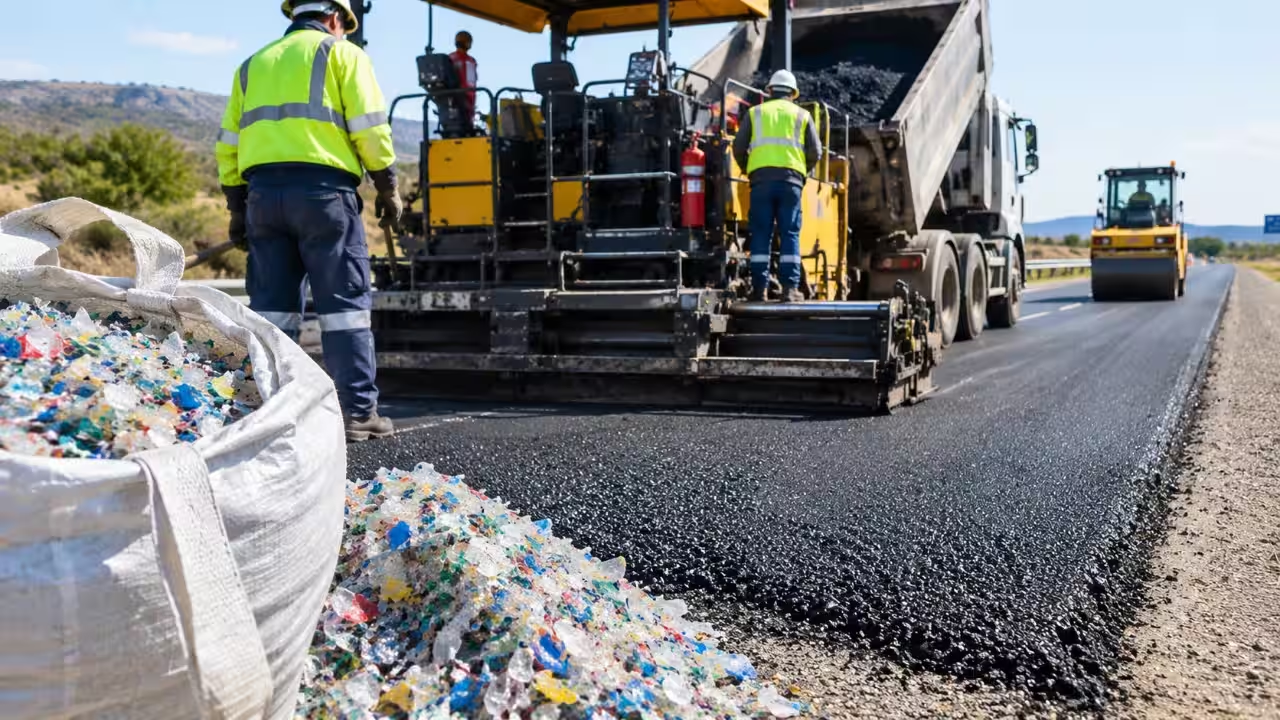
Plastic waste is increasingly being used in road construction. In South Africa, researchers tested asphalt containing recycled plastic on a section of the M7/P82 near Pinetown, KwaZulu-Natal, a route where slow-moving heavy vehicles place considerable stress on the pavement. According to the Transportation Research Board, the trial was designed to answer a practical question: could waste plastic be incorporated into asphalt without compromising the road's performance under demanding traffic? The early answer was encouraging. The two experimental sections were assessed on two occasions a year apart, with checks covering surface condition, riding quality, rutting, texture and structural behaviour. Both were reported to be performing well despite substantial heavy-vehicle traffic.A difficult road chosen for the experimentThis test was conducted on the slow lane of the westbound M7/P82, between the Hans Dettman Highway overpass and the Thistle Road underpass. The test section covered 172 metres. The M7 is a strategic route that primarily links Durban Harbour with the N3 Durban-Johannesburg National Route and carries heavy traffic. At the test site, heavy vehicles were travelling uphill at about 60 km/h, creating demanding loading conditions for the pavement. The expected traffic loading was estimated at 100 million equivalent standard axles over the design period, making the site a particularly demanding place to assess the experimental asphalt.The trial therefore provided an opportunity to see how the recycled-plastic mixtures performed under regular heavy-vehicle traffic rather than only in the laboratory. The researchers used recycled high-density polyethene, or rHDPE, to modify the bitumen through a wet process. In this approach, the plastic was blended into the hot bitumen before the modified binder was incorporated into the asphalt mixture. This allowed the rHDPE-modified binder to become part of the finished pavement during normal asphalt production.Two asphalt mixtures, one demanding testTwo types of asphalt were used in the experiment. The surface was made from stone mastic asphalt, or SMA, while the base used EME, a high-modulus asphalt designed for heavily trafficked roads. According to the Global Highways project account, both mixtures used bitumen modified with 6% recycled high-density polyethene (rHDPE) by mass of the binder. The EME base was laid in two 60 mm layers, while the SMA surface was 40 mm thick.Before the mixtures were used on the road, they were subjected to laboratory testing to see how they responded to heavy loading and high temperatures. In a Hamburg Wheel Tracking test at 50°C, run for 20,000 cycles, the EME mixture recorded a rut depth of 2.451 mm, compared with 2.857 mm for the SMA mixture, according to the project report. These results provided an indication of the mixtures' resistance to rutting under controlled laboratory conditions, rather than a direct measure of how much rutting occurred on the M7/P82 itself.What happened after the trial?Field testing was one of the most critical aspects of the experiment. The two sections were analysed separately in different years using visual tests and measurements of rutting depth, riding quality and surface characteristics. Deflection testing evaluated structural behaviour. TRID also states that the two sections performed well despite heavy truck traffic moving in and out of nearby industries.The test also faced severe real-world conditions when heavy rains flooded parts of KwaZulu-Natal and triggered landslides. Some weather stations reported more than 300 mm of rain in 24 hours. Yet despite the severe weather, there was no observed degradation of the experimental pavement. This does not mean the plastic road has been proven fit for several decades to come. The scientists intended to keep monitoring the road.The trial highlighted both the potential and the limits of plastic-modified asphalt. The waste plastic could serve as a road construction material capable of withstanding heavy truck loads. However, the sustainability and performance of such roads still need monitoring.You use AI every day. Now get your AI Quotient. Take the AIQ test.
Topics in this story
Gathered from external sources. Rights to this text belong to whoever originally published it.