A wind-tunnel experiment paired two vertical-axis turbines; closely spaced counter-rotating models produced 13% to 16% more power than two isolated turbines
Discover how a groundbreaking wind tunnel experiment revealed the potential for vertical-axis turbines to outperform traditional setups by generating up to 16% more power when paired closely together. This research challenges conventional wind farm designs and could reshape the future of wind energy production.
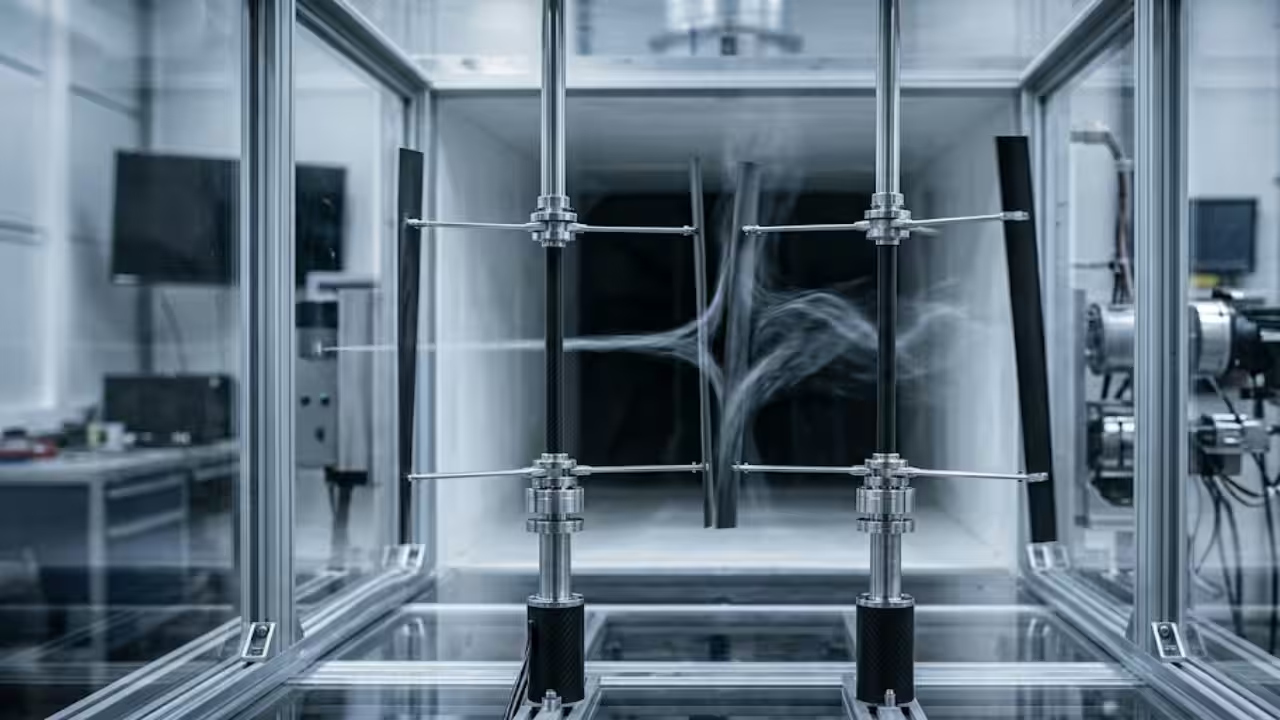
One basic criterion governing wind farms is that each turbine needs room. Developers disperse the industry's well-known three-bladed machines widely to prevent one from starving the next of wind since they leave a long, turbulent wake behind them. That configuration has never been suitable for vertical-axis turbines, the upright type that spins somewhat like an egg whisk. A single one typically gathers less energy than a traditional design, which contributes to the problem.Some researchers have explored the opposite approach: placing vertical-axis turbines close together. A 2004 US patent described a coupled vertical-axis turbine with two counter-rotating rotors, while Caltech researcher John Dabiri later proposed arranging counter-rotating vertical-axis turbines in close proximity, inspired in part by fish schooling. A 2021 paper by Yoshifumi Jodai of Kagawa National Institute of Technology and Yutaka Hara of Tottori University cited Dabiri’s work estimating that a vertical-axis wind farm could achieve six to nine times the power density of modern horizontal-axis wind farms.One of the clearest answers so far came from a wind tunnel study published in February 2020 that tested the hypothesis on genuine spinning models. Two small turbines placed close together produced a higher combined power coefficient than two identical turbines operating separately. What follows discusses how the experiment worked and how big the gain was and why it matters for wind generation.How the test workedAntoine Vergaerde led the 2020 study, with researchers from Vrije Universiteit Brussel and collaborators from other institutions. Each turbine had a two-bladed H-type Darrieus design, i.e., two straight blades maintained parallel to the shaft by struts. The blades were symmetrical with an NACA 0018 aerofoil shape. The solidity, that is, the fraction of the swept area occupied by the blades, was 0.20.The researchers measured the mechanical power output of an individual turbine and then compared it with the output of two turbines operating as a closely spaced, counter-rotating pair. The rotors in the paired runs spun in opposite directions, rather like meshing gears, and sat extremely close together. The distance between their shafts was only 1.2 to 1.3 times the width of one rotor. They tried it both ways, one with the blades facing each other going with the wind and the other with them going against the wind. They compared the power coefficient, a measure of how much of the wind’s energy is caught, to see if two turbines together were better than two on their own.What did the figures showThe 2020 Renewable Energy paper found average relative increases of 13% to 16% in the paired turbines’ power coefficient compared with two isolated turbines. At the smallest spacings tried, the improvement was as much as nearly 16 per cent. The experiment was set up to verify what computer simulations had indicated, and the measured gains were consistent with those predictions.Earlier numerical work by Zanforlin and Nishino helped explain the aerodynamic mechanism: the two closely spaced rotors alter the incoming flow between them, improving the conditions for lift and torque.Not every lab has named the same winner. The best practical spacing in the Japanese test, which used small 3D-printed rotors just 50 millimetres across, was a gap of barely a fifth of a rotor width. The authors attribute such differences to rotor solidity, which is a reminder that the outcomes are dependent on the exact turbine design.From tunnel to wind parkScaling up brings new questions. Real farms are exposed to turbulent wind and a high number of turbines, and the wakes of vertical axis machines behave differently than those of ordinary rotors. The architecture is so important, as field trials of offshore farms with conventional turbines have shown wake losses in the range of 10-23 per cent depending on spacing and wind.In 2025, researchers from Delft University of Technology and their collaborators published a wind-tunnel experiment involving nine H-type vertical-axis turbines arranged in a 3×3 grid in Wind Energy Science. They used fixed blade-pitch settings to alter wake interactions within the simulated farm. The researchers calculated that the available power within the simulated farm could increase by factors of 6.4 and 2.1 for the two blade-pitch settings, respectively, when potential downstream rotors were directly aligned with upstream ones, compared with the baseline case. Those numbers are for wind energy accessible in the wake, not electricity transmitted to a grid, so they indicate potential, not demonstrated output.The 2020 experiment found that closely spaced counter-rotating H-type turbines could achieve a 13% to 16% increase in power coefficient compared with two isolated turbines. Spacing, rotation direction and rotor design all affected the result, while wind-tunnel tests alone cannot establish how a large commercial farm would perform. The findings nevertheless support further investigation of high-density vertical-axis turbine layouts.You use AI every day. Now get your AI Quotient. Take the AIQ test.
Topics in this story
Gathered from external sources. Rights to this text belong to whoever originally published it.