Senate Republicans return to Capitol furious with Trump after big losses
Senate Republicans returning to the Capitol on Monday are furious with President Trump, whom they blame for last week’s big losses in Senate and House races....
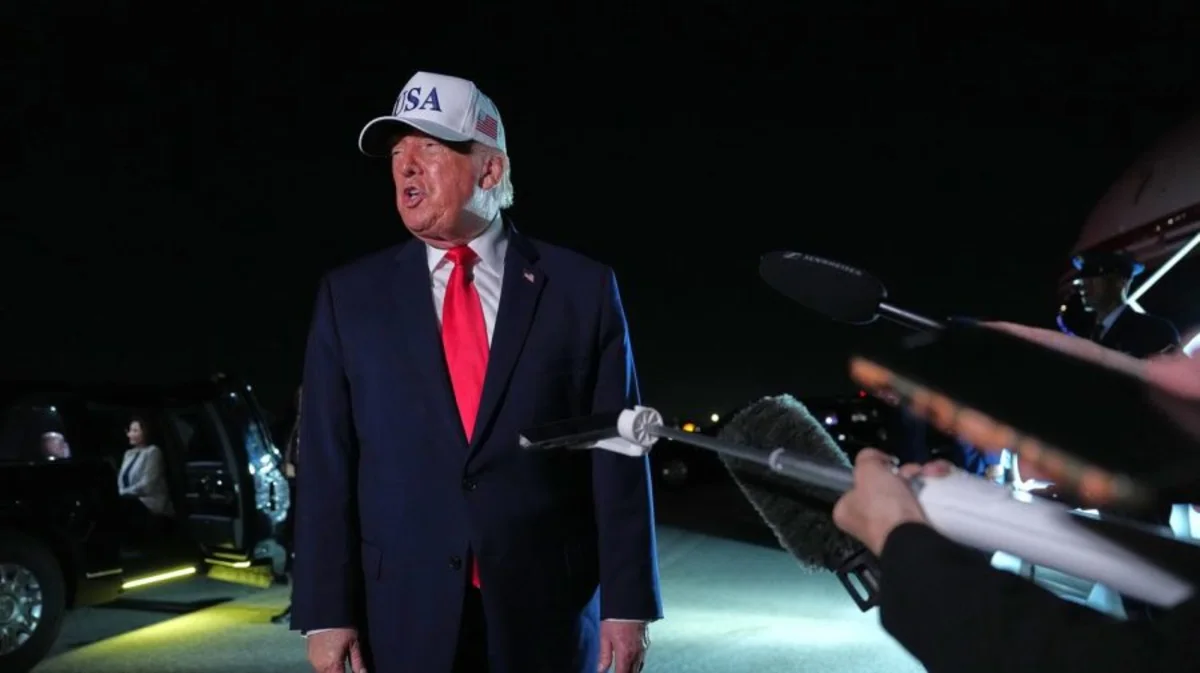
Senate Republicans returning to the Capitol on Monday are furious with President Trump, whom they blame for last week's big losses in Senate and House races.
The anger is raising the chances that the party could pivot away from the lame-duck president in the lead-up to the 2028 presidential election, according to GOP aides and strategists.
Tensions are also rising with Trump's Friday announcement that immigration hard-liner Stephen Miller will be his new chief of staff, replacing the outgoing Susie Wiles.
The Miller appointment suggests a doubling down on the president's policies, particularly on immigration enforcement, after an election in which Hispanic voters swung decisively toward Democrats, especially in Texas.
Rep. Marlin Stutzman (R-Ind.) on Sunday said Miller should be fired, not promoted.
"If your team takes a beating as badly as we took this last week, you have to fire people," Stutzman said in an interview on CNN. "You don't promote those who are — who were in charge of what was supposed to be delivered."
Whit Ayres, a prominent Republican pollster, said Senate Republicans will be less deferential to Trump after suffering a huge loss of seats in last week's election.
Ayres said Trump "clearly will remain the leader of the party for the next two years, but I also think the knee-jerk obeisance to whatever his whims are at the moment is likely over."
"There is so much resentment particularly among Republicans in the Senate for what Donald Trump did in North Carolina and South Carolina and Texas," he said, referring to Trump's endorsement of candidates Michael Whatley, Darline Graham and Ken Paxton, who all lost by large margins in the general election.
"I think his iron grip over the Senate Republicans is likely to be loosened," Ayres said.
One senior Senate Republican aide predicted GOP senators and the broader party will begin to shift away from Trump over the next year.
"Trump said he was on the ballot. He wasn't on the ballot but acted like he was on the ballot," and "a lot of people" voted as if Trump was atop the GOP ticket when they voted for Democrats in battleground states around the country, the aide said.
"We need somebody who can work together with people, who doesn't just try to divide — who is focused on real issues that people care about that are of importance versus stupid little internet memes, which it seems like Trump and Vance are more focused on now," the aide argued.
Republican sources say Trump undermined their chances of winning key Senate races by endorsing weak candidates, such as Paxton and Graham, and by failing to adhere to any message discipline.
GOP senators are also frustrated by what they saw as Trump's reluctance to spend from his massive campaign war chest until late in the campaign.
Senate Republican aides and pollsters say Trump's dismal influence on races across the country will spark an intense discussion about what's next for the party and whether it's time to turn the page on MAGA and its policies.
Senate Majority Leader John Thune (R-S.D.) and members of his leadership team lobbied Trump for months to back Sen. John Cornyn (R-Texas) over Paxton, the state attorney general, in the Texas Senate Republican primary — or to at least stay neutral — but Trump ignored their advice and endorsed Paxton before the primary runoff, sinking Cornyn's chances.
Thune and his leadership team urged the president and Senate GOP colleagues to keep their political messaging focused on their legislative accomplishments, especially the popular tax cuts in the One Big Beautiful Bill Act, such as its tax deductions for tips.
But Trump instead often veered off from the plan, getting into fights over the White House ballroom, the Lincoln Memorial Reflecting Pool, the Kennedy Center, the East Potomac Park golf course and other topics that GOP strategists viewed as unhelpful to delivering the broader Republican message.
Trump blamed last week's losses on poor Republican candidates, but many Senate Republicans think the blame for the loss of at least seven seats lies squarely with the unpopular president.
"We're up here talking about the generational benefits of avoiding a $4 trillion-plus tax hike and everything else that's inside that bill, and then the president is talking about the Reflecting Pool or the ballroom, and those are the things that get the headlines," a Senate GOP aide said. "Message synchronization was off."
Senate Republicans were galled when Trump dismissed the passage of the 21st Century ROAD to Housing Act as a "big yawn."
GOP leaders were touting the bipartisan legislation as a major accomplishment to address housing affordability, but Trump popped their balloon as he said he cared more about passing the Safeguard American Voter Eligibility (SAVE America) Act, a package to overhaul election rules that had virtually no chance of passing Congress.
Senate Republican sources also said Trump waited too long to spend the hundreds of millions of dollars he stockpiled ahead of the midterm elections.
"They sat on that $400 million until it was too late to start spending it," a second GOP aide said.
Trump said in August he would spend "a lot" of money from a pro-Trump super PAC to help "good" GOP candidates, but Senate GOP strategists complained the president's political allies waited until the final weeks of the campaign to dump money into races, which diluted their firepower because they had to pay higher television ad rates.
Trump announced in late October that he would end up spending more than $400 million by Election Day to help Republicans keep Congress.
When Republicans got blown out on Election Day, the White House blamed GOP candidates for not putting in as much effort as the president to promote their candidacies and records.
Trump declared on election night: "I wasn't on the Ballot and if I was, we would have won IN A LANDSLIDE!"
Senate Republicans say they think Trump also hurt them by constantly bashing their failure to pass the SAVE America Act, even after Republicans held at least five votes on the legislation, either in whole or in part, and came nowhere close to collecting the 60 votes the bill needed to advance.
Trump warned Senate Republicans would be "in big trouble" if they didn't abolish the filibuster to ram the bill through the chamber.
"When you're casting your own teammate as the opponent, what message does that send to the voter?" the GOP aide said.
A third Senate Republican aide argued that Trump clearly deserves the blame for the loss of seven — and maybe as many as nine — Senate seats and more than 40 House seats.
"Trump's message was, 'I'm going to deliver you a good economy,' and it seems like the only person who benefited from the economy was him," the aide said, adding that Democrats successfully tied together voters' concerns about rising prices and corruption in Washington.
"Those two things led to a disaster with independents," the aide said.
The GOP aide said some Senate Republicans expect more "pushback to Trump because his half-life is rapidly diminishing" but cautioned that "he's still a popular figure in the Republican Party."
The president's elevation of Miller, who is seen as a conservative hard-liner, may be a bid to keep base MAGA voters firmly in his corner.
Sen. Thom Tillis (R-N.C.), one of Miller's sharpest critics in the Senate GOP conference, called his elevation to chief of staff a "colossal mistake."
"The worst of all possible choices," Tillis told CNN's Jake Tapper. "The president needs to rethink it."
Senate Republican candidate John Sununu blamed Trump for his double-digit loss to Rep. Chris Pappas (D) in New Hampshire, a state that Senate GOP leaders in August saw as a promising opportunity to flip a Democratic-held seat.
Sununu said Trump's failure to end the months-long conflict with Iran and a steady stream of media stories about Trump's family business dealings sunk his chances of winning.
"This president ran and won on a platform of no more needless, endless wars. And then he attacked Iran, and we're still in it," he told SiriusXM's "The John Kasich Show."
"This president ran on and won on a platform of drain the swamp, right? … And now it seems like he or his family is in on every transaction and deal that goes on in Washington," he said. "And those two things, I think, caused people to say, 'You know, I just can't vote for a Republican while he's still in office.'"
Cornyn argued Trump "misread his mandate" after the 2024 election.
He argued the president's "arbitrary" decisions on tariffs raised prices for millions of Americans without improving trade deals, and the administration's "hyperaggressive" immigration enforcement efforts went well beyond what voters expected.
"Voters wanted to retool our trading relationships, but got arbitrary 'Liberation Day' tariffs that raised prices without creating incentives for long-term reshoring. Voters wanted secure borders and peaceful streets, but got hyperaggressive immigration enforcement," Cornyn wrote in a Wall Street Journal op-ed.
Other Republicans have stepped up to defend Thune and Senate GOP leaders, arguing that they had little control over the negative political environment that Trump played a major role in creating.
"I don't think any rational, honest person … could blame John Thune for any of this," Sen. Kevin Cramer (R-N.D.) told reporters shortly before the election. "I don't think anybody could blame him for any bad outcome."
Asked if Trump would get most of the blame if Republicans lost control of the Senate, Cramer only said, "There will be a lot of finger-pointing."
Topics in this story
Gathered from external sources. Rights to this text belong to whoever originally published it.